
Pinbreaker
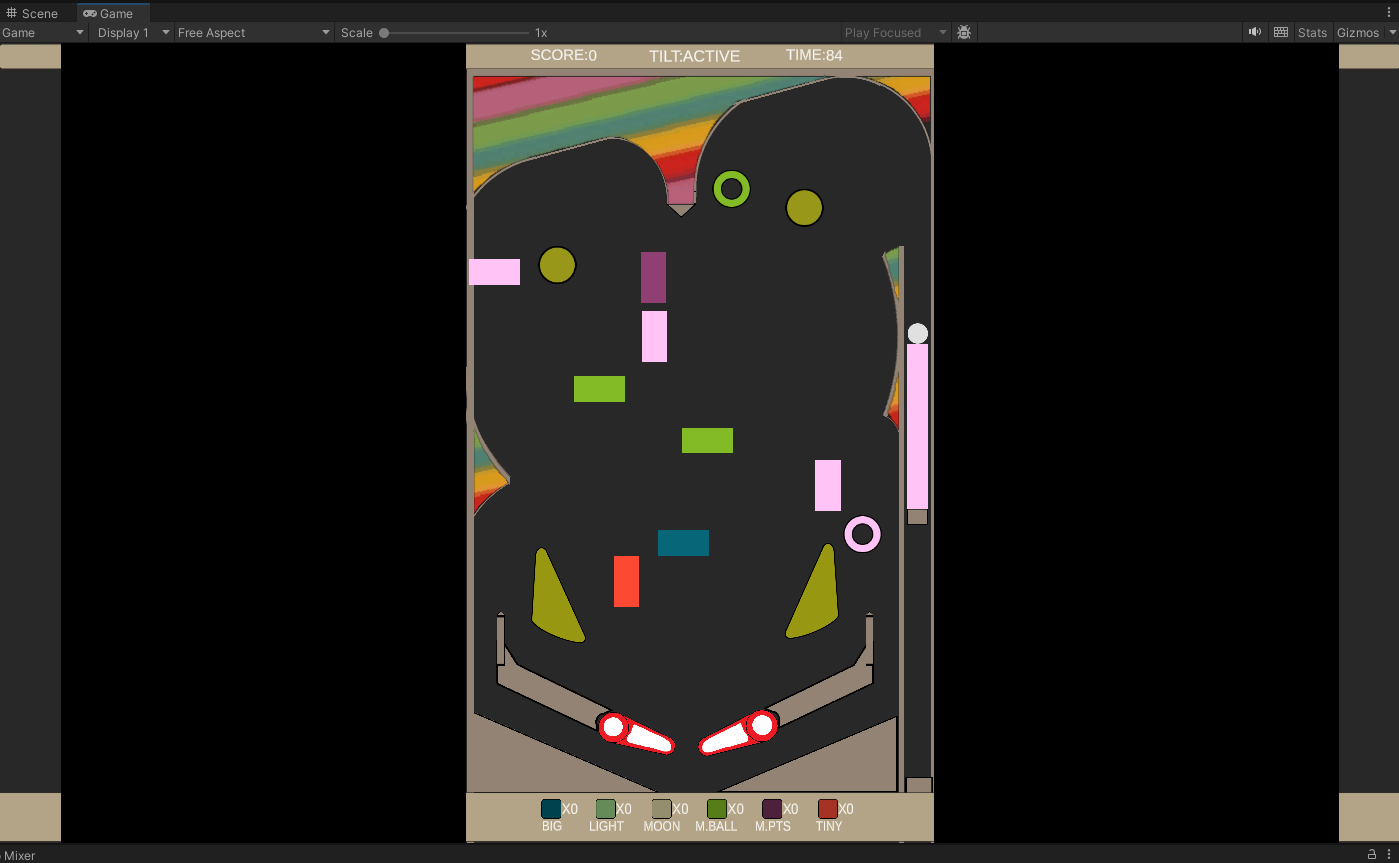
Summary: A video game for Pinball Diehards! In this game the board is made of various destructible bricks to break! Use the paddles to get the highest score you can in 2 minutes! But watch out, all kinds of wacky power-ups can happen when you hit the bricks!
Role: Creative Director, Level Designer, Systems Designer
Project: Personal Project
Team: 3 Person Team
Development Time: Late February 2025 - April 2025 (Shelved)
Made Using: Unity
This was an unfinished project that I spearheaded as a systems design portfolio piece for myself. I teamed up with a programmer to assist in coding and an artist to help with the project. Unfortunately, due to time constraints and other factors, this project didn’t achieve the results I desired, resulting in its shelving.
Lessons Learned:
Plan with programming in mind: this project showed me the importance of planning all design with programming in mind, as well as writing thorough pseudocode for you, other designers, and programmers to understand what you want.
Know your limits: This project was where I understood my limits as a designer working on a time crunch. It also helped me understand that reaching out for help is not only key but encouraged in this industry. It takes a village after all.
Cutting losses: Sometimes a mechanic, concept or design just isn’t working out for a variety of reasons, this project helped me learn that sometimes letting go is better than submitting to sunk cost fallacy.
Creating Concept & Games Research:
The idea for this game came from a presentation by two pinball developers in my game history class. They talked about the challenges involved in designing pinball machines. It was really fascinating
It was during this presentation that it occurred to me how similar pinball and brick breaker are on a conceptual level. Both are games where you hit various objects with points and have to maximize your lifetime via the use of a paddle or paddles to bounce the ball back to the objects that need to be hit.
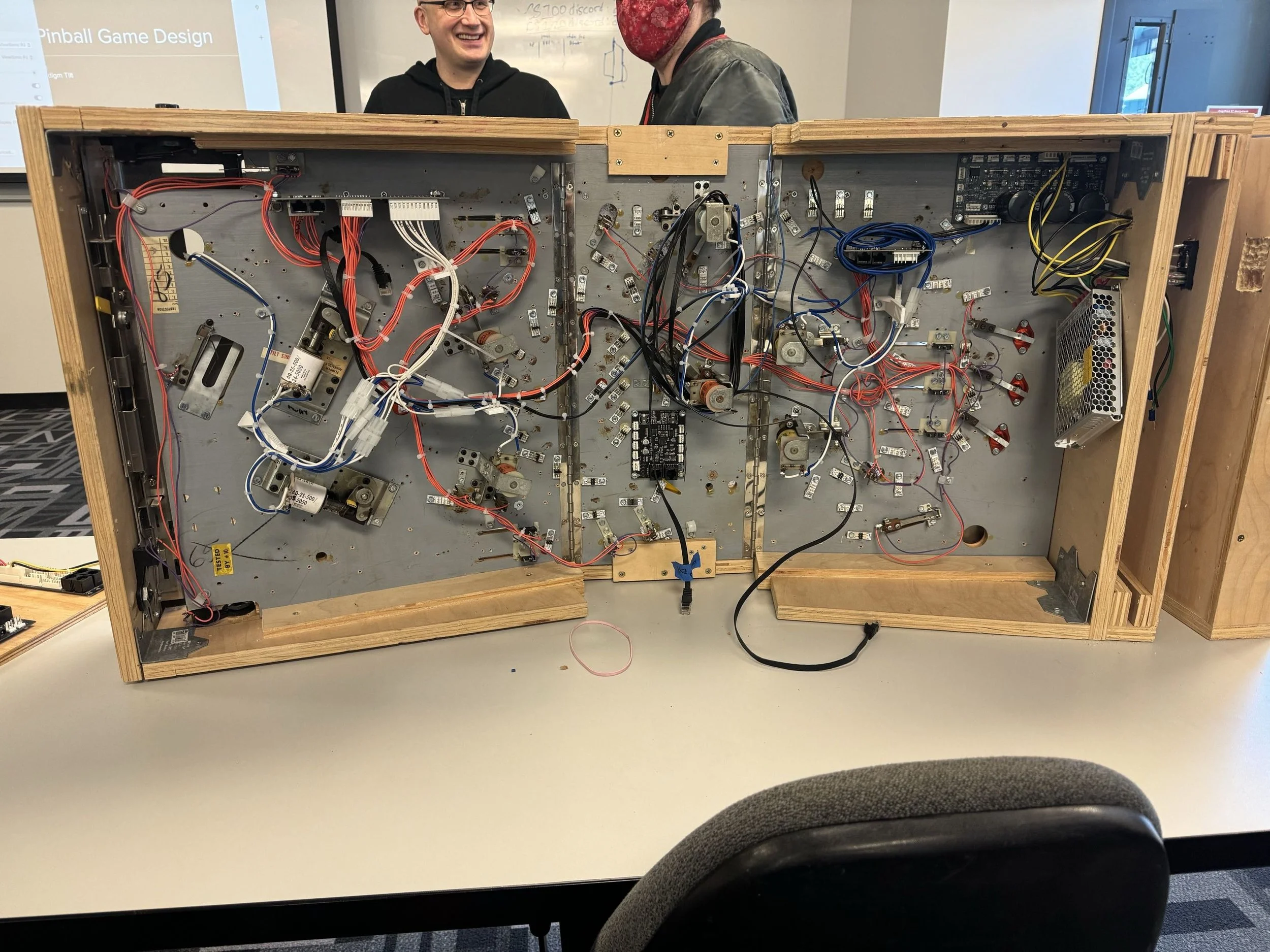
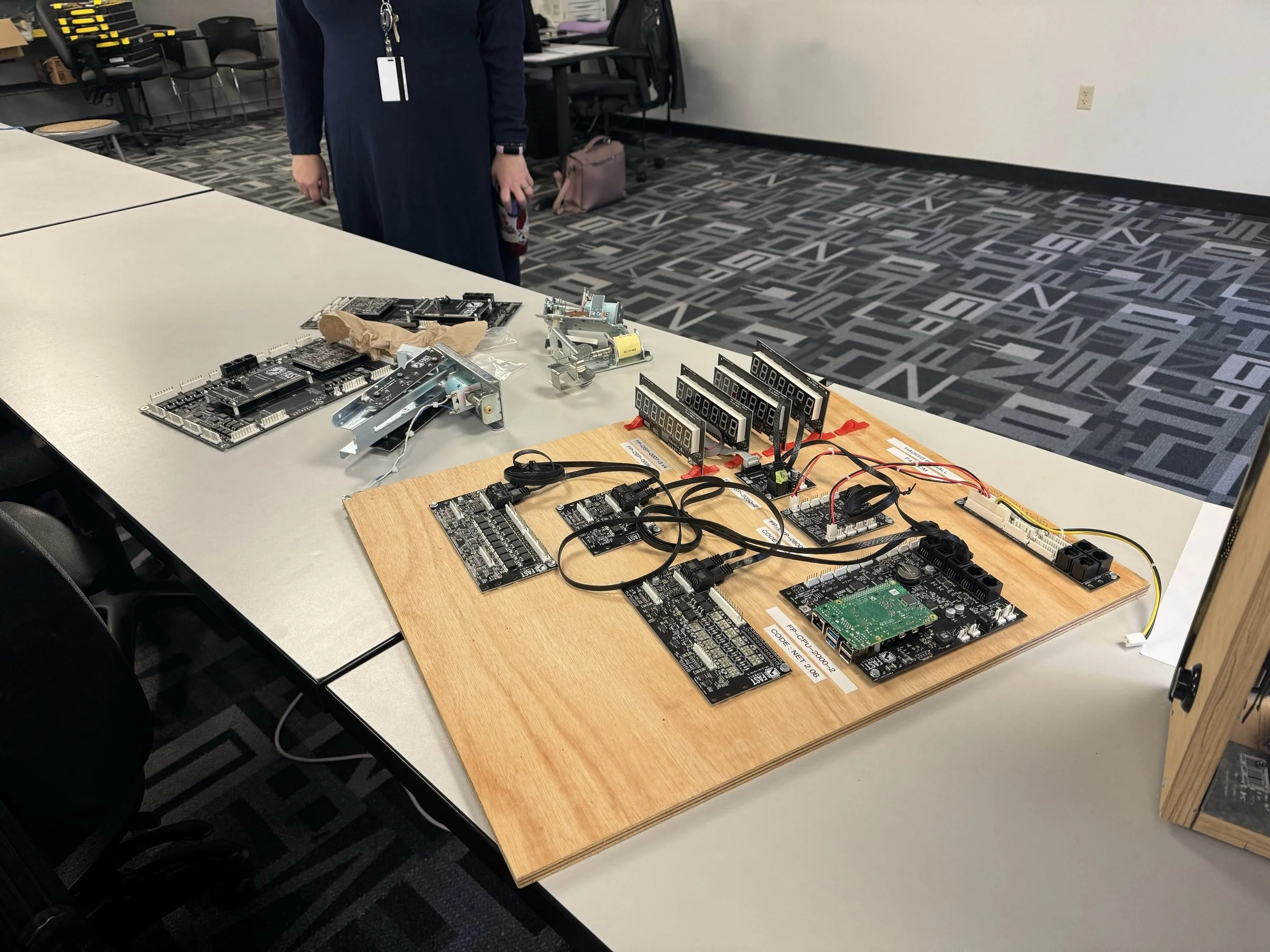
During the Q&A portion of the talk, one of the students asked these designers: What do you think of video games based on pinball? The answer surprised me.
The designers mentioned that they do not like pinball games much because they do not respect the limitations of pinball, one of which is the use of multiple screens.
This gave me an idea: why not make a pinball game that respects these limitations while also taking advantage of the digital format of video games?
A few years later, during one of my portfolio classes I decided to act on this idea and began to conduct research into both pinball games and Brick Breaker likes to understand how the current names in the industry replicate these experiences.
The first I investigated was naturally pinball. I played several pinball machines in my local area, as well as several pinball machines in Zen Studios’ Pinball FX
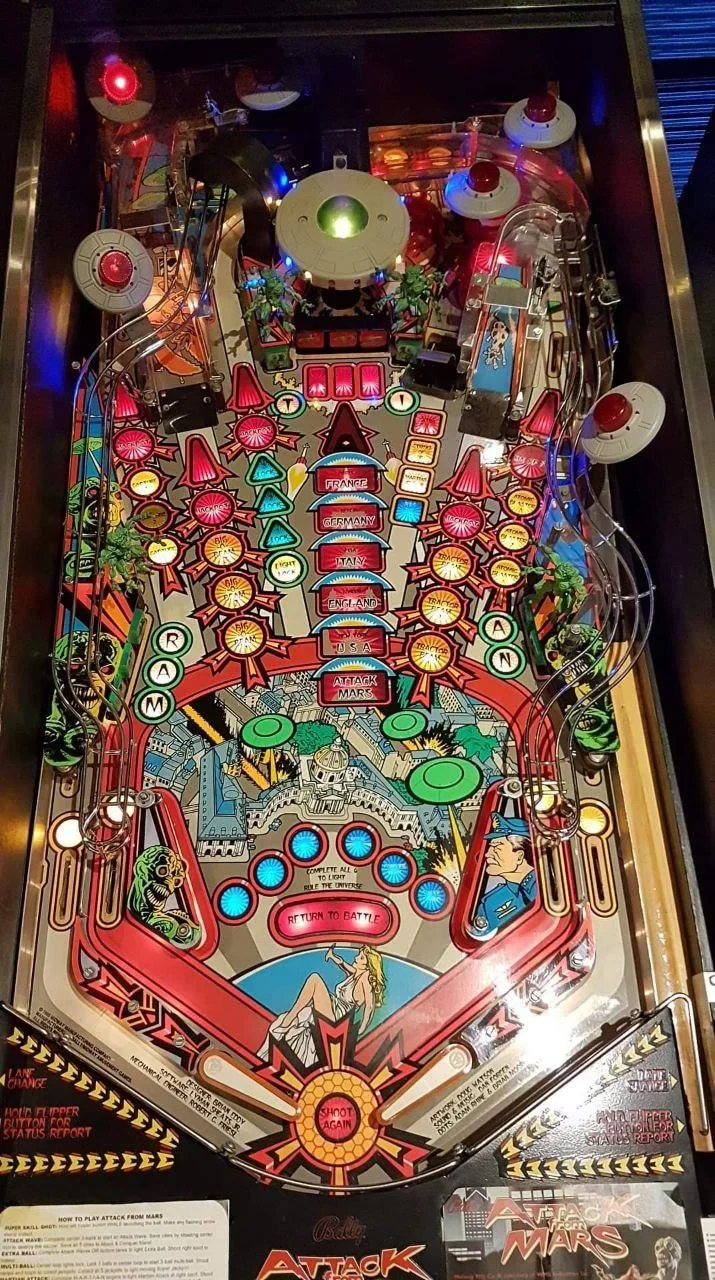
One of the main boards I studied for this project was Attack from Mars. By Midway (under the Bally label). I specifically studied how this board used a wide variety of different objects as side objectives for the player to interact with such as the aliens and UFO’s.
I was also able to get a good glimpse of how pinball machines would do their curves for natural flow from the top to the bottom end of the board in such a way as to continue play.
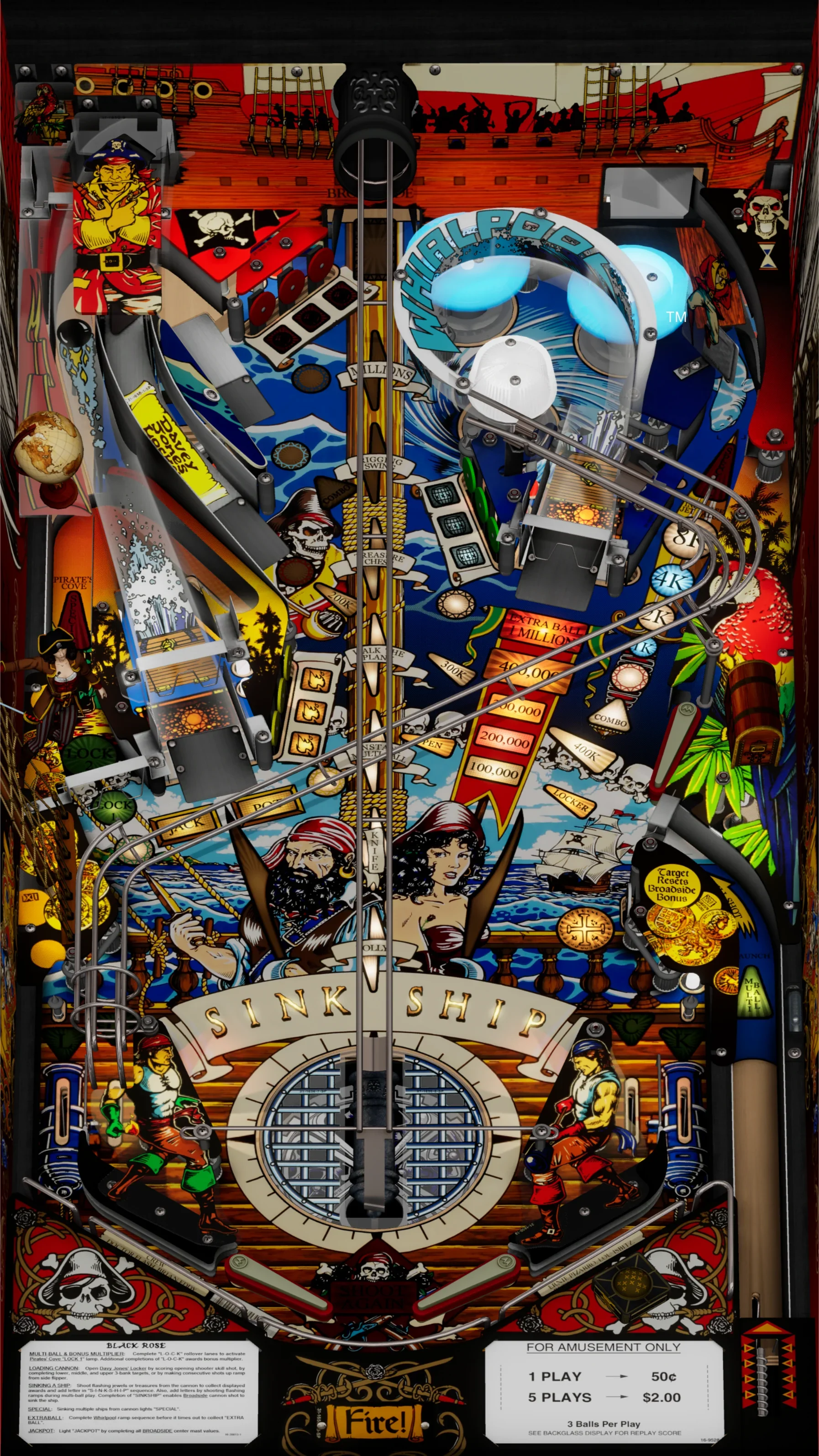
Another machine I studied was Black Rose by Midway. I used this machine to study a more unconventional board layout, since Black Rose has several gimmicks that set it apart from its peers.
One of these is a special ball launcher at the center of the board that allows the player greater control of the ball upon activation, and a third paddle. Creating additional areas for player interaction.
I also studied several other boards such as Medieval Madness, Indiana Jones: The Pinball Adventure, Junk Yard, The Getaway: High Speed II, The Party Zone, and even some early pinball machines from the 40’s!
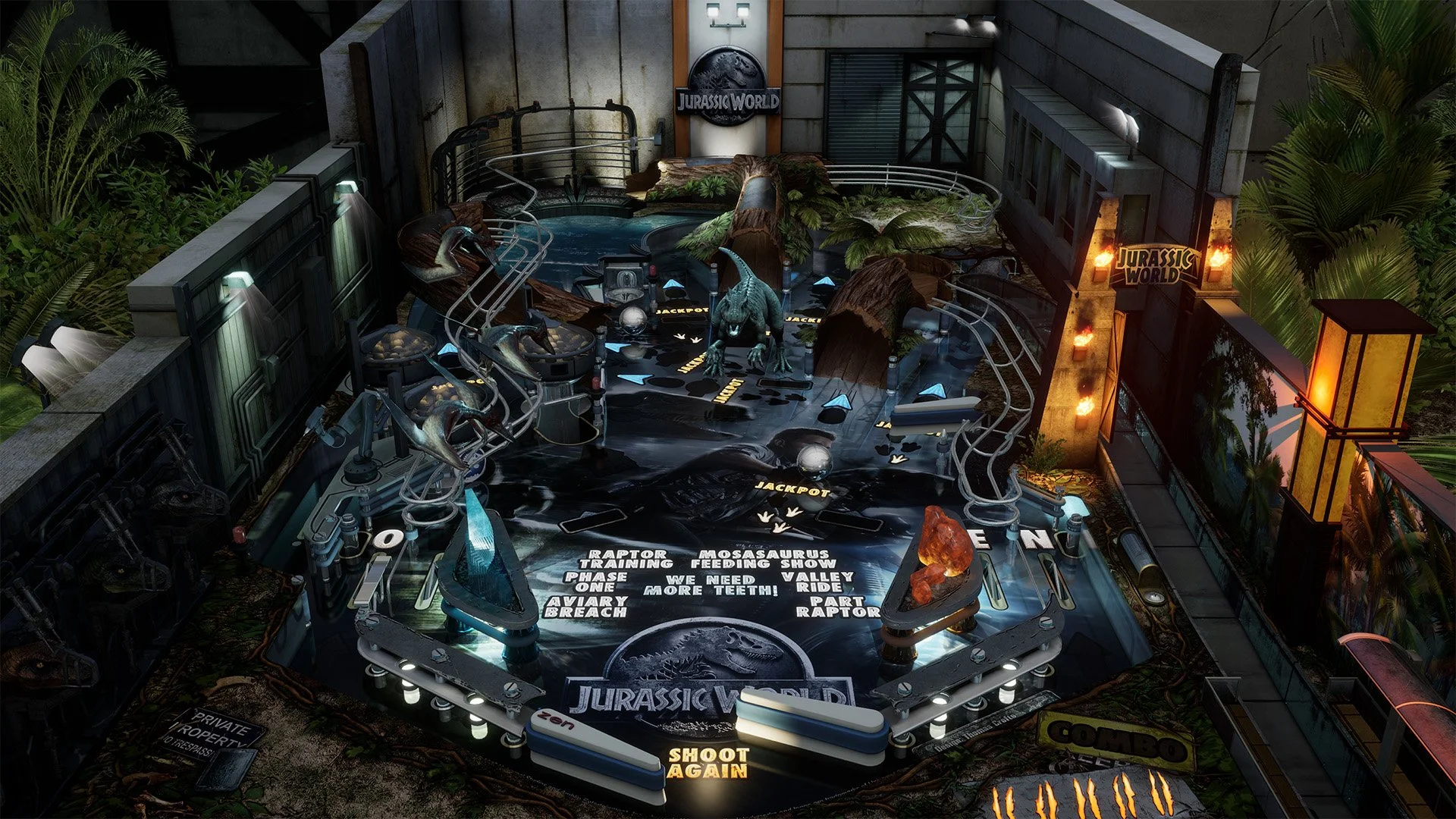
I also studied Zen Studio’s original digital pinball machines. I found a lot of interesting ideas in these boards; however, I chose to steer clear of them because they felt too square to compare with their real counterparts.
I also noticed that while these boards are visually stunning, they relied too much on the digital aspect of presentation. I wanted to capture something a bit more “low-tech” to reach the hardcore pinball crowd.
The next section I decided to check was brick-breaker (also known as Arkanoid) games. My main comparison game was DX-Ball 2 20th Anniversary Edition by Longbow Games.
It was here that I saw various ideas and concepts for power-ups in Brick Breaker. Both positive and negative power-ups, and how they affected the gameplay loop.
This also showed me how to balance the level design in a brick-breaker-style game, with the shapes of objects in the field affecting the ball's physics and the strategy that comes with it.

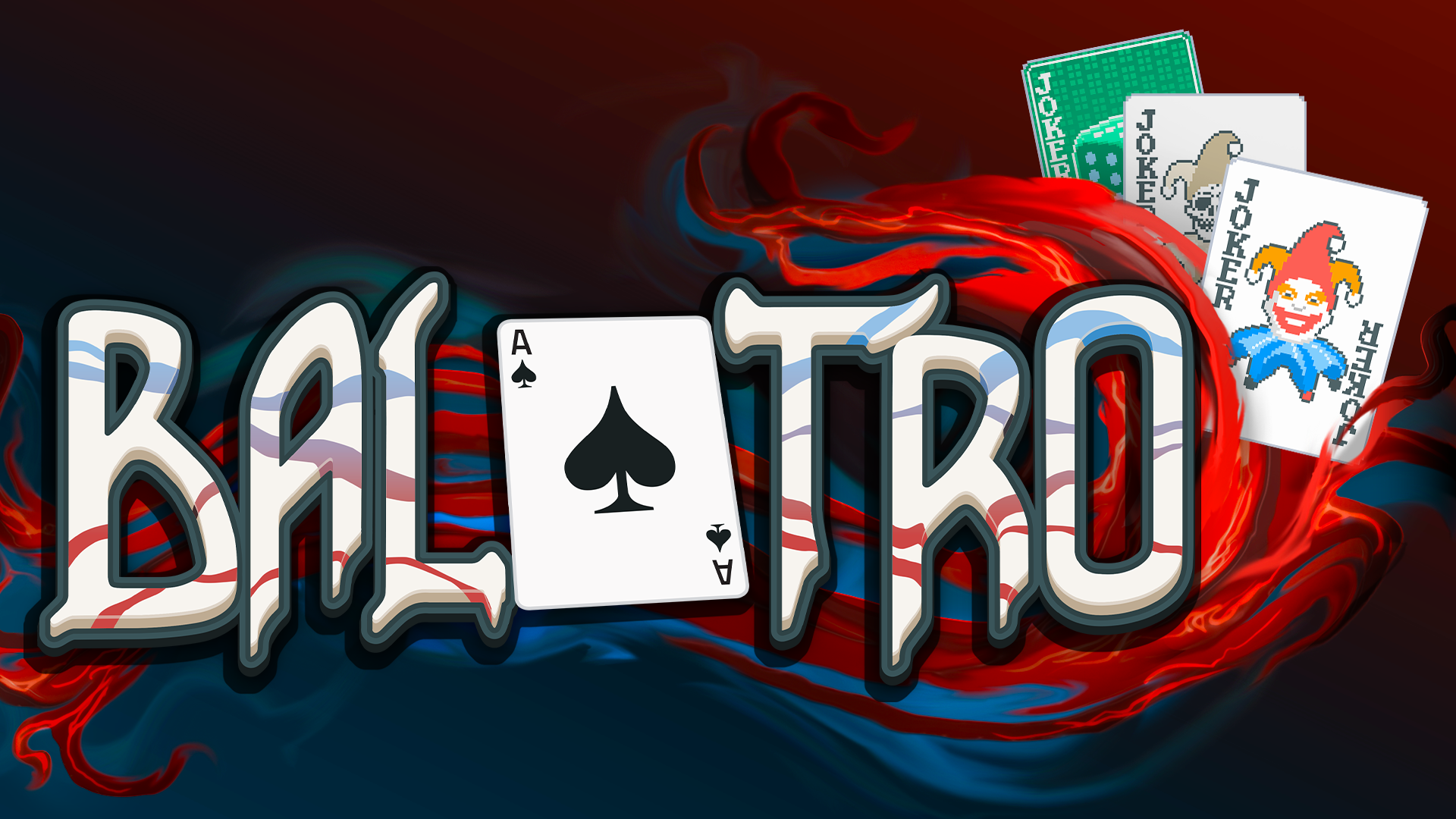
I also investigated Balatro by LocalThunk. I sought to understand the hidden third aspect of my pinball game. Randomization and Rogue-Like Gameplay loops.
It was from this game that I developed the idea of having a new set of objects appear every time a board is cleared. Allowing for infinite combinations of board layouts.
Construction of the level
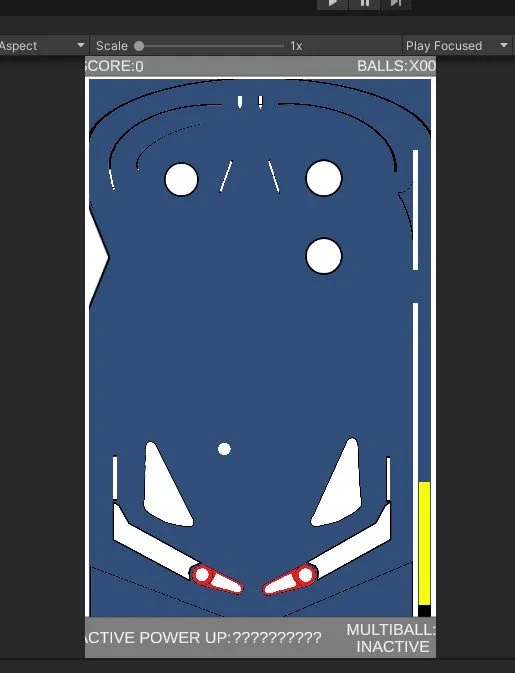
This was the first layout of the board. This layout was intended to look like a much more traditional pinball board, with several avenues on how to reach the top of the bottom.
The idea was that there would be several bricks that could appear in these higher areas where the player could break them, allowing for a form of meta progression within a round. The reason is that destroying the bricks would grant access to more of this curve, opening up ways into the top half and increasing combo potential.
However, this board was scrapped after it proved too difficult to fire into the curves. They were too narrow, and widening them any further would prove to be too congested
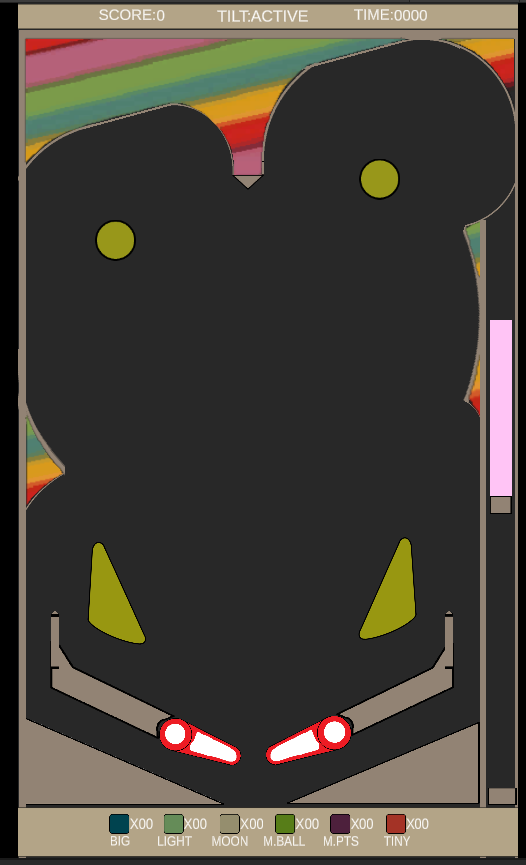
This was the second board layout. While I had sacrificed complexity, I made up for it in maneuvering and playflow. The player would now be able to launch the ball into the curves they desired consistently
The large, empty areas now allow for a greater breadth of bricks to spawn. Allowing the board to become naturally more complex with each brick spawned.
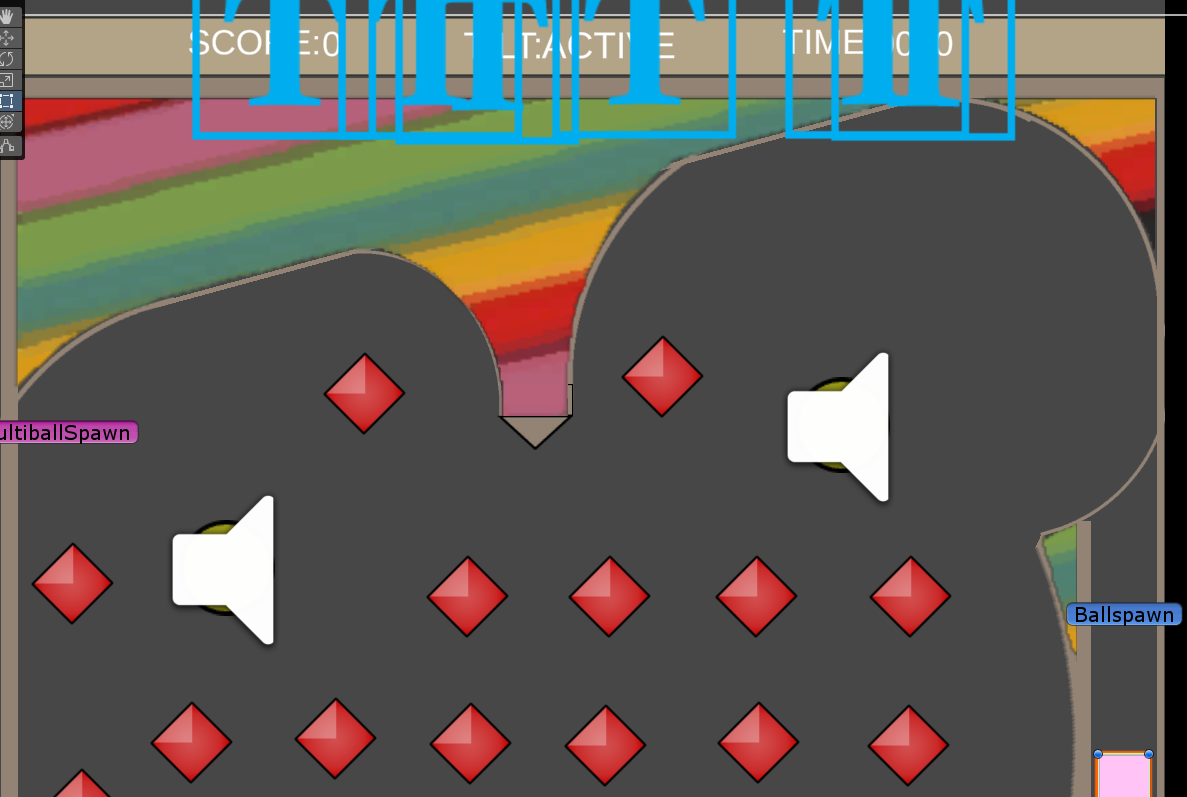
This is the top third of the board, this is where the player will ideally want to show towards so that in the fall the player is able to cascade the ball into multiple bricks for greater point value.
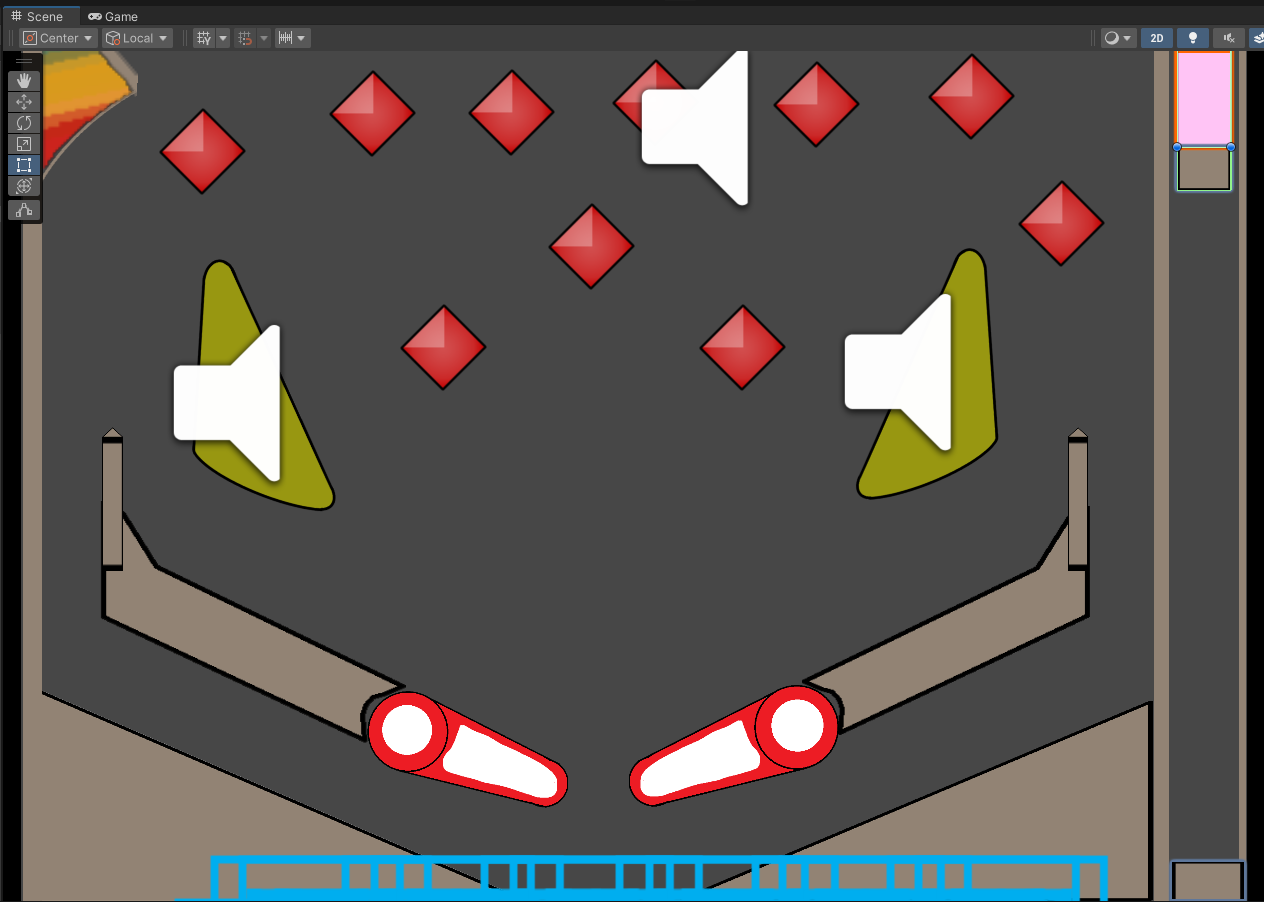
For reference. Each Red diamond indicates a spawn point for a brick with the sound sections where bumpers were placed. The bumpers were placed inside these curves to allow the ball to reach further inside or outside the curve in the case of the ball not having enough speed to commit. They also provide a chaos factor to the board that pinball thrives on.
I was even able to preserve the original intent of the first board by strategically placing brick spawn.
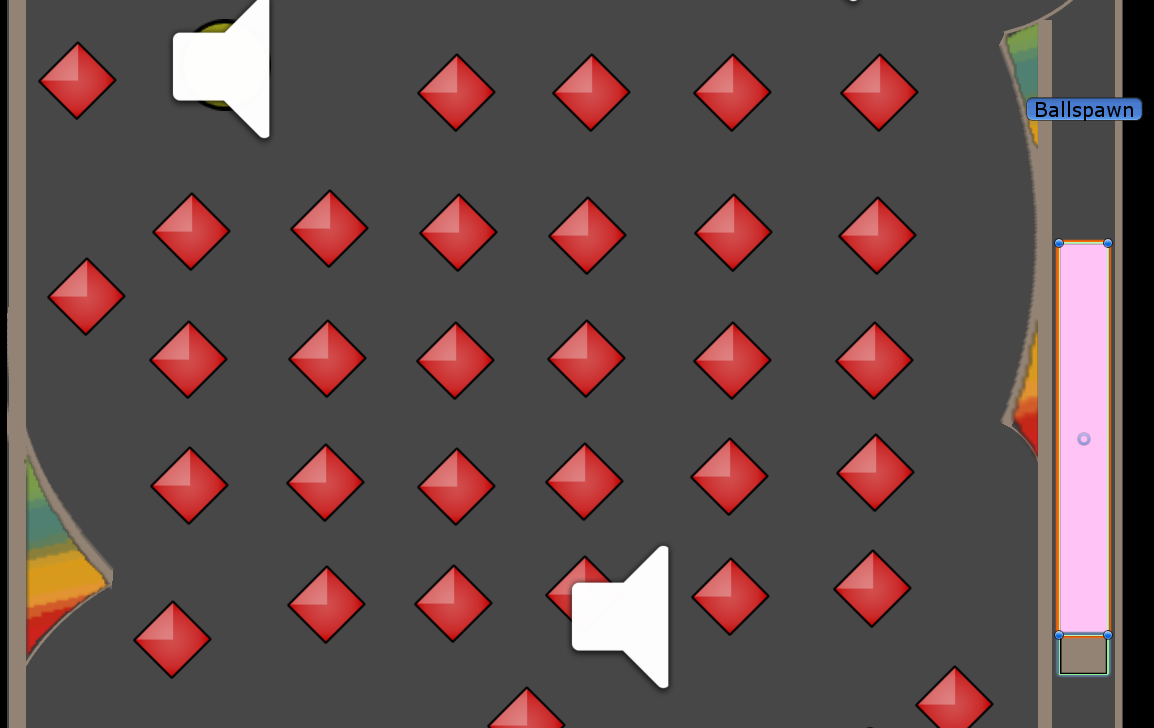
This is the middle third of the board where most of the bricks will spawn. I wanted the game to scale with difficulty so that the player has an overall greater experience in learning and later mastering the controls of the game.
As such I designed the systems of the pinball machine so that with every board of bricks cleared a new board spawn in its place with an additional brick to clear, with the board filling instantaneously upon clearing.
This meant the ball could continue a streak even if a board is cleared, which played nicely with several of the power-ups in the game, such as the point multiplier and the implosion brick, which pulls the ball inward instead of bouncing upon destruction.
This is the lower third of the board, where the player has the most control. This is the area closest to the standard layout of a pinball machine. This was intentionally designed to appeal to hardcore pinball players, allowing transferable skills.
Bricks were intentionally placed in this section to create specific safeguards or danger zones for the player. in the case of those closer to the border, they provided a safeguard from the ball falling into the gutters as well as providing score, and for those closer to the center they were meant to be a reaction check from the player.
Even after several playtests, the ball would continuously end up in the gutters, much like how, in normal pinball, a ball can end up going to the gutters outside of your control. This was even after several iterations of shortening the gutters. In response to this problem, I decided to adapt a classic pinball mechanic, Tilt.
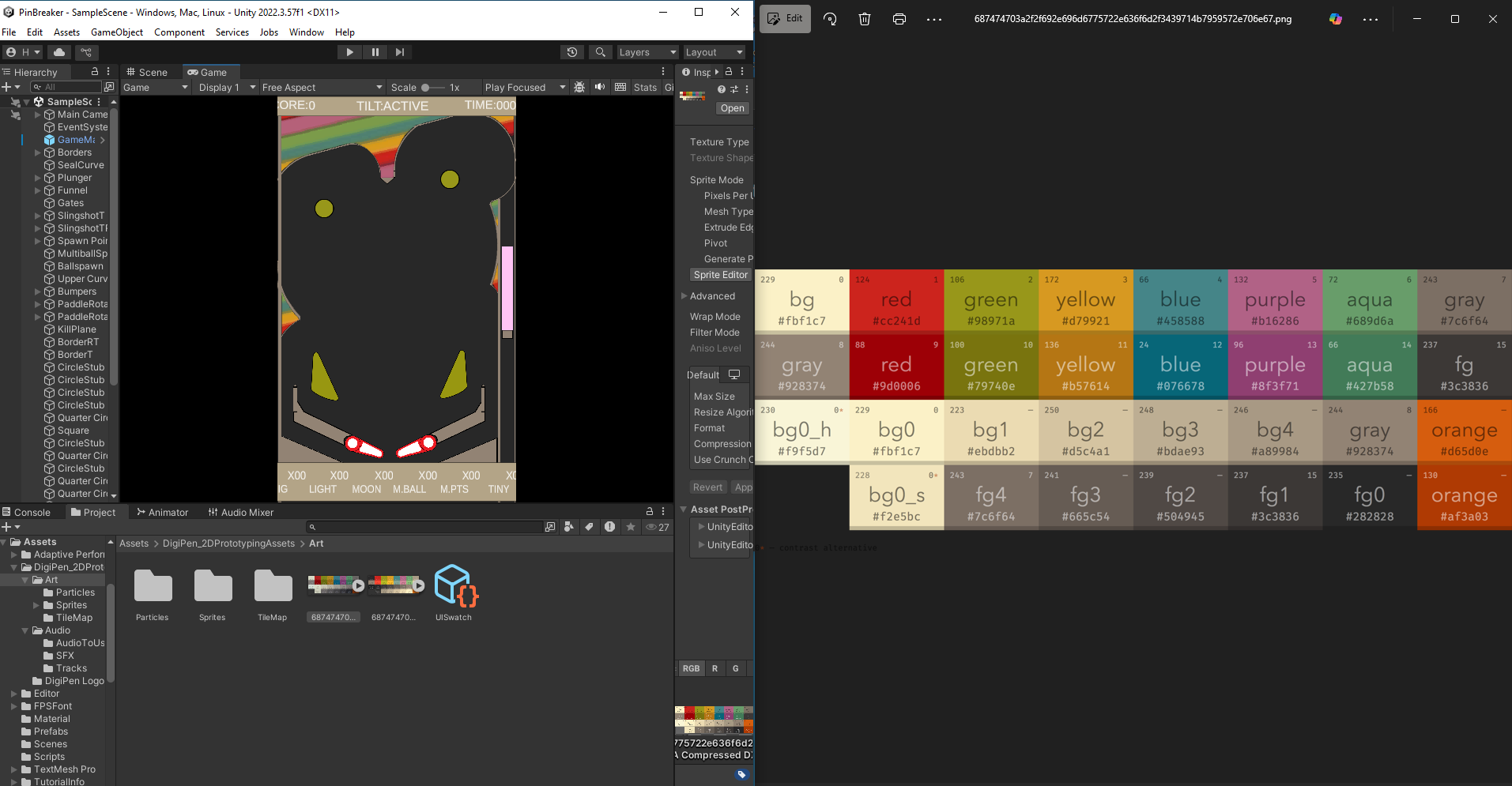
The board's color scheme was intentionally designed as a callback to cassette disks and the hardware of that era. The muted color scheme allowed the bricks' and power-ups' colors to pop out to the player, making them easy to reference.
However, due to time constraints and lack of foresight, I had not explained what any of the power-up colors were in the game, meaning most of my color theory work was useless.
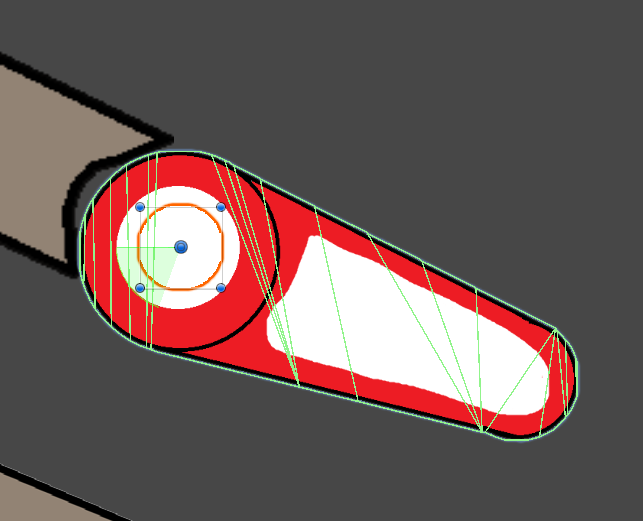
This is a close-up of one of the paddles. Paddles, as I have now learned, are deceptively tricky to program due to having to consider how much torque to apply and where they are on the board
Using pseudocode I was able to come up with how the flipper would work, using a hidden circle inside the paddle to be the true control of the paddle and rotating upon input and lerping back to starting position upon input release.
There was also the problem that, because I didn't have an artist until the final 2 weeks of development, I had to create the assets myself, resulting in them being misshapen and lumpy.
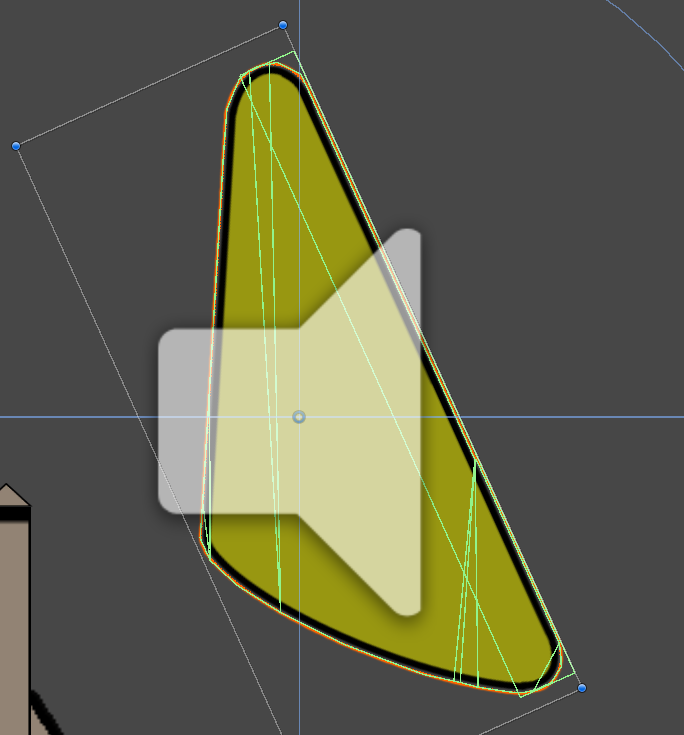
This is a close-up of one of the bumpers on the board. During my research, I discovered that bumpers are multi-purpose in pinball. They pose obstacles to the player in certain scenarios, adding to the chaos. Still, they can also be potential points of skill expression and opportunity, such as with bumper combos.
This is why I had the bumpers award 10 points upon contact, since the ball often bounces between them, potentially providing 50 or more points in a single combo.
Assembling Bricks & Power Ups
This is a shot of the game in action. Seen here are various power-up bricks, including Big Ball, Tiny Ball, Multi-Ball, and Points Multiplier. You will also notice the 3 different brick types, horizontal, Vertical, And Circle.
While horizontal bricks are self-explanatory, the vertical bricks were chosen to construct walls around the board, allowing dynamic changes in how the player must interact with the board and providing gameplay opportunities.
Circle bricks were selected to be akin to bumpers as well as naturally serving as a way to add further chaos factors to the board, thanks to their hard-to-predict reactions with the ball.
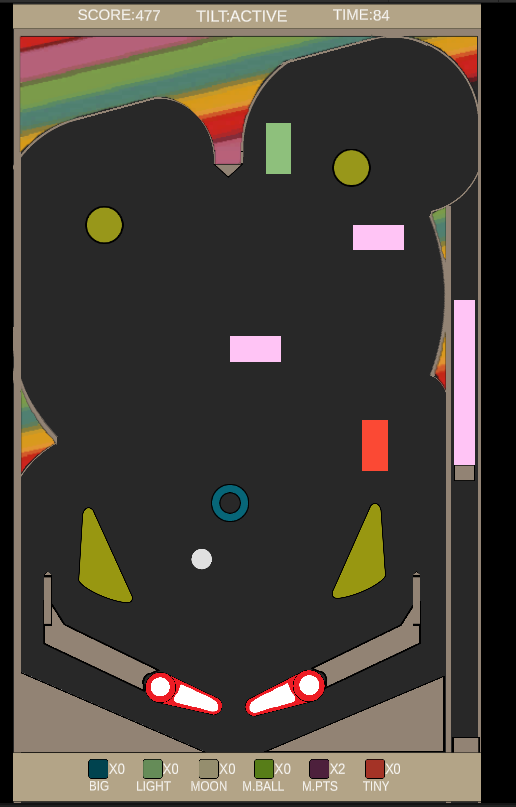
Unlike brick-breaker games, most, if not all, the power-ups were designed to be positive. This was intentionally done so as not punish the player excessively, pinball is already a difficult game at the high-level and adding a power-up that hurts the player on top of this proves too frustrating.
Some power-ups were already staples of pinball, such as the Points Multiplier, which multiplied your points, and the multi-ball, which adds another ball to the board. But some are more abstract to pinball, such as big and tiny ball.
Big Ball and Tiny Ball proved very interesting to play with as the larger balls cleared bricks much more easily and were harder to sink into the pit,t but at the cost of getting stuck more often and crowding the board in negative ways. The tiny ball, however, made it easier for players to slip past bricks, allowing for better cascades and skill shots, at the cost of being hard to keep around. These problems and benefits were exacerbated when the effects were stacked on top of each other.
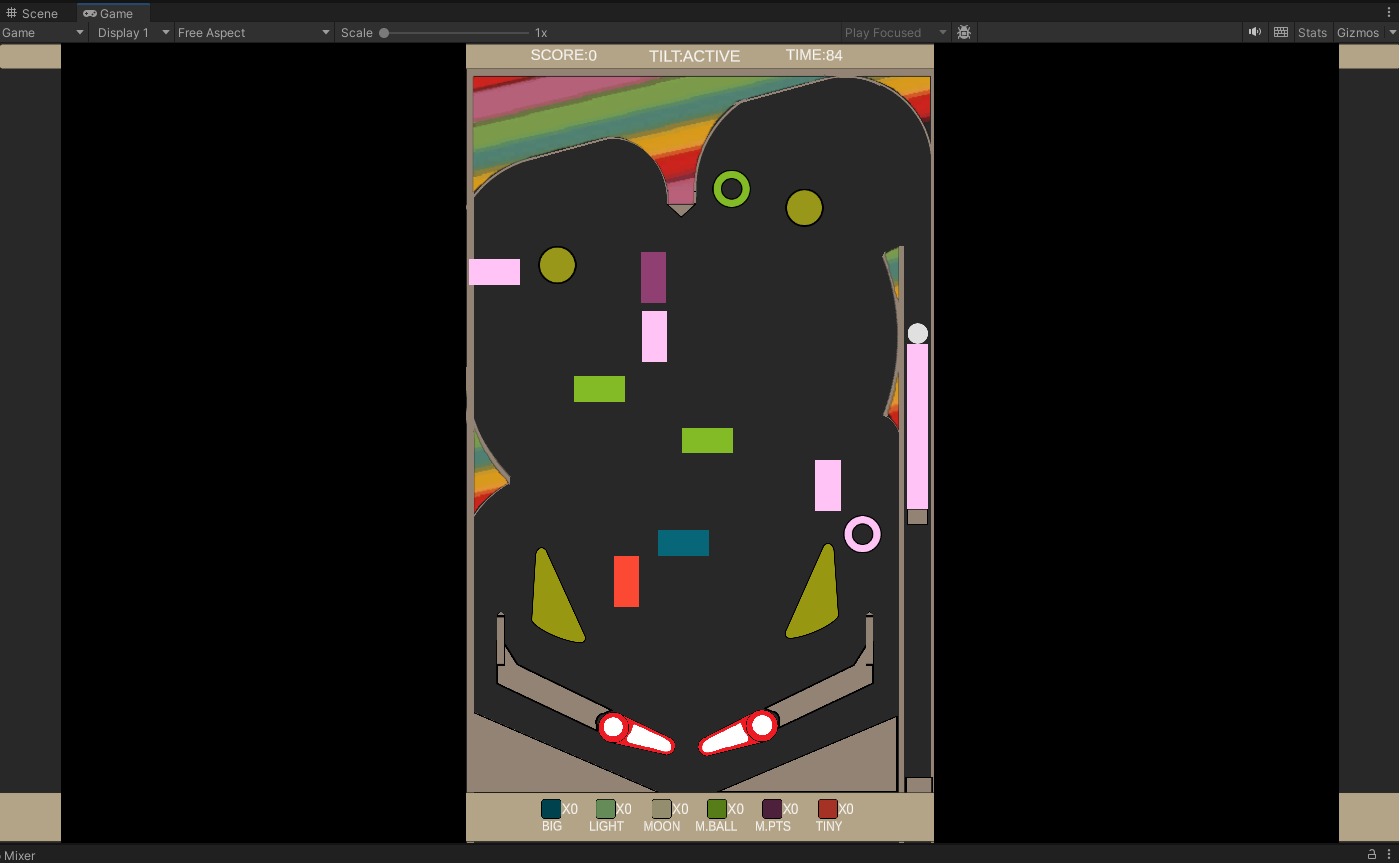
Light and Moon Ball were two power-ups that behaved similarly but provided much different contributions to the board. Light ball itself made the balls have less mass allowing them to be fire at a greater speed, where as Moon ball lowered the gravity of the bored, making the balls fall down much slower, allowing for greater control.
In hindsight, I think light ball is a rather useless ability, and moon ball likely would have stayed due to its greater impact in the gameplay loop, especially during more chaotic situations
Originally, this game was planned to be in 3D, but due to the lack of time from pivoting twice on what I wanted my project to be, 2D was chosen for a faster production cycle.
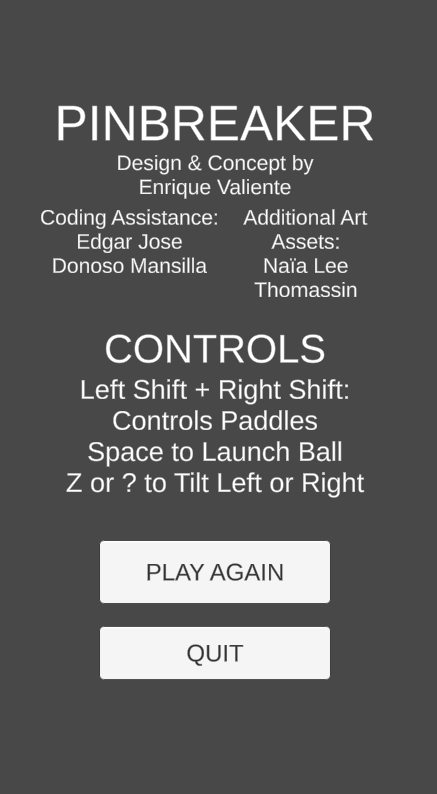
The game was also intended to be a lives system like pinball. However, due to coding faults, poor player feedback, and time constraints, the time-based system was elected instead. And even then, there is a game-breaking bug that prevents the game from being played more than once on the same execution.
Overall, this game stands as one of my biggest failed projects as a designer, but one I do wish to return to one day with more time and greater experience.