
Dead Canyon
Summary: An FPS game with a focus on fast-paced combat. This was my first-ever 3D project in a team, as well as my first project in Unreal Engine.
Role: Systems Designer/Level Designer/User Researcher
Project: Classwork
Team: Double Dice (14 Members)
Development time: August 2022-April 2023
Made Using: Unreal Engine 5
Lesson Learned:
-Research: when creating systems, see how other games have done it before and try to see what you can tweak or iterate on, especially if you’re unfamiliar with the genre.
-Balance (Abilities): creating abilities that not only synergize well but are also fun to use by themselves.
-Balance (Enemies): Creating enemies that not only complement the abilities but also make them fair enough for players to fight while also being scary enough to put up a fight together.
-Cutting Down: Sometimes a level doesn’t have to be big to be exciting. Having a limit on the size of the level can breed much more creative products.
-3D Level Process: Sketching, Creating, and iterating on levels in a 3D Space!

Creating the System

This board has the first renditions of the abilities within the game.
I took all the ideas the team had for abilities they would find enjoyable, weighed them, and formed a move set that was conducive to the game we were making.
I then began writing about how the abilities would interact with each other and how much they would cost. These abilities would then be balanced and reconfigured over time.
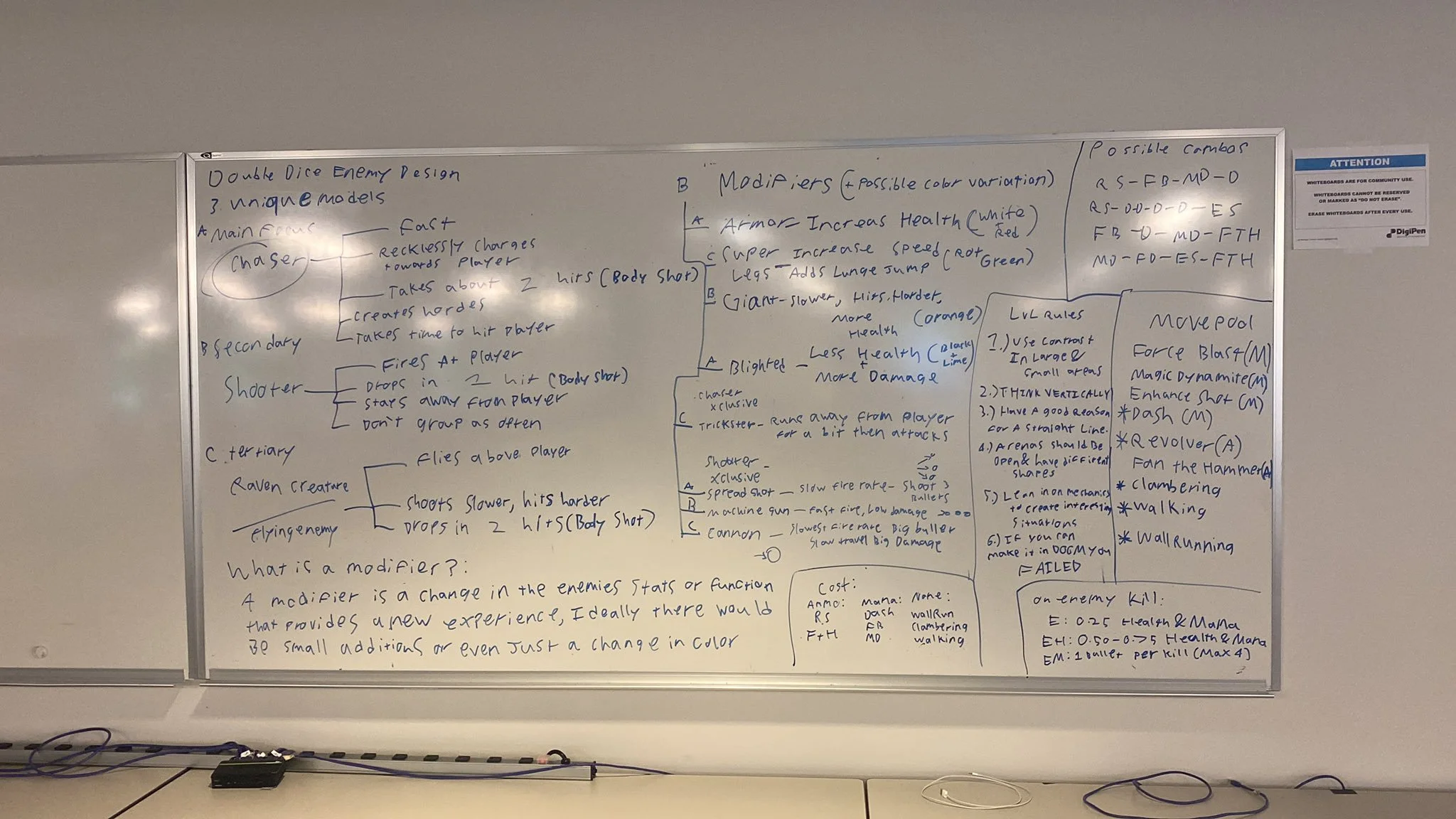
This was the first breakdown of enemies for the game. Here I wrote down and presented to the team what enemies should be in and in what priority, as well as what should happen when they are killed
I wrote about how to potentially expand on enemies easily via variants. Variants were unfortunately cut, but were close to being included.
In the end, we had 3 enemies in the game: a basic melee attacking enemy, an enemy that fires from a distance, and a flying enemy with slow but powerful shots

As the systems were iterated on, we ended up with 3 core abilities that felt like they covered the basics of a standard movement shooter loadout.
I attempted various control schemes for the game, but ultimately drew heavily on current hero shooters, ensuring a comfortable play experience.
In retrospect, I do feel like the Q and F abilities would be swapped.

Wall Riding was the big showstopper ability in our game, being desired from the start of development.
We heavily based it on the dash seen in the Titanfall franchise, but gave it some tweaks to fit our game.
When I was on level design, I originally had the wall-riding have a very wide arc so the player would take longer to fall off.
However, as we added new levels, I refactored this to be much shorter, requiring the player to pay attention to how far they’ve wall-run.
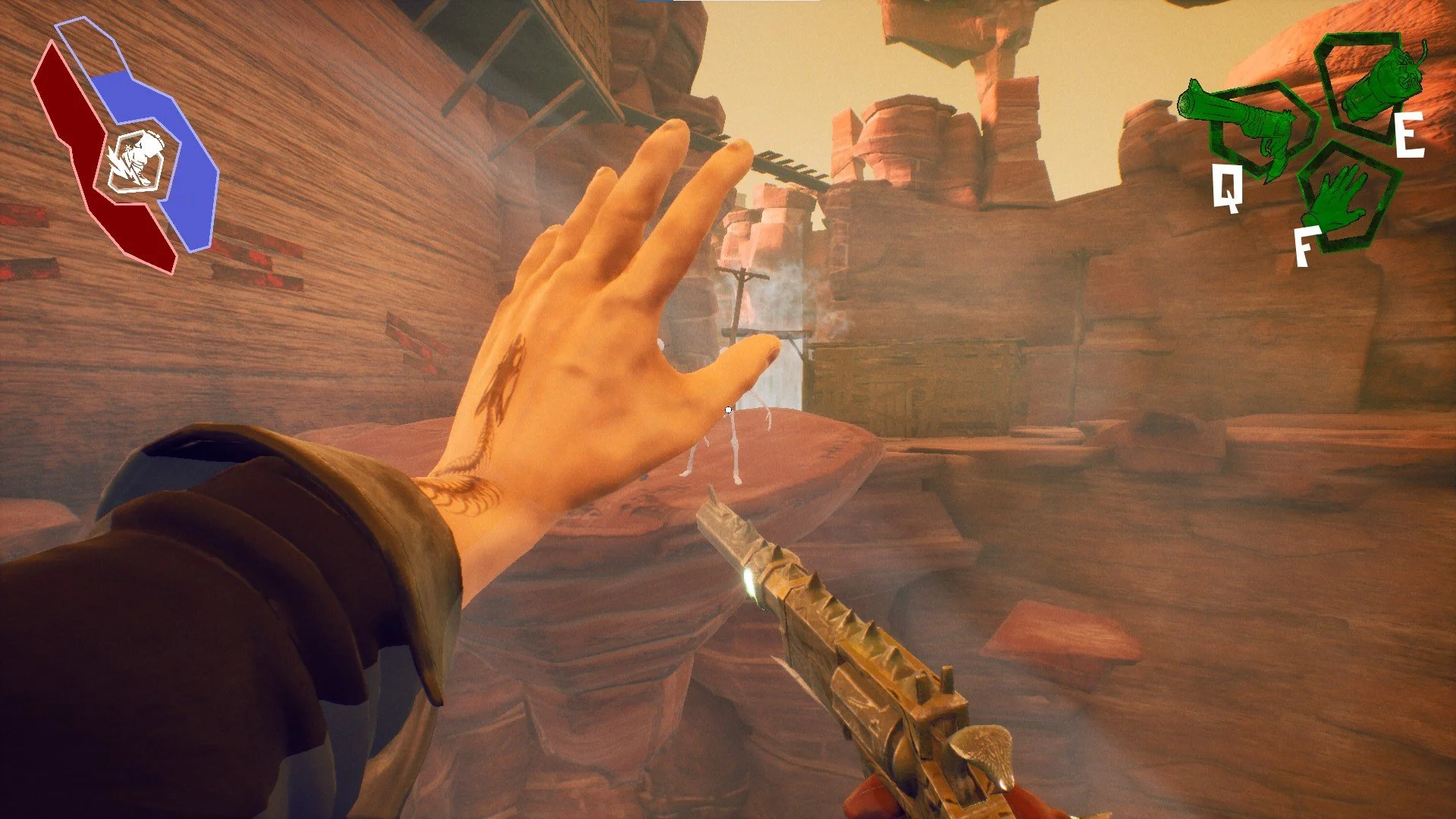
When we were creating the abilities for our character, Force Blast was one of the first abilities I had pitched to the team.
I found that a simple push ability gave us a lot of bang for the buck, since it’s a simple move with myriad uses, and given the number of enemies we planned for the player to fight, it felt like a great ability for crowd control.
The amount of push the ability had fluctuated a lot during development as I balanced the abilities accordingly, and overall, I found I could keep the force I wanted by actually meddling with other factors in the ability that interacted most with it. Magic Dynamite.

Magic Dynamite was an ability proposed by the team, as they wanted a grenade-like ability in the game.
I personally really liked the idea and incorporated it alongside force push. As development progressed, this ability arguably received the most balancing, as it became one of the more volatile in our game.
As it produces an object, I had to learn how Unreal’s physics engine handles forces and fine-tune the throwing arc to be just right so the player can use the dynamite to its full potential.
This included changing its throw distance and size to make it more visible and easier to throw. I even changed the weight as the dynamite could be pushed forward by force blast, creating an expensive but flashy move for players to try.

The final ability to be finalized was the enhanced shot ability. This ability went through the most ideation phases. First, it started as a move that enlarged your shots, making them easier; later, it became a ray-traced laser that shredded anything it pierced.
Eventually, we took inspiration from a game our level designer, Jonathan Serafica, was playing at the time, Deep Rock Galactic. The laser in its current state fires a beam that deals damage for as long as it’s active.
By the time we finalized, I had realized this ability felt rather independent of the rest and proved quite popular among players, as its high cost was offset by the sheer damage it could deal. This was a great lesson in how to better design abilities that mesh well together.
Creating The Prototype Level:

In the first half of development, the team hired 3 designers: me for systems, another for level design, and one more for UI/UX.
However, due to various circumstances, this level designer was unable to contribute levels to the development team. As our UI/UX designer was busy, the responsibility for the team's level design fell to me for the first half of development.
This was a visual representation of the level design rules I developed for the game, drawing on John Romero and Sandy Peterson’s rules for level design. These rules would eventually be refined by a later team member, Jonathan Serafica.

This was the prototype level of the game, where we conducted extensive playtesting.
This was my first time learning level design in Unreal Engine, which proved difficult because the engine has several built-in tools, some of which I became aware of halfway through development.
This level, in retrospect, is bloated and poorly paced, which is why it got cut once a new level designer was hired. However, this level did serve its purpose in providing valuable playtesting data.

This first area was made to tutorialize the player in verticality, as our movement system had a lot of verticality available. I wanted to make sure the player could handle our jumping and clambering abilities so they could be prepared for future challenges.
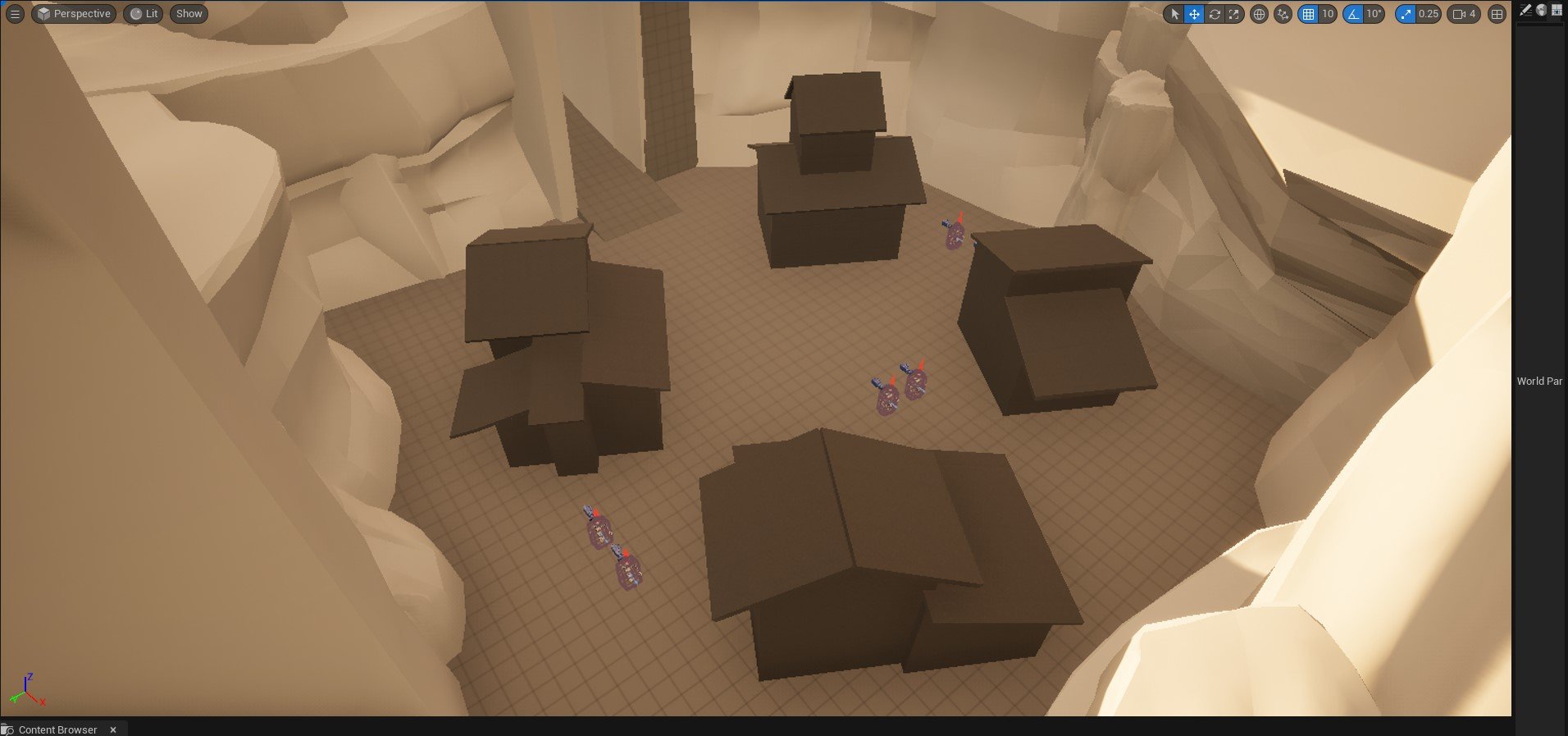
This is the first combat encounter zone in the level.
The long corridor would serve as a build-up for the player as they finally confronted real enemies.
The tight space was designed to keep the player never too far from an enemy, while still giving them plenty of room to hop around in the houses and corridors.

This area was made to tutorialize dashing.
This section has two sections that can only be passed by dashes: one straight and one curved, to prepare the player for both types of scenarios.
However, as dashing became more and more crucial to the game, I feel it’s a mistake to put it after the first combat encounter, and it should have been earlier. This area could’ve been a lot smaller as well.

This area was meant to be a showcase for what magic dynamite could do. The intended purpose is for the player to throw the explosive down to safely maneuver themselves to the ground. However, most players in the playtest would simply try their best to jump over! This likely would’ve been rectified if more active tutorializing had been put in the level.

This segment was meant to tutorialize the Enhanced Shot ability. I took inspiration from classic shooting galleries to create. The idea is to shoot all the enemies with enhanced shots to slowly eliminate them. This would be much easier than attempting to snip them. This worked quite effectively, as many players did exactly that as they learned how to use the enhanced shot ability.

This segment follows the enhanced shot tutorialization and teaches the player wall riding.
These long, thin stretches were meant to show the player how much time they had before wall riding began to slow and cause them to fall, with later segments even requiring the player to jump from wall to wall.
In hindsight, this segment was also way too long, and could have been shortened or possibly included more, but shorter walls.

This is my favorite segment of this level. This is the final arena of the level where all of the players’ abilities are tested against a mob of skeletons.
The area is wide and open, with many ways to approach the encounter. Almost every play tester I had enjoyed it, even with the struggle, and after their 2nd or 3rd attempt, would manage to get through.
I tried to use as many props and pieces as I could to build an interesting environment for the player as well.

The segment you see here uses several assets, specifically the crane, which combines scaffolding assets to add additional flooring.
It actually worked surprisingly well, since the assets blended well with the crane and didn’t clash with any collisions!
The walls themselves are also blended from a variety of canyon assets created by the artists.

In this aerial view of the final arena, we can see the layout more clearly. The intent of this segment was not only to test the players but also to begin to teach them more advanced techniques at this level, such as circle strafing and parkour.
If you noticed the level has two major concentric circles built into it, one on the ground floor and one in all the props, this was created to show the two different styles of circle strafing you could do in the game, evasive and aggressive.
Parkour segments are seen as the large gaps between the level's major segments. Players could spend the whole of the fight barely touching the ground! It’s that sense of freedom I wanted to project onto the game, and I feel like this segment presented that in droves. No two playtesters handled the level the same way.