
Blade Life
Summary: A platformer with many different abilities, all based on movement. This is the first Project where I was in a Two-person team, and I was the Level Designer.
Role: Level Designer/Enemy Designer
Project: Classwork
Team: E-Squared (2 people)
Development time: June 2021-July 2021
Made Using: Unity
This is the first Project where I was in a two person team. I was the Level Designer!
Lessons Learned:
Level Progression: Pacing a series of levels to slowly incorporate more and more features of the game is incredibly important to pacing! It can even save a bad level if done correctly!
Level Theming: By building a level around a certain theme, you can get a lot more out of a mechanic and make some creative set-pieces!
Creating The First Level

This was the second game I was involved with in my GAM150 class.
I was brought on as the level designer, while the other team member, Eric Moser, was the systems designer and handled the programming.
This allowed me to go all out on level design. For this game, I challenged myself to create 5 levels in 6 weeks. To help in getting things done quickly, I used some of my old assets, including my tutorial signs from Laboratory 5.

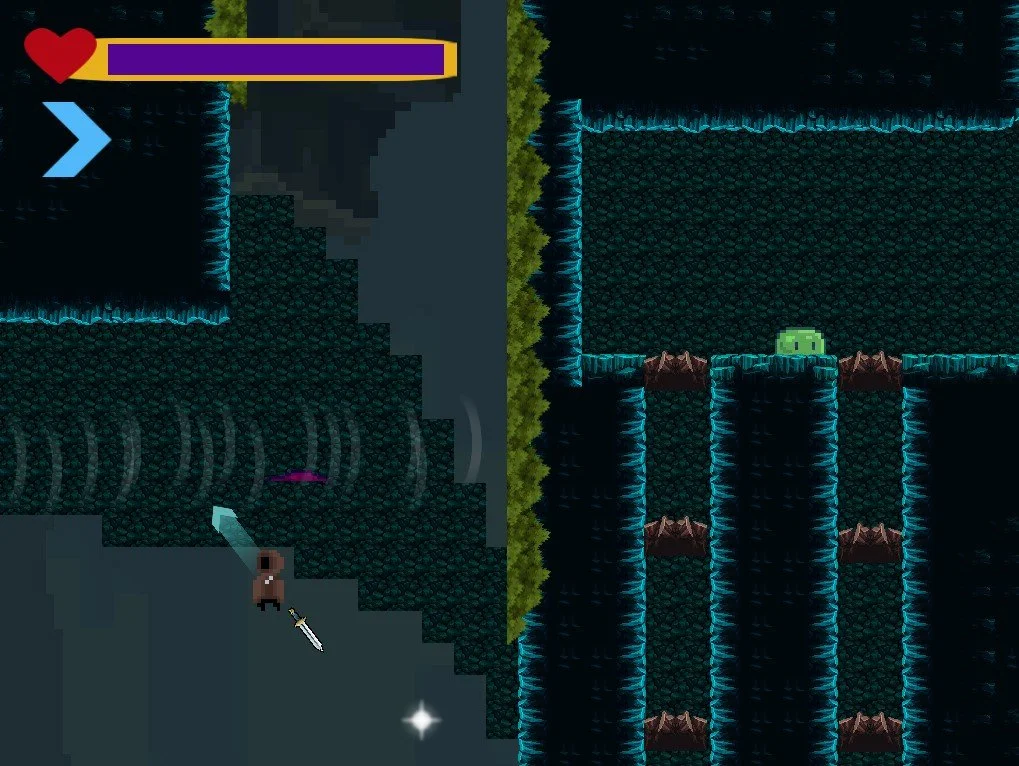
This was the first enemy encounter in the game.
I intentionally made it so the player has a height advantage to avoid scaring them with a sudden enemy attack and to allow them to fight the enemy when they are ready.
I did this later with all the other enemy variants, of which there are 3 per enemy type.

The original version of Blade Life had secret gems that could be collected, but ultimately served no purpose.
I floated the idea of perhaps hiding developer trivia as our collectibles, and it stuck.
This also allowed me to create many secrets and side paths that players could access within the levels.

Seen here is one of the new items introduced in the system, sword orbs that allow for sword bouncing.
Sword Bouncing also worked on enemies, which I tried to showcase with the introduction of the new flying slime enemy type.
However, in playtests, the players struggled to register the sword orb as a part of the level.
Creating The Second Level.

This area was meant to finalize the showcase of enemies by introducing the blue wall slime.
This was done in a space that was easy for the player to study their movement.
This also reviewed the sword bounce mechanic introduced earlier.

Seen here is a simple block puzzle. Block puzzles were in the original version of Bladelife, and I wanted to expand on what was possible with them.
However, I could not dedicate a whole level to exploring this idea, nor much space, as I only had so much time to playtest and make levels. As a result, many of the puzzles were tragically simple.

This is an example of one of the side paths I had created for secret hiding.
The idea was by beating this more advanced sword-bouncing challenge. The player can see some new information about the game.
This was also obviously a side path, as a checkpoint just out of frame is visible to the player.

This is level 3, based on an underground forest, and this is also where we show off the float mechanic.
This is a showcase of my attempt to create various themes within the level using our limited asset pool, since the previous level is intended to be a gem cave.
Creating The Third Level.

Level 3, unfortunately, I believe, is the worst level in the game.
The issue with the level is its openness and the use of the newly introduced air vents, which made it confusing to navigate.
Thankfully, I have learned my lesson with signifiers and have taken it to my newer projects.

Another showcase of level 3's failings. The puzzle is intended to have the player slowly float down and strike the slimes as they fall.
Unfortunately, I did not consider how heavy the player would be, and results in a challenge that is easily passed by just not floating.
The lesson learned here is to evaluate the game's systems before creating any challenges.

This boss arena is mostly unchanged from its original version.
However, I added some side platforms and sword orbs along the edges so the player can escape the boss if they get cornered by lasers or missiles.

Level 4 introduced the wall climbing ability and stomping mechanics, which means I got to experiment a lot with verticality in this level.
This is arguably my favorite level, as its tall towers allow for lots of speed and controller freedom.
Creating The Fourth and Fifth Level.

Level 5 was the final level in the game. I tried to create an oppressive atmosphere by starting the player in between some broken pillars.
This was meant to create a sense of seriousness by saying, “You’re in the big leagues now.” I unfortunately was familiar with the term “red overload” when creating this level.

In this block puzzle, I wanted to challenge the player by adding some more complexity. However, as I was designing this, I realized there’s a possibility the player could soft-lock themselves.
To counter that, I added in that singular spike as it would teleport you back to the start of the puzzle. In my future puzzle designs, I actively tried to avoid making puzzles like that again.

This final segment is meant to be a kind of mad dash to the top as the big, scary laser comes at you. In the original version of Bladelife, this pillar was relatively easy to access.
I wanted to make it a little more complicated to make the final slam much more satisfying. It’s a very simple dash that tests almost all the abilities introduced in the game, but it feels very satisfying to do!