Fusion Fighters
A Card Game where you take on the role of a monster master. Fuse two monster decks to create a fusion monster. Use each of your monsters’ strengths and abilities to create the ultimate monster. Then acquire training abilities and mill cards to create the ultimate battle monster!
Role: Creator
Project: Classwork
Team: Solo Dev
Development time: February 2023 -January 2024-February 2024-January 2026-April 2026
Made Using: Tabletop Simulator
This is a card game I had been designing and redesigning for the greater half of my time at DigiPen. It has undergone 2 major revisions, and its current version is the most successful and stable. This project is near and dear to me and helped me gain more confidence as a system designer.
Lessons Learned:
Card game Design & balancing: This project showed me the deep, complex world of designing and balancing card games. These games require an intricate level of balancing that is heavily defined by statistics and numbers, with even a small change in a card's damage value dramatically affecting a deck's performance. This project also showed me the production pipeline of card introduction, from concepting to testing to physical production.
The “Onion Method”: This project has introduced me to my latest design workflow, the onion method. When designing a game with many moving parts. I begin with the barest, basest version of the game and then test it until it is polished. I then add the next layer of mechanics, playtest the game with those mechanics until it's polished, and continue the process until I have the complete game!
Reframing and refactoring: Because this game has been remade from scratch 3 times now, this project also showed me the importance of reframing design ideas and taking time away from the project to refactor more effectively. A fresh set of eyes and new design experiences can dramatically improve projects!
Version 1: Created in 2023
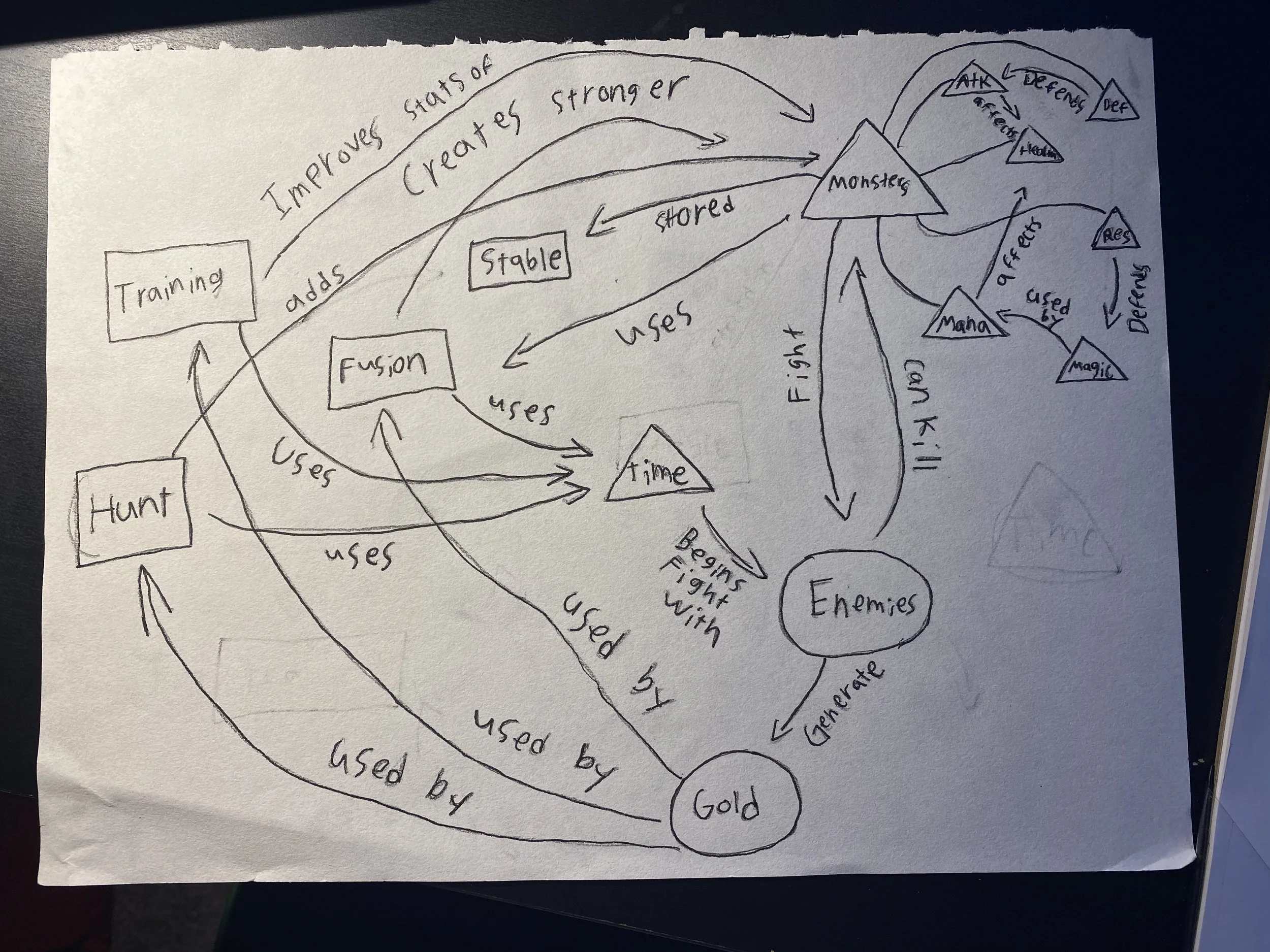
This is the oldest recorded screenshot of this card game. Seen here is an economy map of the game.
The first version of the game was developed as a project for my systems design class, intended as a PvE experience. The idea being that the player must go through about 4 encounters to be declared champion. Each encounter produces gold, which the player can then use to perform various actions in the rest phase between battles.
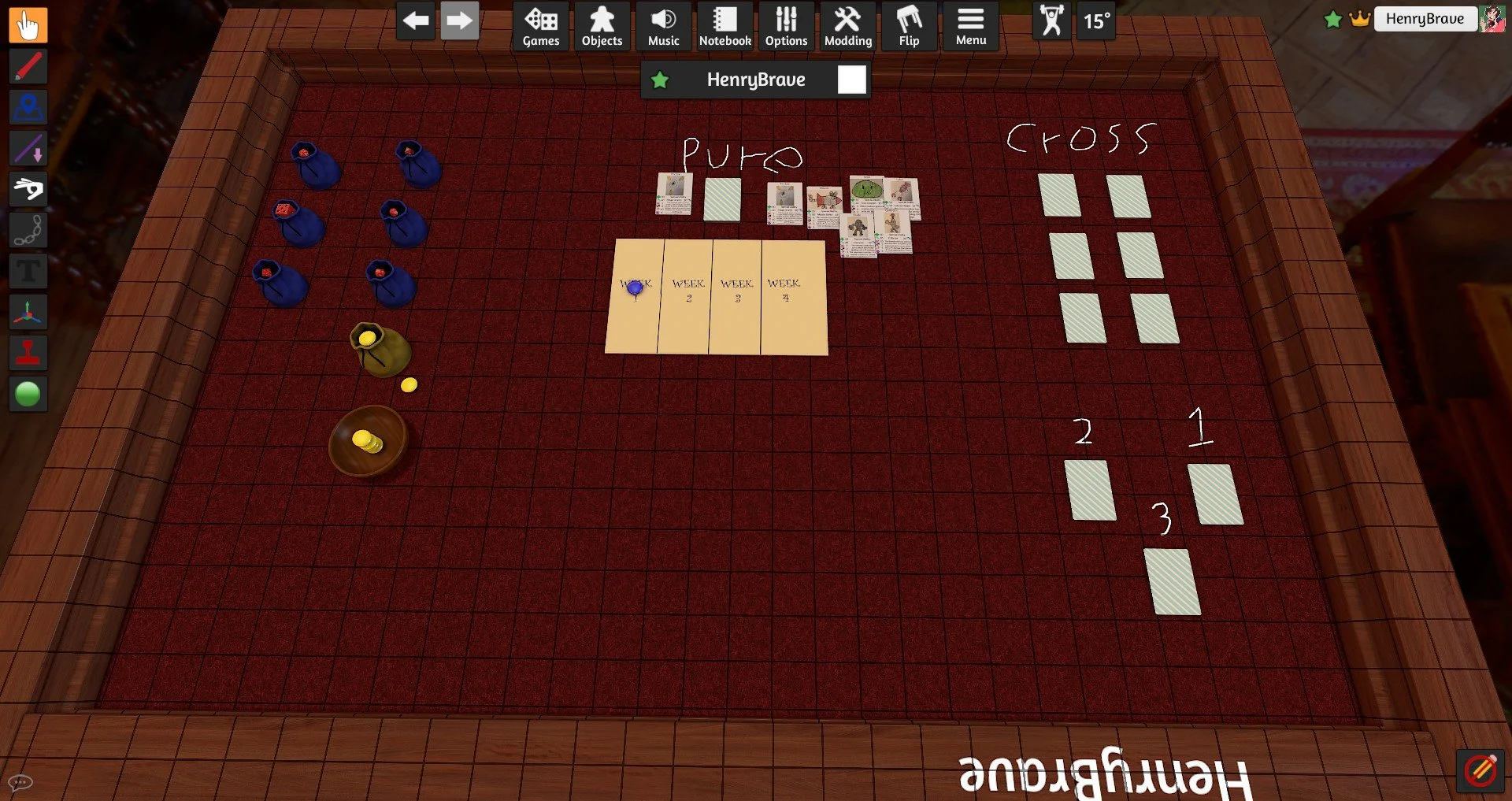
This is the first version of the game in a tabletop sim. This was also my first foray into designing for a tabletop sim. In this version, I had already made several compromises to the design due to time constraints and inexperience.
In this first version of the game, fusions were a generic ability, meaning that two monsters fusing would result in any fusion between one of the two species to occur. This meant that any two monsters could create any fusion, which ran counter to my design intent; however, it did provide a great deal of player expression.
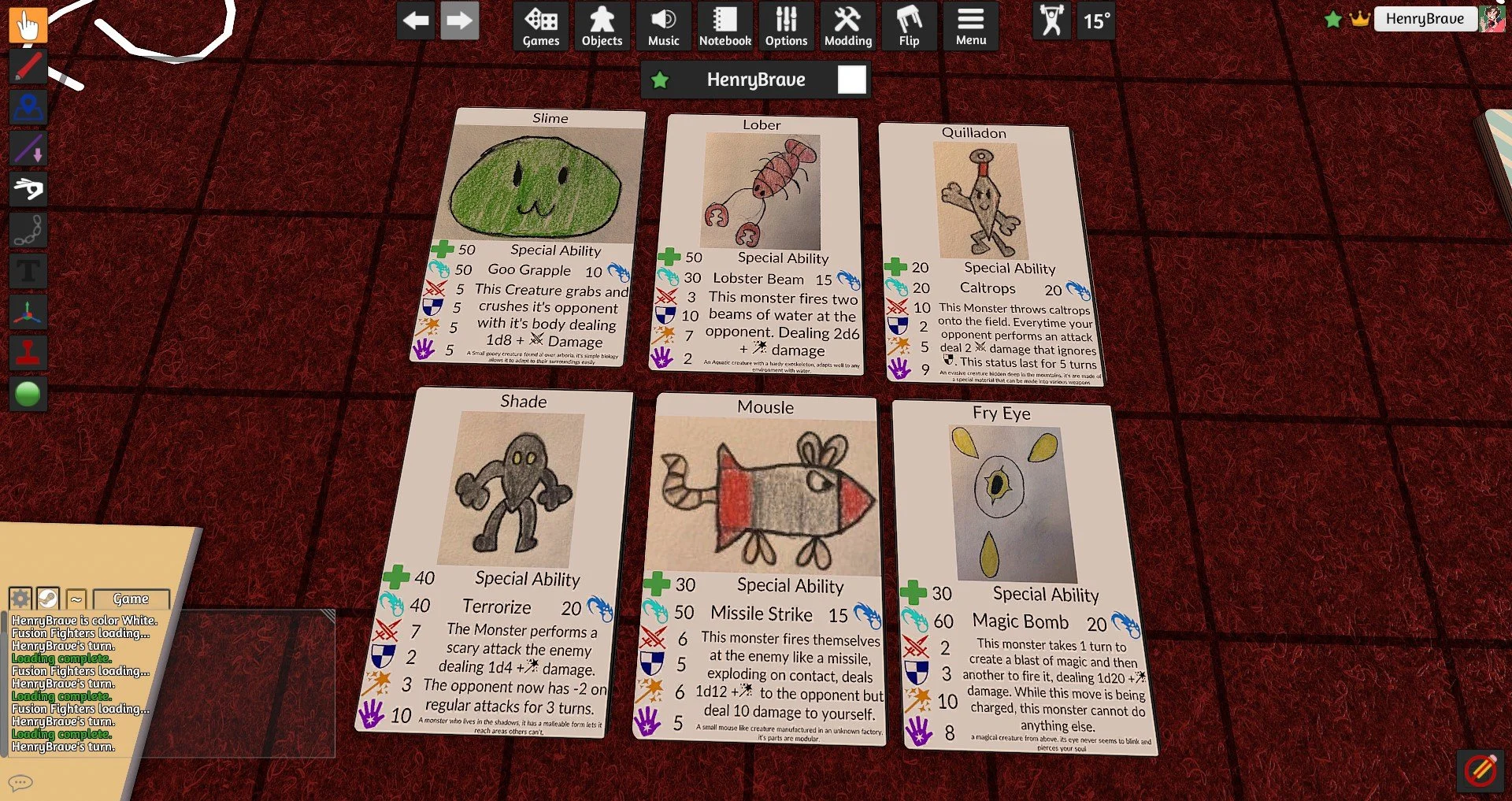
Seen here are the purebred monsters. These are the main monsters the player would purchase and would be used as material for the fusion mechanic. Each purebred came with 6 stats. From top to bottom, they are Health, Mana, Attack, Defense, Magic, and Resistance. Attack, defense, Magic, and resistance are essentially the same stat, just with demarcations of the former being for physical attacks and the latter being for magical attacks. akin to Pokémon.
I think one of the major problems with this game was the sheer number of stats the player had to keep track of. Made worse by the fusion mechanic, which stacks their status effects.
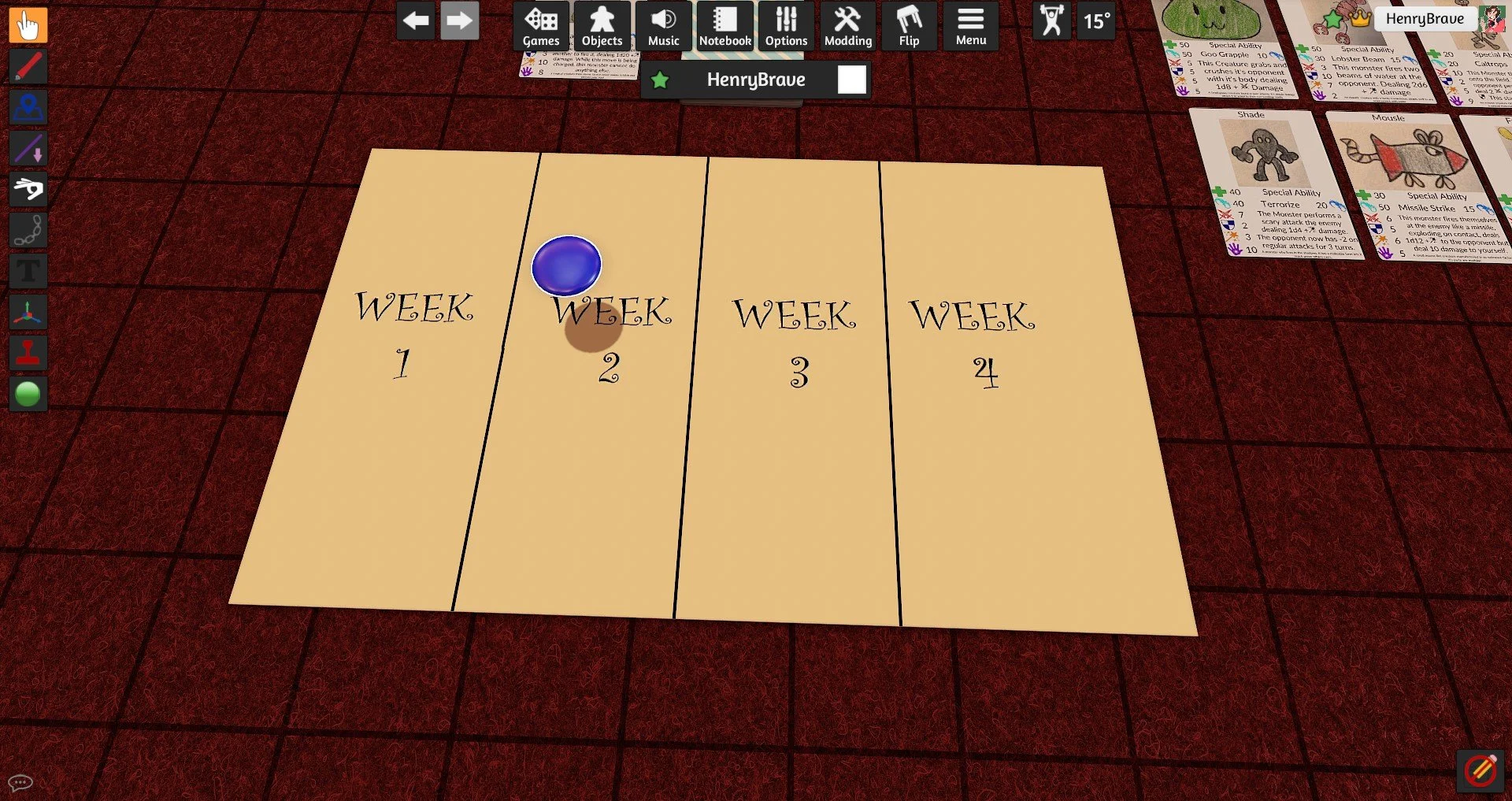
Each encounter was defined as a “week,” a callback to Monster Rancher, the core inspiration for this game.
This was the first attempt at creating custom assets for a game, and I used Photoshop to create a bunch of generic assets for the game.
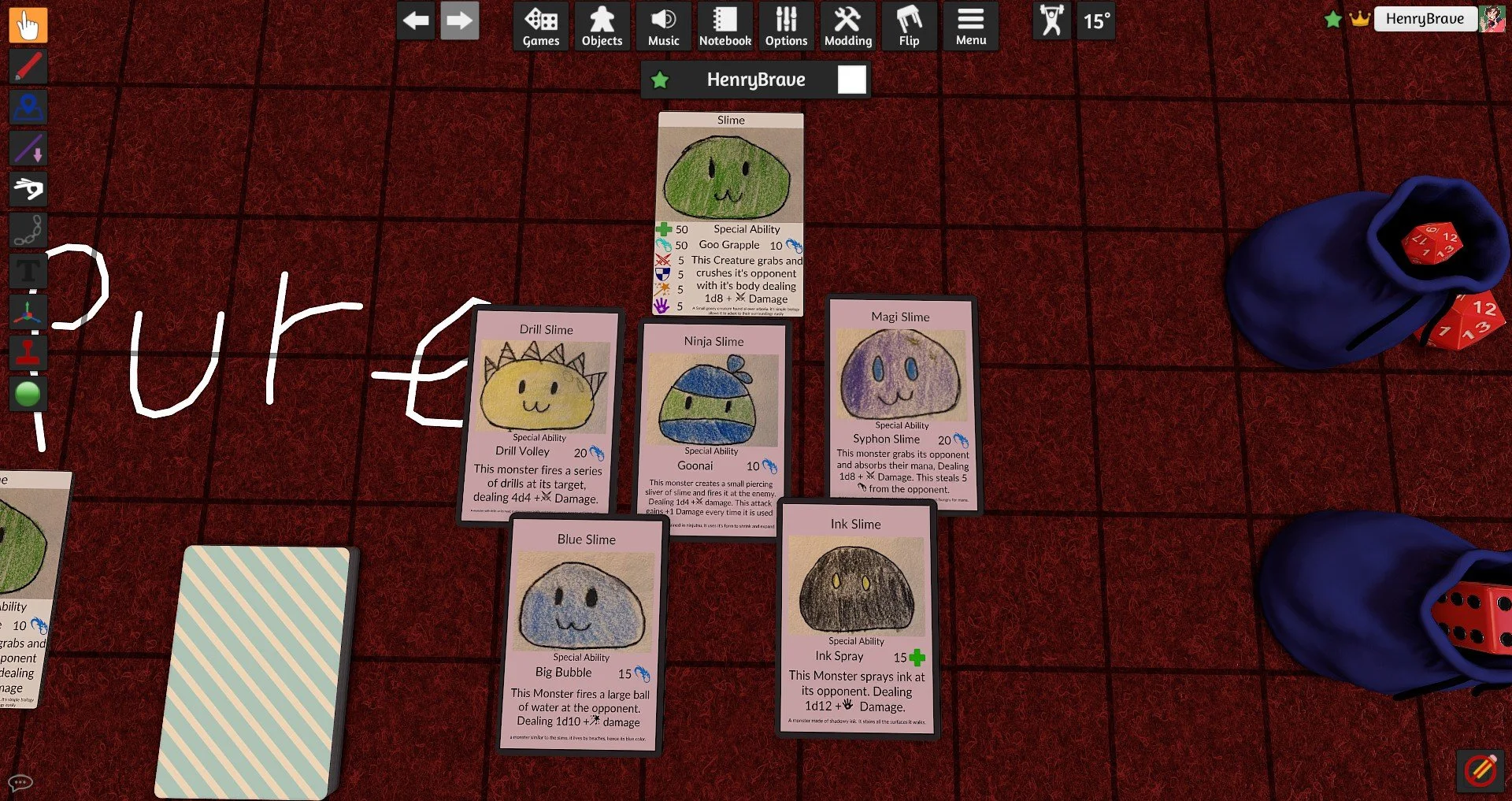
Seen here are all the fusion monster cards for Slime. Slimes were intended to be the all-rounder monster of the group, with their effects being designed to take advantage of all the different stats available.
Due to being in 3 other classes at the time and only having a month to complete the game, none of the card effects were tested, a massive flaw of the game. As a result, many abilities are frankly overpowered in comparison to the enemies you face. In PVE situations, being overpowered isn’t a bad thing since it feeds into the power fantasy.
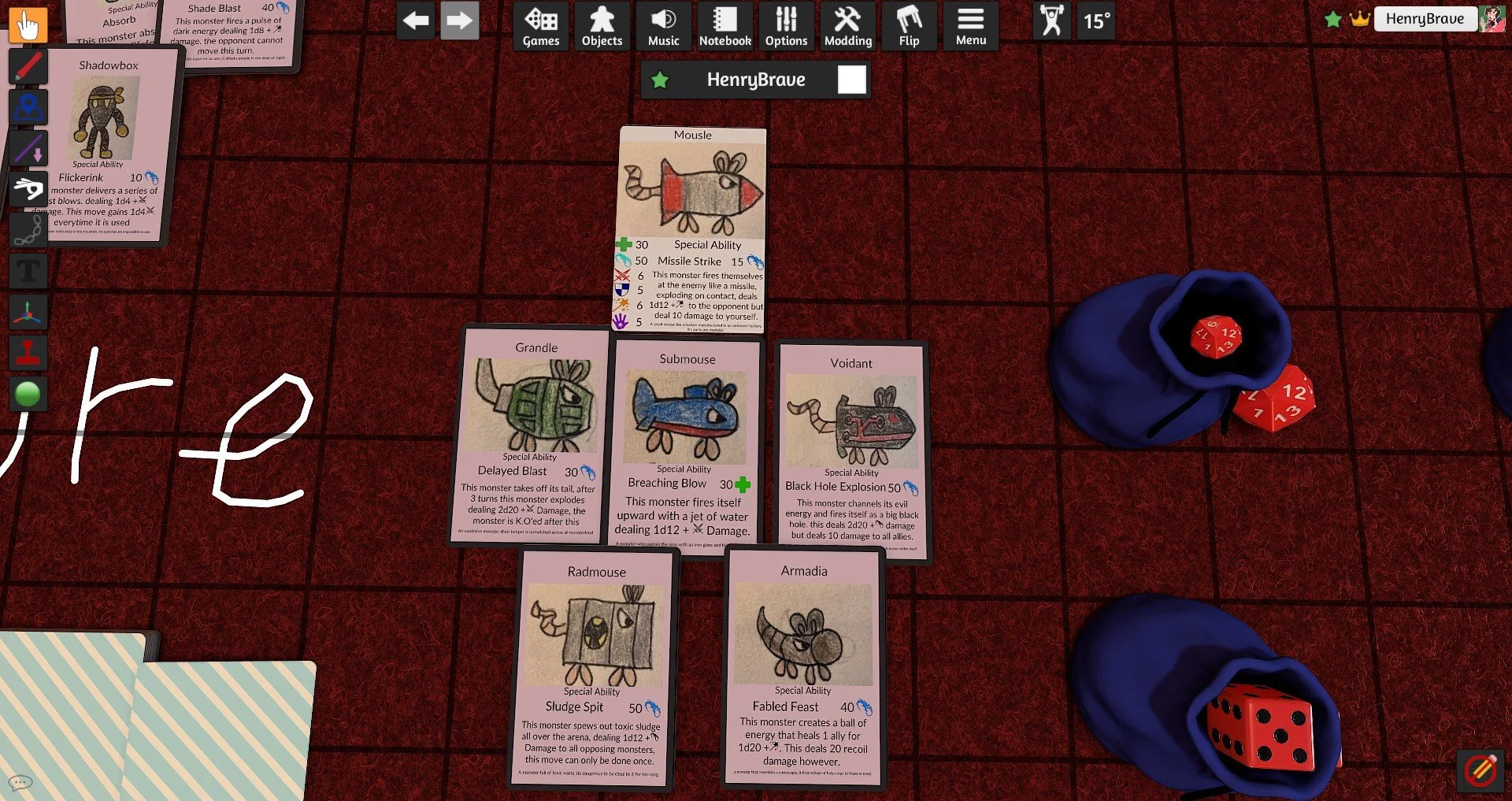
Seen here are all the fusion monsters for the Mousle Card. The Mousle card was intended to be a magic attacker with its high mana pool.
However, in retrospect, this is the worst-designed card line in the game since all of them are tied to Mousle, who, while having the highest mana pool in the game, has the worst stats spread, with many of its abilities also doing self-damage, making it almost impossible to take advantage of its attacks meaningfully.
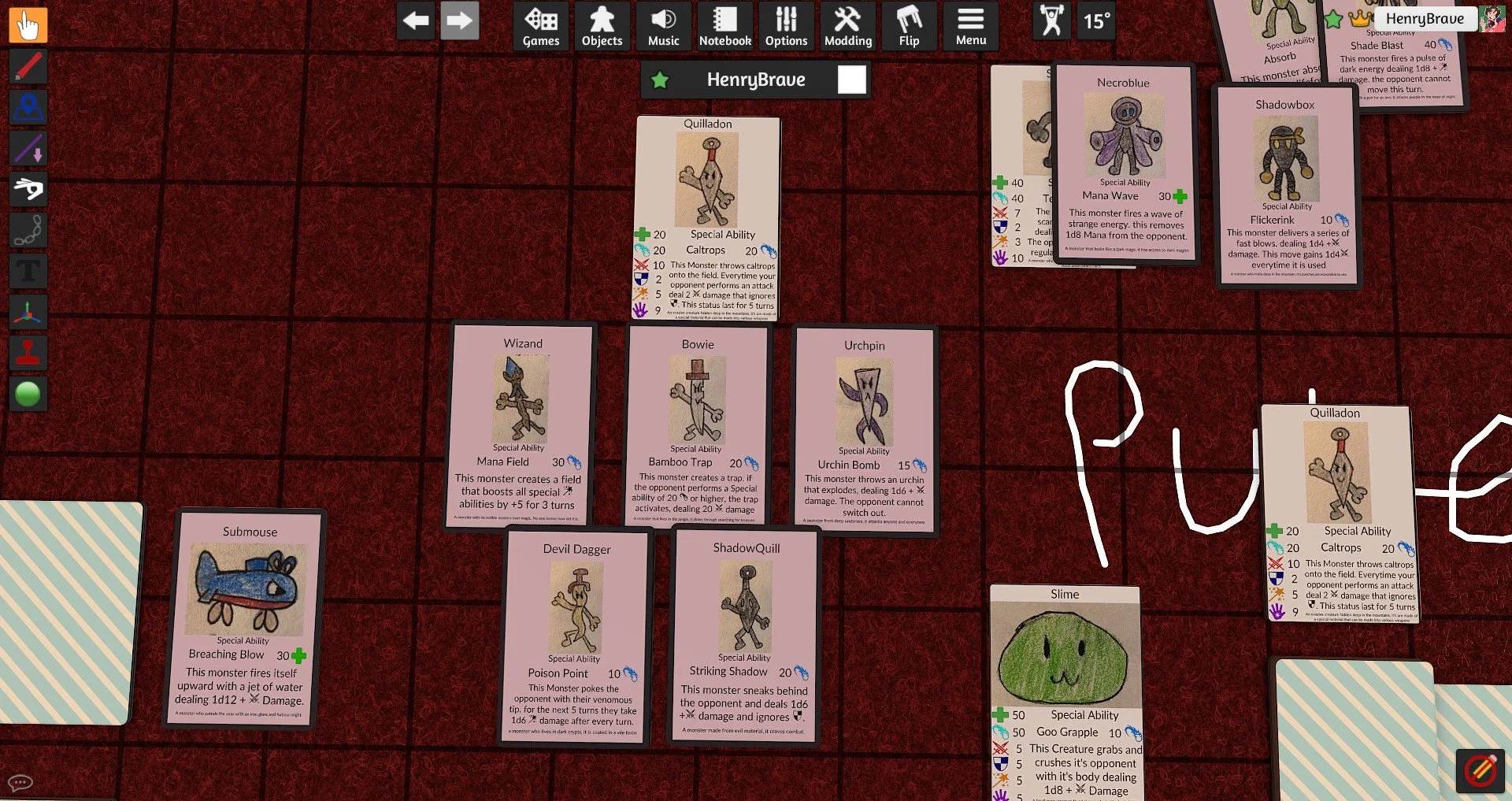
These are all the fusion monsters for the Quilladon monster card. Quilladon was intended to be the glass cannon of the game, capable of dishing out substantial amounts of damage but having to rely on a fusion to have survivability.
There are two key issues with this card line. The first being that several of its effects are set-play-based. Which means that, coupled with the already large number of stats the player has to track, the player also has to keep track of these additional card effects. This results in an overly high mental stack.
The other issue is that several effects run counterintuitive to the card's design, such as a support-based skill or a delayed damage type skill, which does not fit a card that doesn’t have much health to begin with.
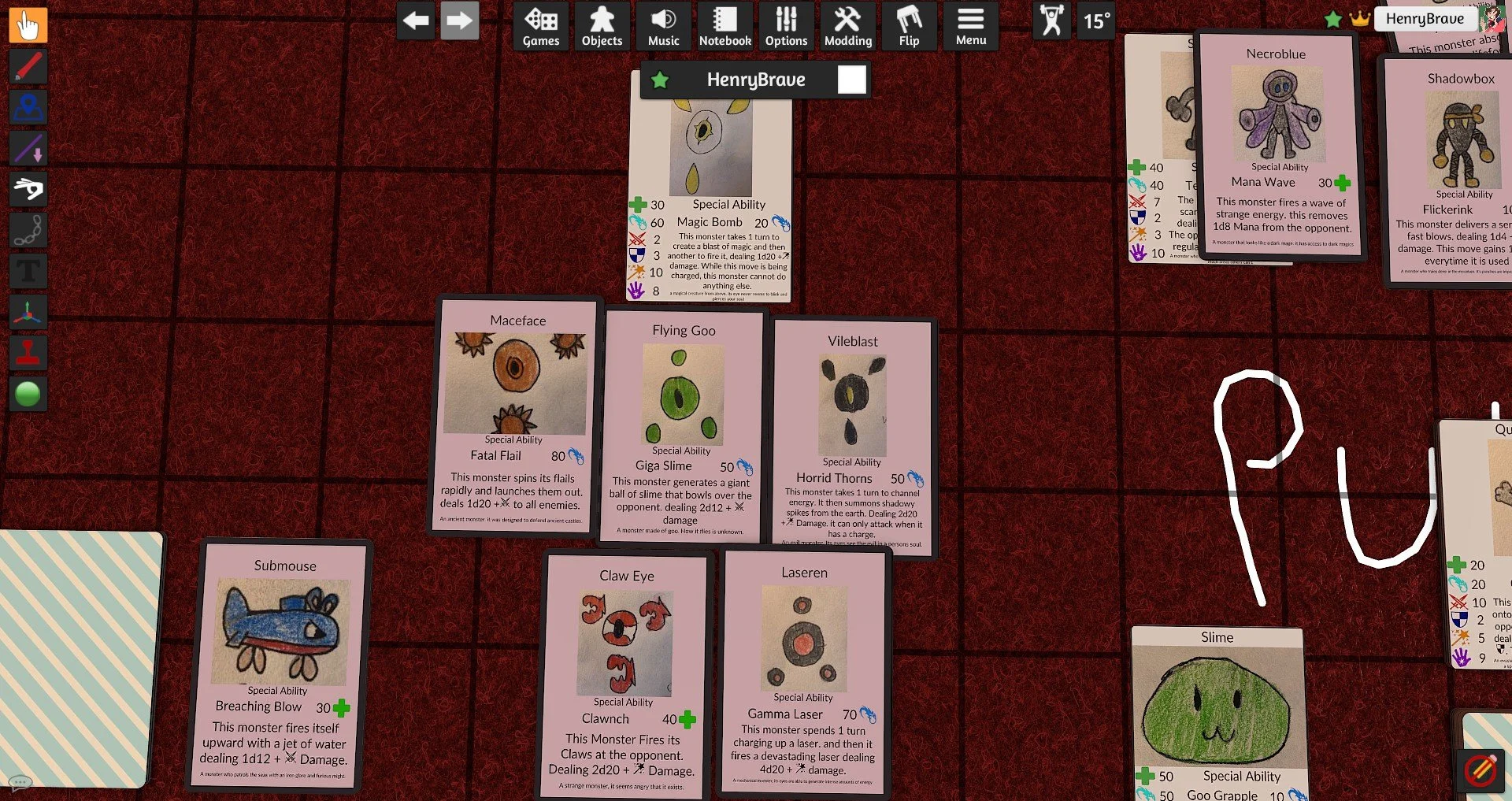
These are all the fusion monster cards for the Fry Eye card. Fry's eye was designed as the magic equivalent to Quilladon, including suffering the same problem as Quilladon in that they remain gimmicks, having moves that require an additional turn to charge up, but not having the health to survive it.
Many of these cards also have redundant card effects, since a fused monster is allowed to use the moves of the monsters that were used to create it. Meaning fusion versions of Fry Eye would have two moves that had the same drawback, but one with more payout.
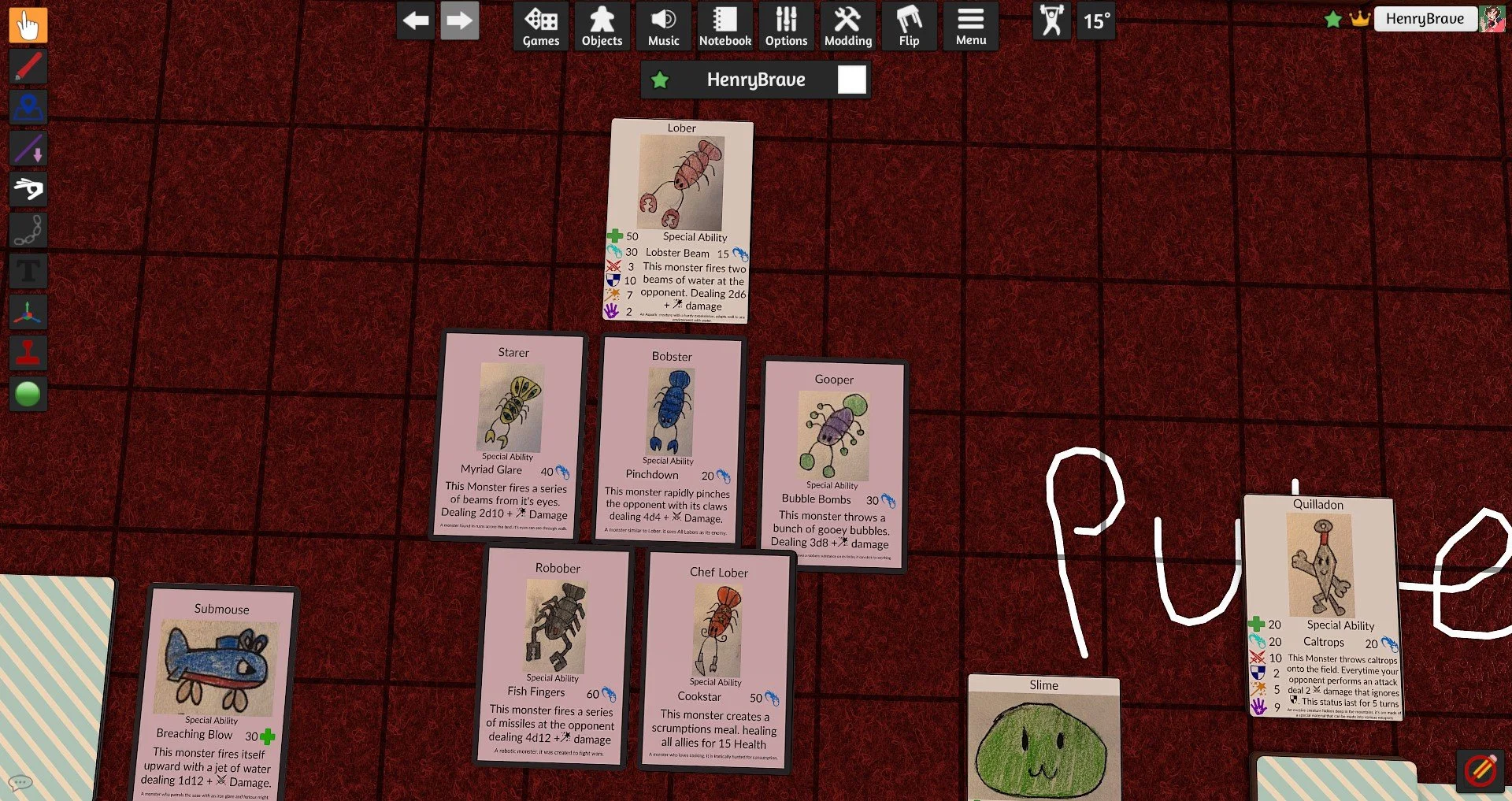
These are all the fusion monster cards for the Lober Monster card. Lober was designed to be the game's physical tank, with a large health pool and a high defense star. With many of its abilities also being generic damage-dealing abilities.
The problem, however, is that an overwhelming majority of the stronger fusion monsters deal magic damage, against which Lober has poor defenses. To make matters worse, it accidentally has the second-highest magic stat out of the purebreds, resulting in not having a clear strategy attached to it.
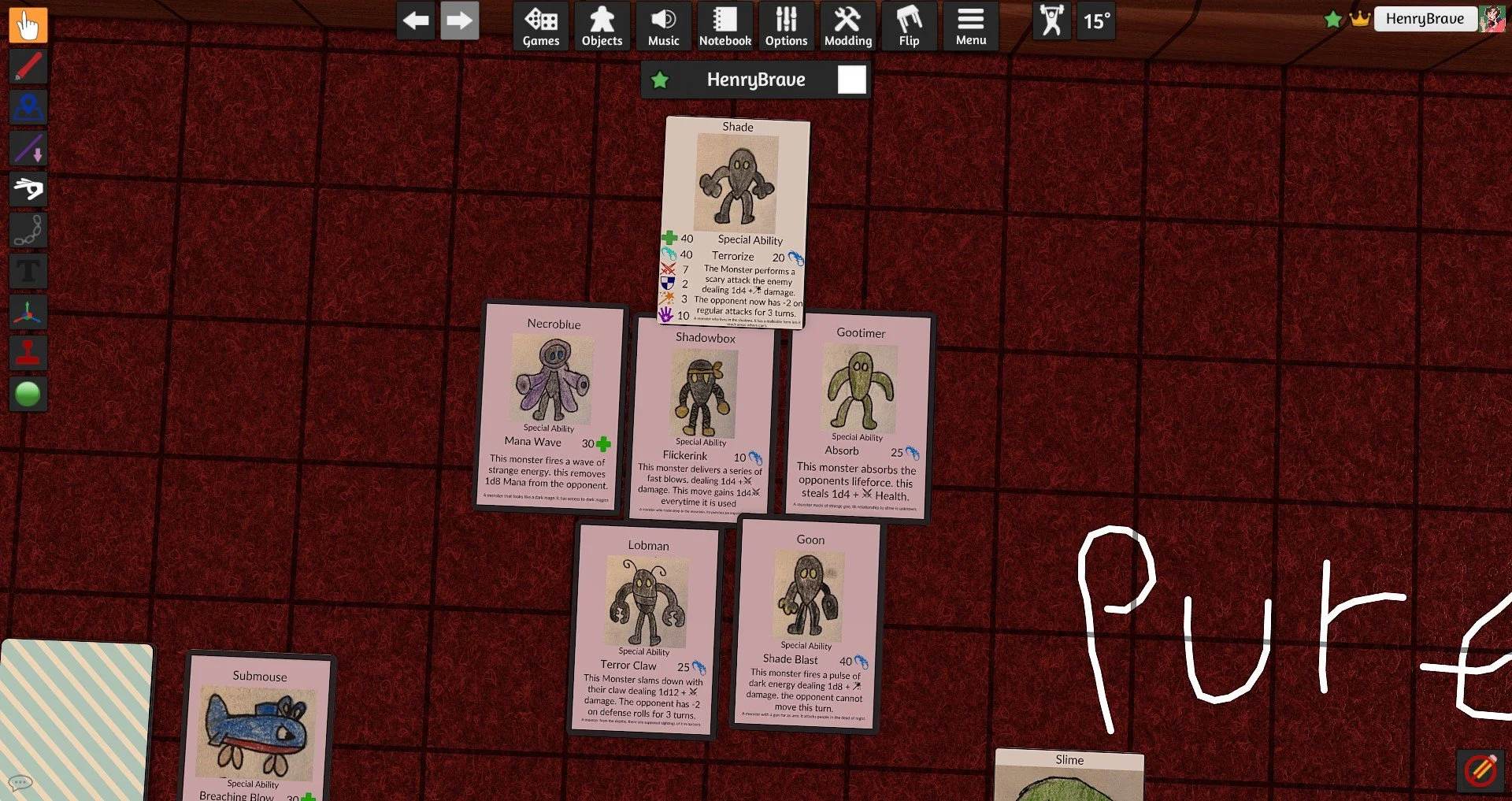
Seen here are all the fusion monster cards for the shade card. Shade was intended to be the magic equivalent to Quilladon, or at least, was. It ended up becoming a strange, worse version of Quilladon, state-wise. However, its effects spread better from its start than its counterpart's did. It even had better health, meaning it can take more hits than Quilladon.
In hindsight, if the two had their effects swapped, I think they would have achieved their intended effects much more greatly and turned Shade into a much better set-play-based monster.
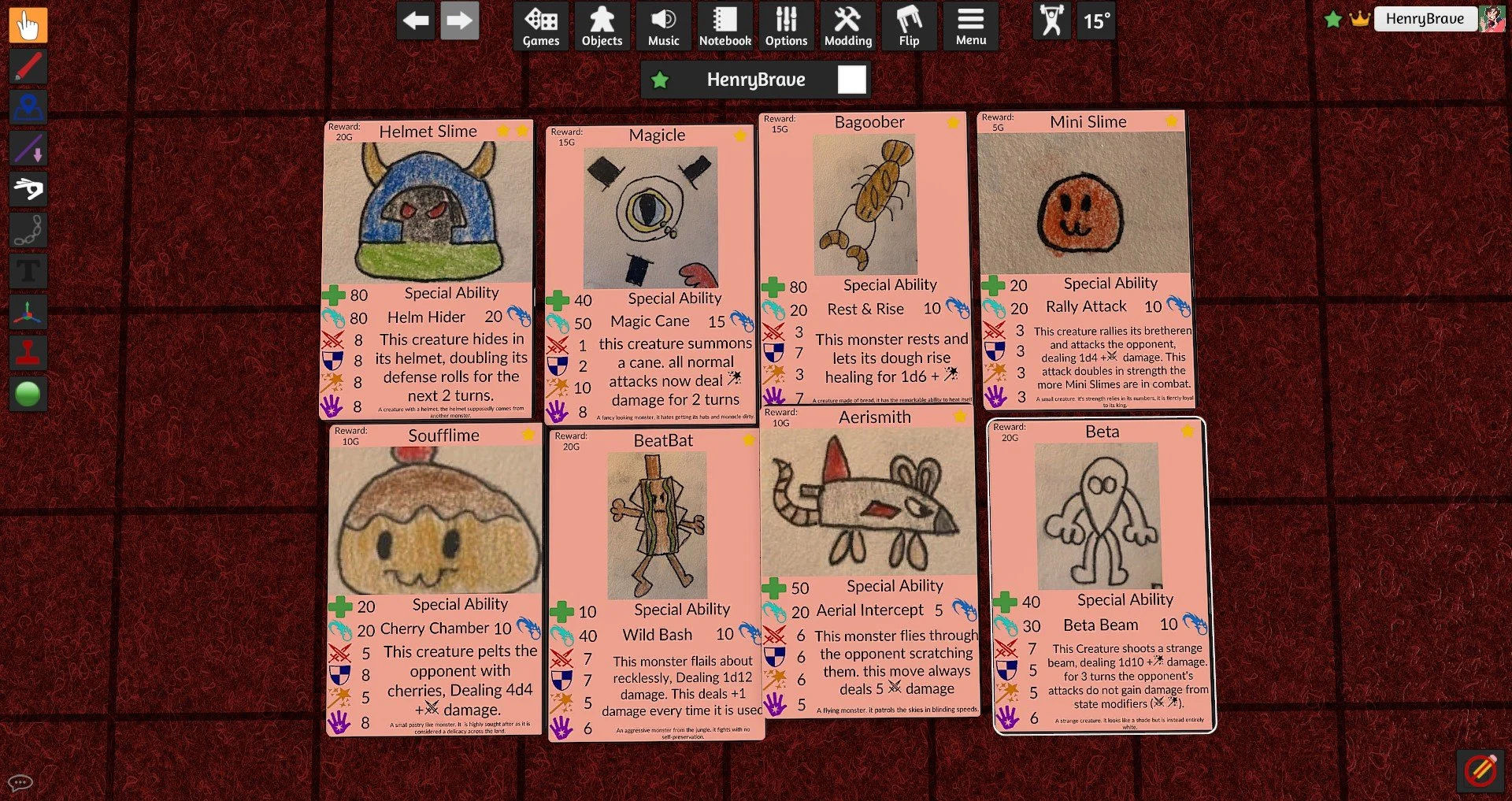
Seen here are the 1-star enemy monster cards the player would go up against. The way monster fights worked was that the player would encounter a set of monsters ranked by rating, from 1 to 3 stars. For example, the first encounter was entirely composed of 1-star monsters. Encounter four is composed exclusively of 2- and 3-star monsters.
Each of these monsters also had its own AI dictated by dice, with its actions determined by a 6-sided die.
The idea was that the player would shuffle the decks of each of the enemy monsters at the start of the game, meaning no two runs are the same. In hindsight, this was clever of me.
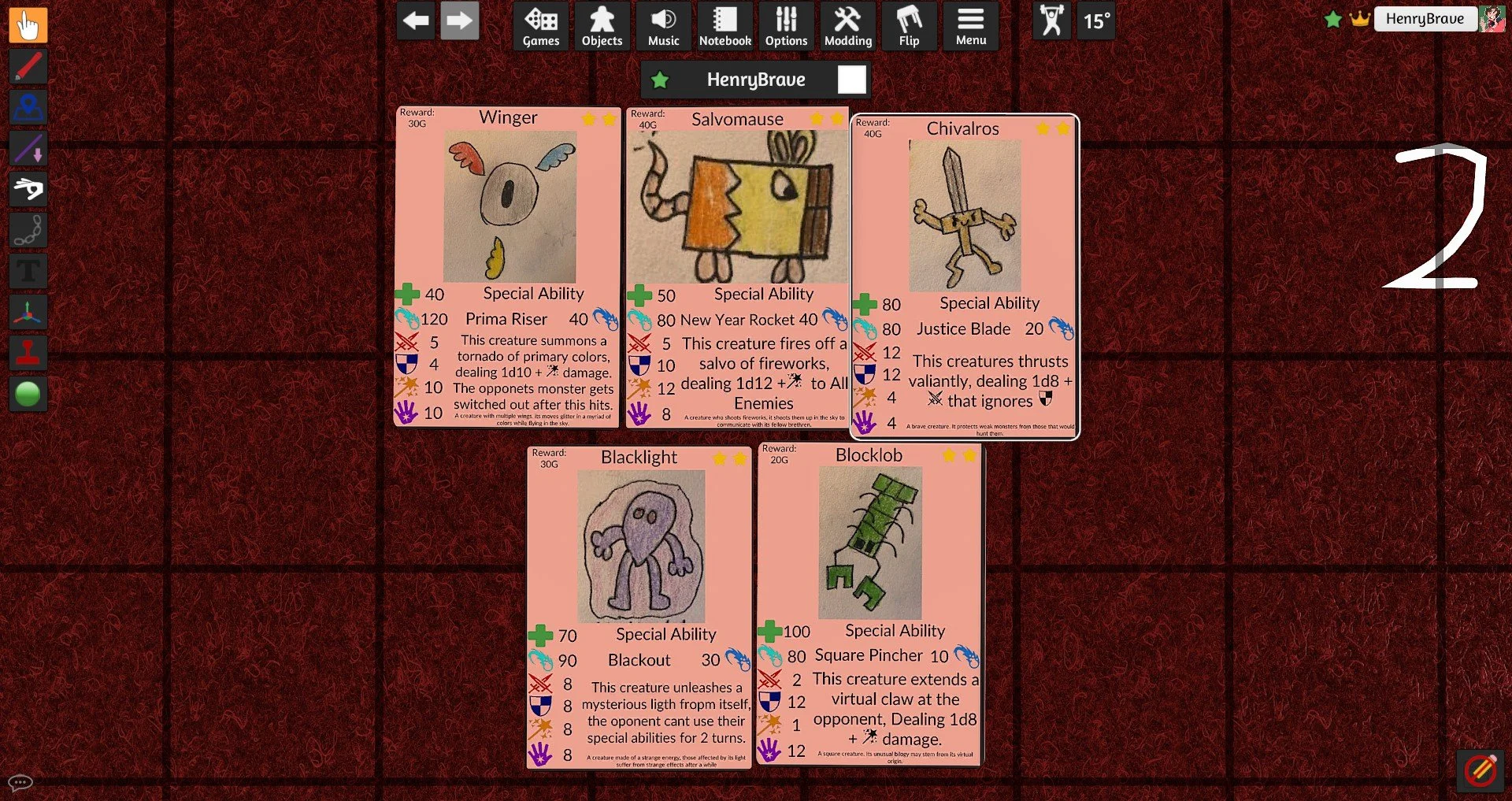
Seen here are all the 2-star monsters the player faces. Since this was a PVE game, and since the enemy monsters cannot fuse, I decided to have these enemies have stats beyond the normal amount possible for a singular monster to have
The two-star monsters are designed to be about on par in strength with a fused monster. I do think that I gave them too little mana to execute their abilities.
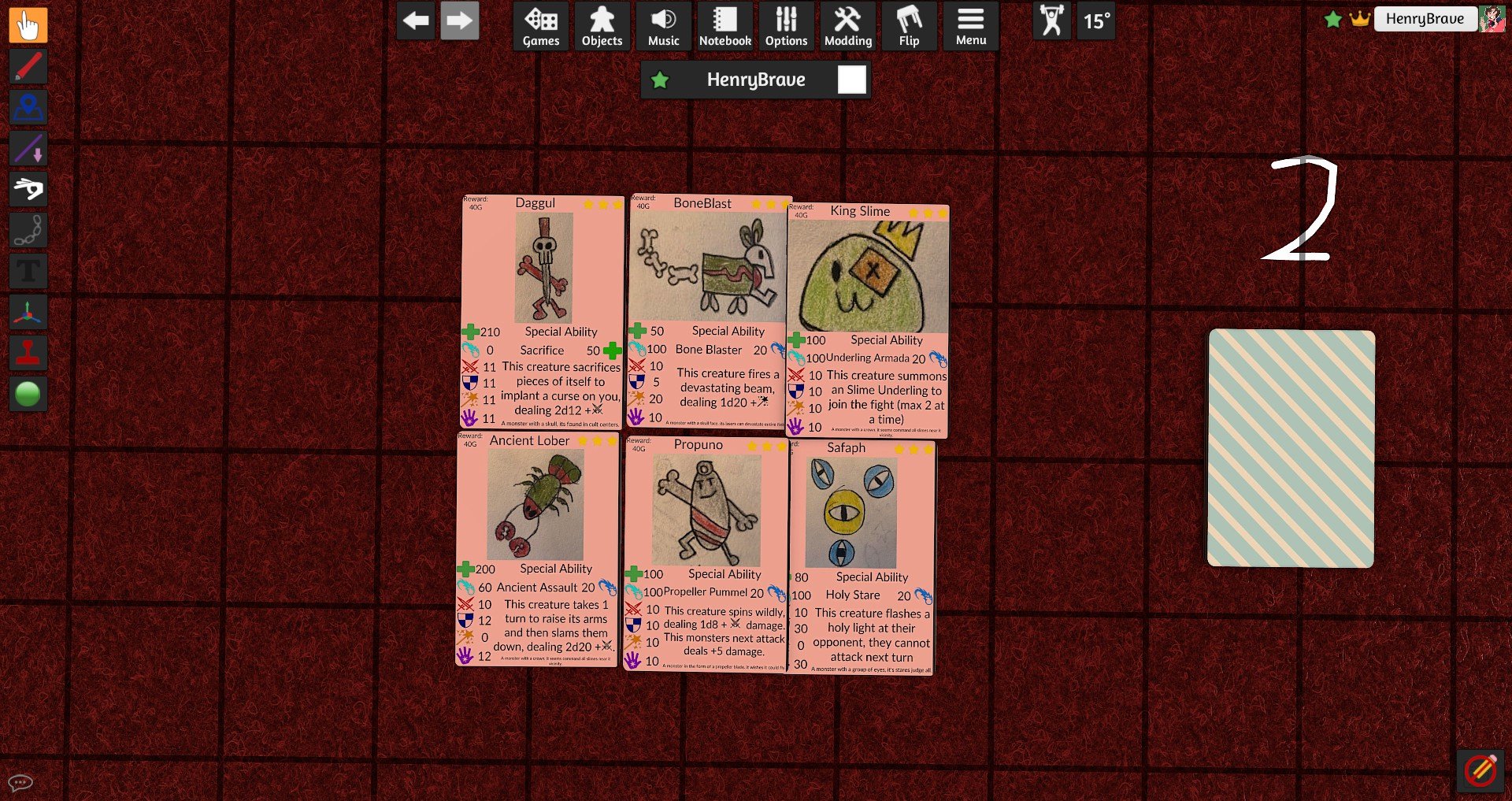
Seen here are the 3-star enemy monster cards the player can face. These are designed to be the strongest monsters the player faces in the game. However, I think some are outright unfair, specifically King Slime's ability to summon new enemies onto the field.
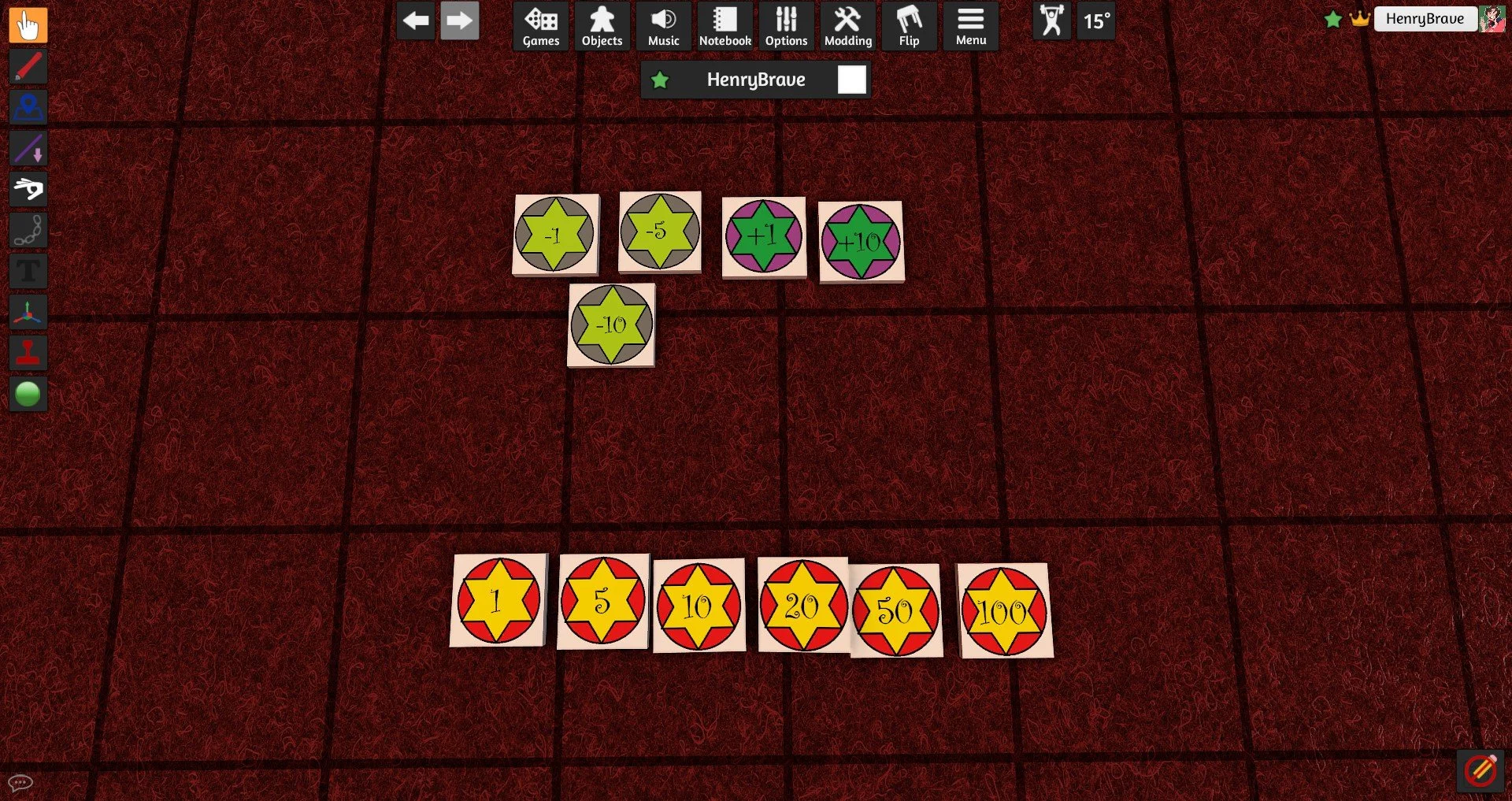
These are the damaged pieces that were designed for the player to keep track of. These were added late to development as a Band-Aid to the sheer amount of calculations the player must keep track of from monster to monster.
I would learn my lesson from this in later revisions of the game.
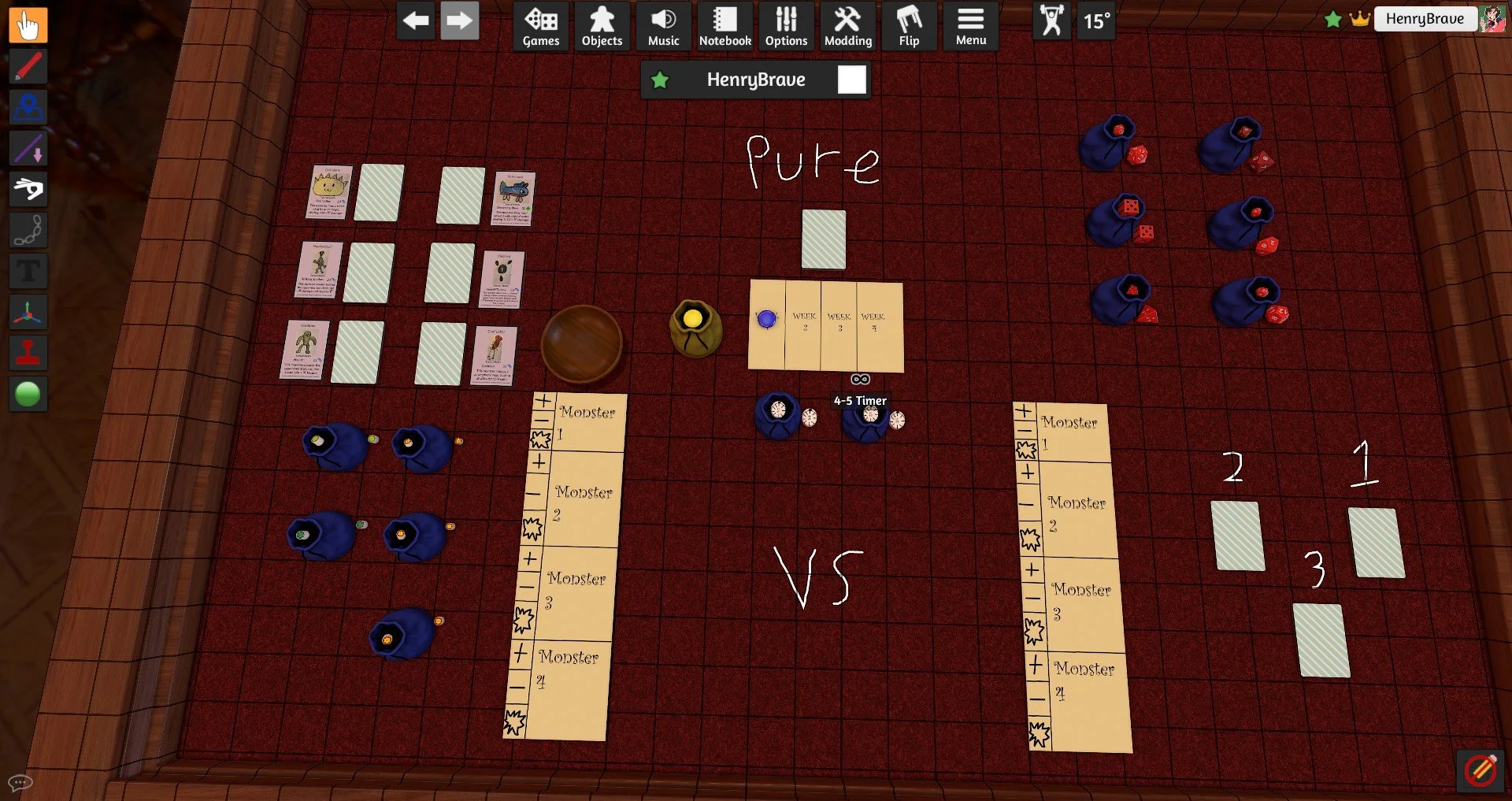
Seen here is the full game field, including the stable, which is the main place where the players would keep their monsters. I designed the table to be as accessible as possible, with all items that directly affect the player, such as the fusion monster cards and the damage counters on their side of the field.
However, I could have streamlined this further by moving the dice to the other side of the field as well.
The stable is also seen here, intended to be where the player keeps all their monsters. This is also where one of the game's big problems arises. Players controlled up to 4 monsters at a time. which meant players had to keep track of 24 individual stats at once—a frankly ridiculous amount.
Version 1 Gameplay Summary:
Version 1 of Fusion Fighters was a very barebones game, designed to be a PVE Experience. In this game, the player can acquire monster cards with Gold and take them into battle.
Each monster was considered 1 card. The game was divided into 4 weeks, with the player having a set number of actions before entering that week’s battle.
The main 3 actions were train, hunt, and fuse. Training acquired a new purebred monster card, with training being able to raise the stats of your already available monsters, and fusion allowed you to combine two monsters in your stable into a fusion monster from either of the two species you fused.
Originally, I had wanted to create a dynamic card system that would average out the stats of the cards you used for the fusion into the new monster, but this proved too difficult at the time.
As such, the fusion monster would instead have an added combination of the two stats. There was also a hard rule in that the player could not fuse two of the same monsters, encouraging getting a variety of monsters.
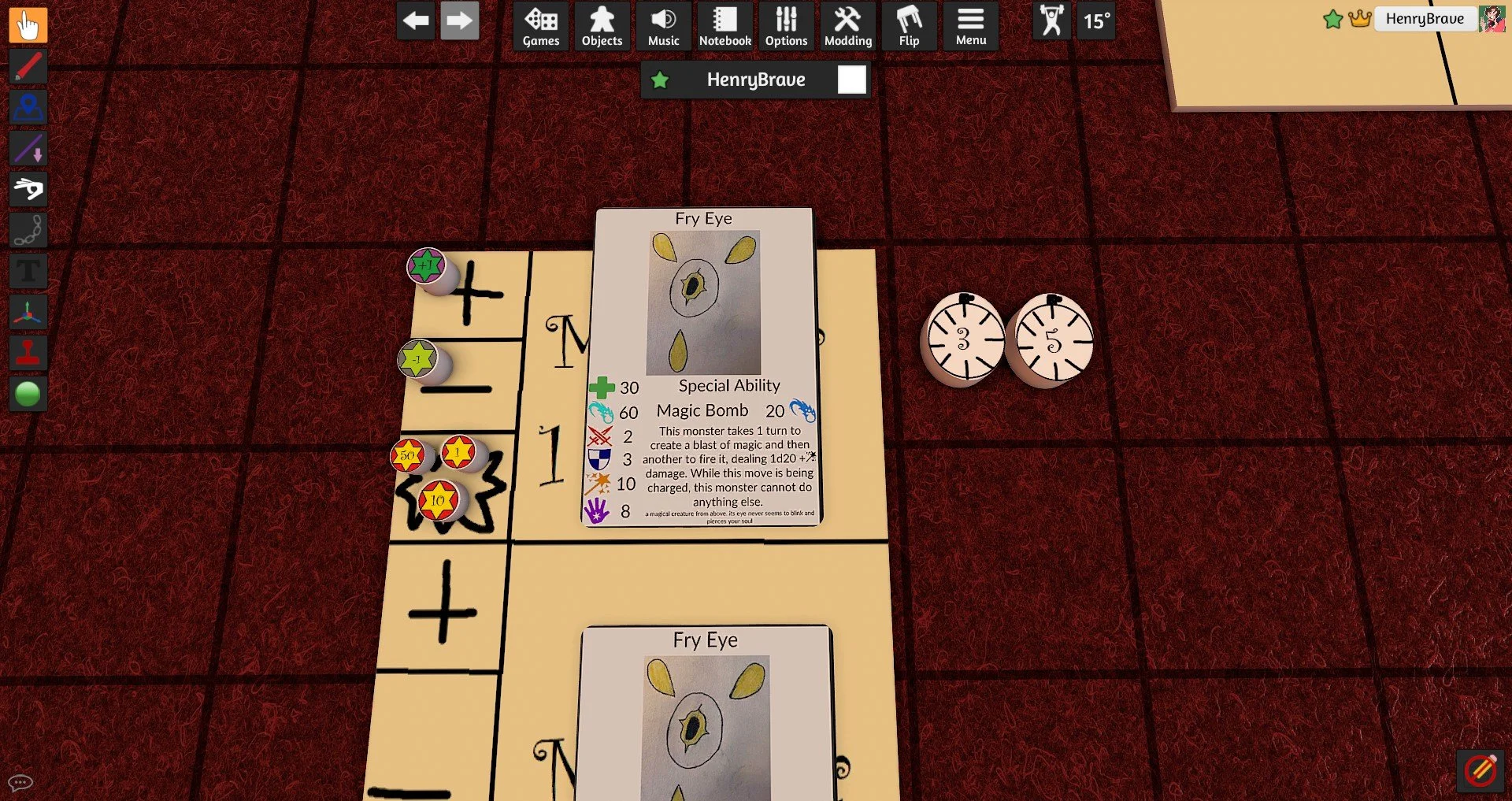
Version 2: Created Spring 2024
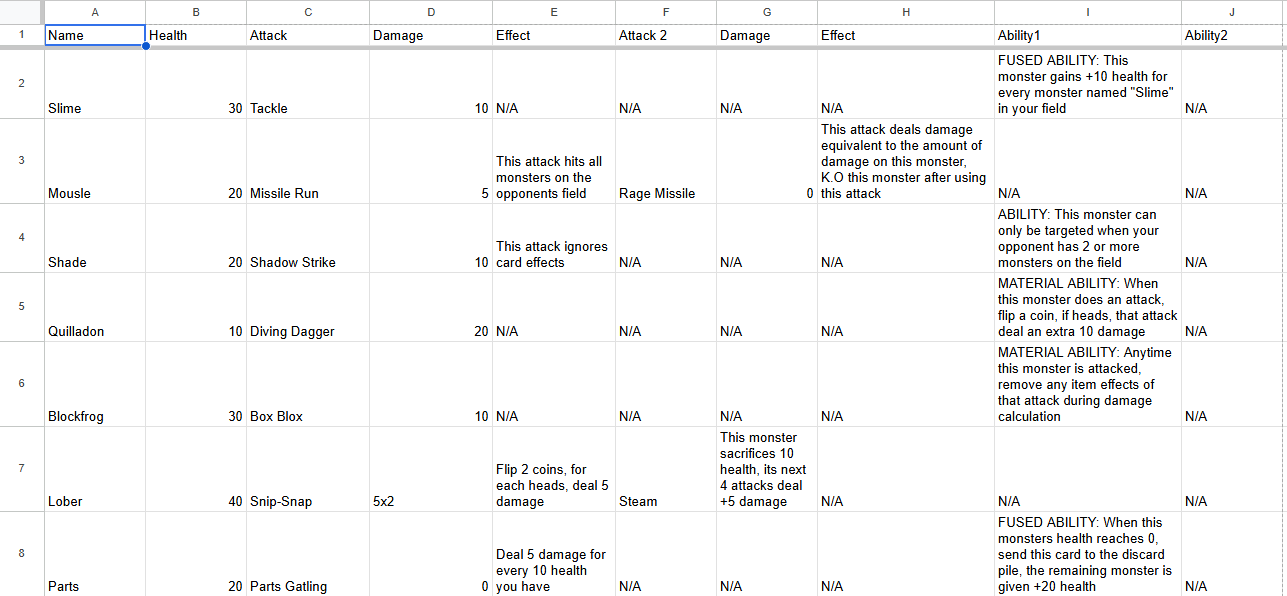
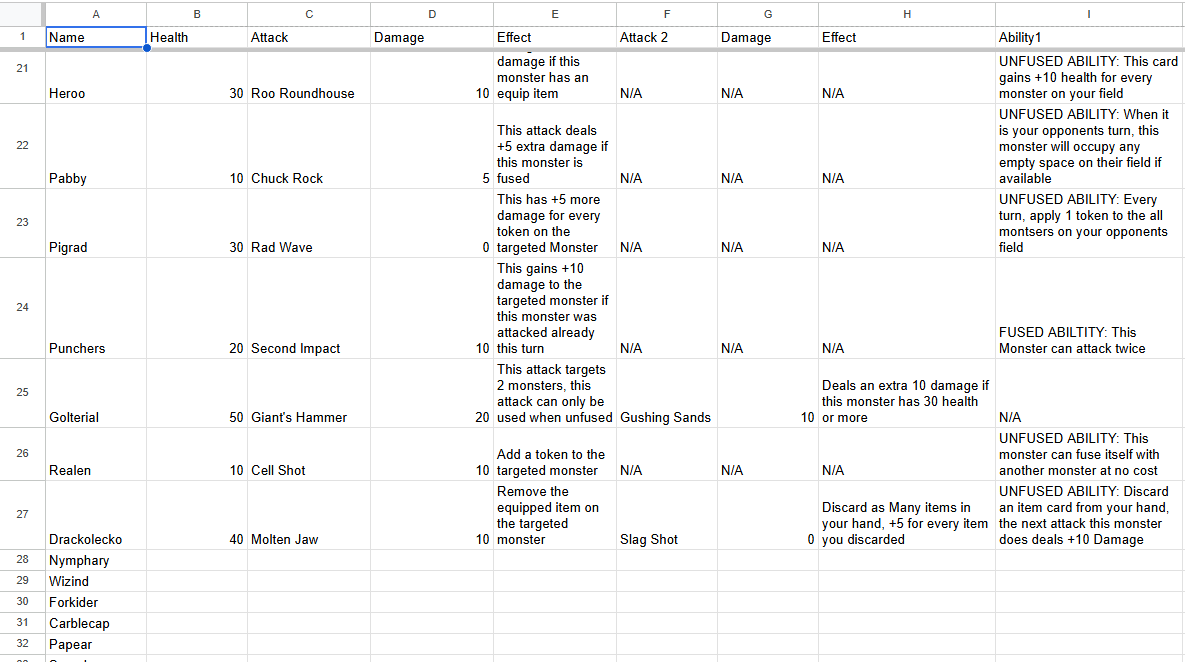
Seen here are various card designs on a spreadsheet. It was actually in this version of the game that I learned how to organize and structure spreadsheets for card design, a skill that would prove invaluable in later versions of the project.
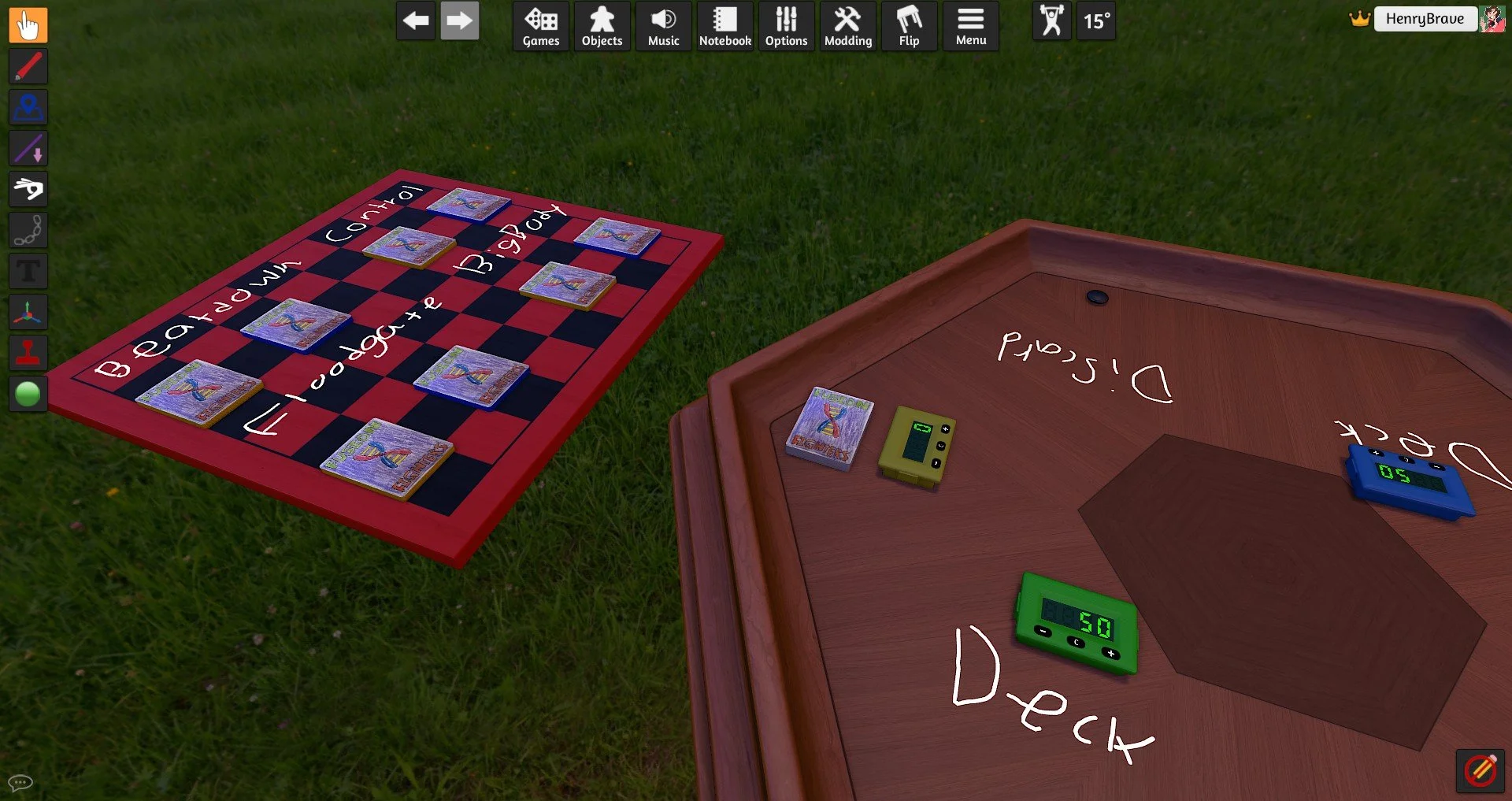
Cards were balanced around various card archetypes, specifically 4 key archetypes: big body, floodgate, beatdown, and control. With monsters designed to provide various sub-types of these 4 key archetypes
The problem, however, is that I had started designing card effects without even playtesting the core gameplay loop, which would come back to bite me later in the project.
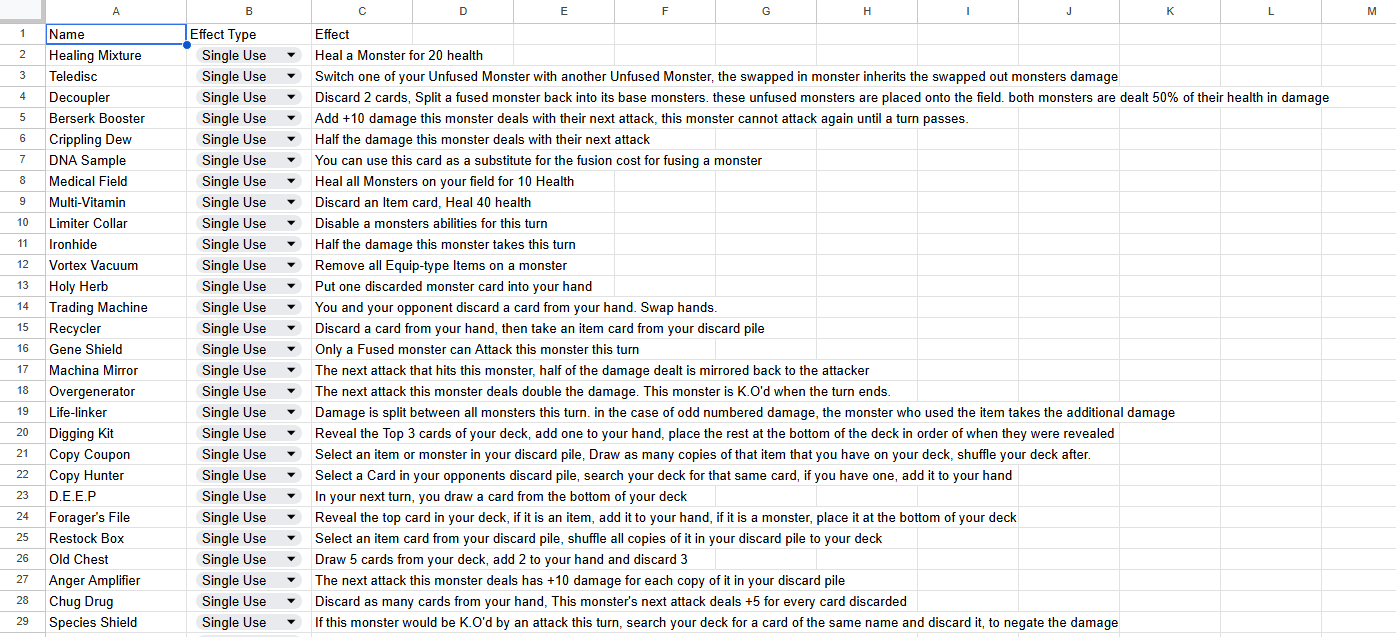
See here the various item cards I designed for the game. Each of these was intended to be a card that would help players achieve their own conditions or provide a unique method of play.
The majority of these were single-use cards that were played and then discarded; however, some were designed to be equipped and remain on the monster until its death or fusion.
I had designed over fifty of these cards, and I did not even test a single one before playing—a boldly foolish move from me.
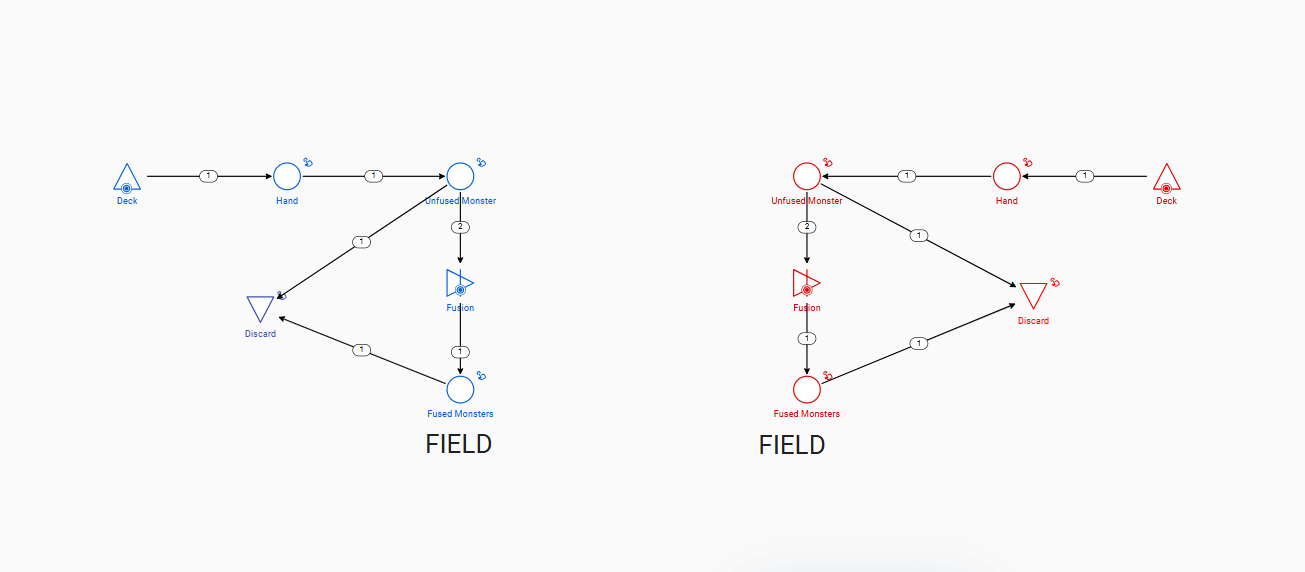
This was a simulation of the playfield I had created on a simulation website. This simulation was emblematic of the problems the game had at a fundamental level of design.
During a meeting with Richard Rowen, a professor at DigiPen, I discussed the mechanics with him, where he then showed me one of the core flaws with the fusion mechanic. For the game to be balanced, I would have to artificially limit the number of monsters the player could have in the field, but this would cause artificial ceilings in player expression and skill. However, if I didn't limit the number of monsters the player could have in the field, they could play wide and have dozens of monsters out at once without needing to use the fusion mechanic, which causes what is known as "degenerate play".
The other problem was that, due to insufficient testing, the game did not hold up under scrutiny. On a single Friday night at an IHOP with a fellow systems-design-minded classmate, the game had crumbled, and the project was abandoned.
Version 2 Gameplay Summary:
This was the second attempt to create the game, this time with the intent to create a pseudo-TCG.
Many of the concepts from the first version of the game would carry over or be improved in this version. In this game, the player would have a deck of around 30 cards featuring monsters and items.
Each monster card had its own individual status and card effects; this time, there was only one stat to keep track of: Health. Cards could also now have more than one effect and even have an ability, which is a passive ability that would activate under certain conditions.
Also new to the game were item cards. These item cards were intended to be like Pokémon items, additional items the player could use to give themselves an edge in combat.
One of the actions the player could also perform during their turn was fusing two monsters to create one, like how the action worked in the first game.
One key difference, however, is that fusing costs one monster from the player's hand. The other key difference is that there would now be a way to determine how monsters would interact with the fusion process, with some monsters activating abilities upon fusion, or being used to pay the cost to fuse the monster (labeled a Material Ability).
Each monster also had a general victory point value of 1, with fusion monsters being valued at 2 victory points. The goal of the game was to defeat enough monsters to achieve 14 victory points.
Version 3: Created in Spring 2026
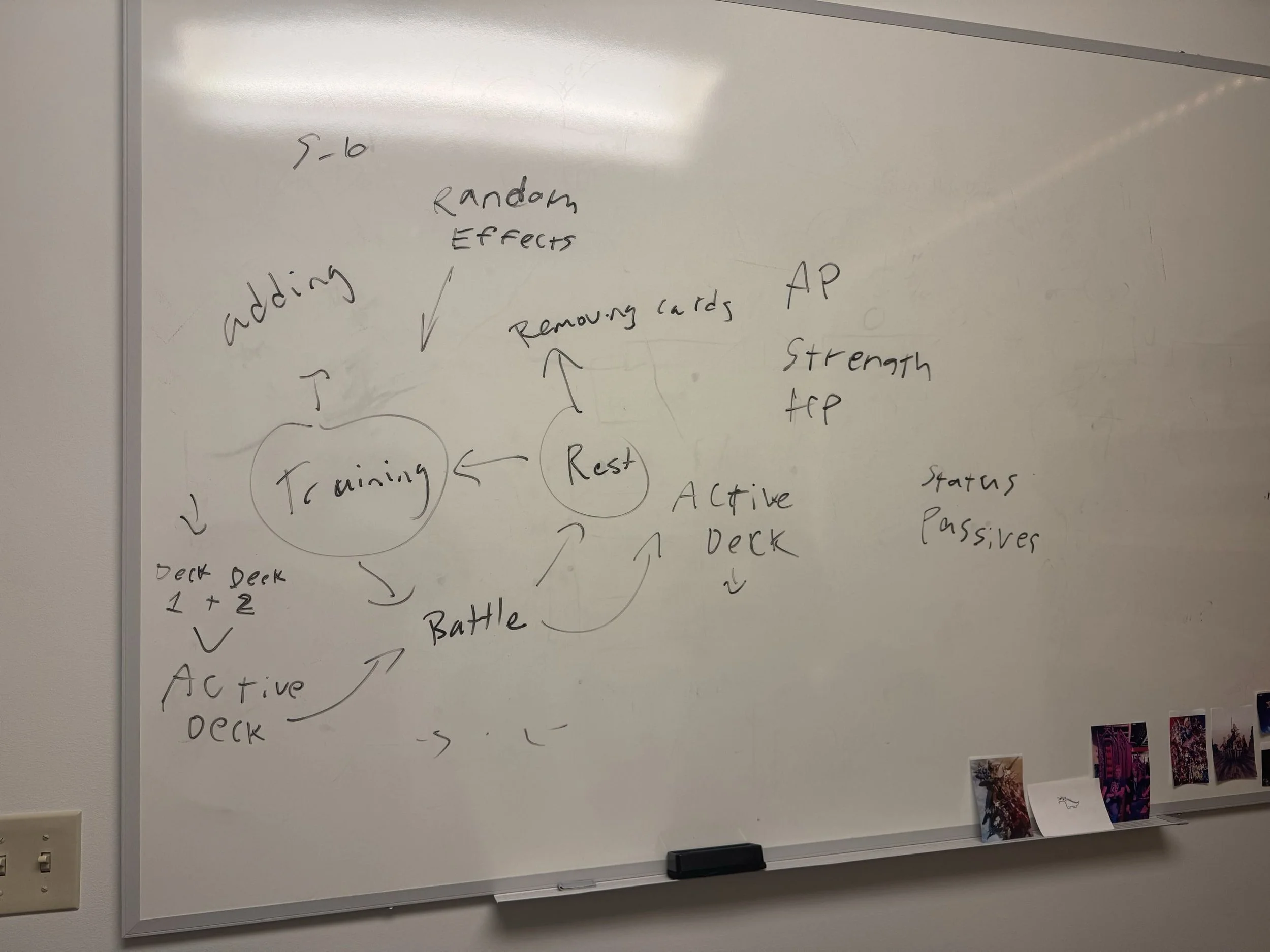
Shown here is the initial concepting of the game, something I had not done before with the previous two versions. Here, I was concepting the game flow and the key stats that would be part of the game.
From here, the idea of removing and adding cards to a deck became clear.
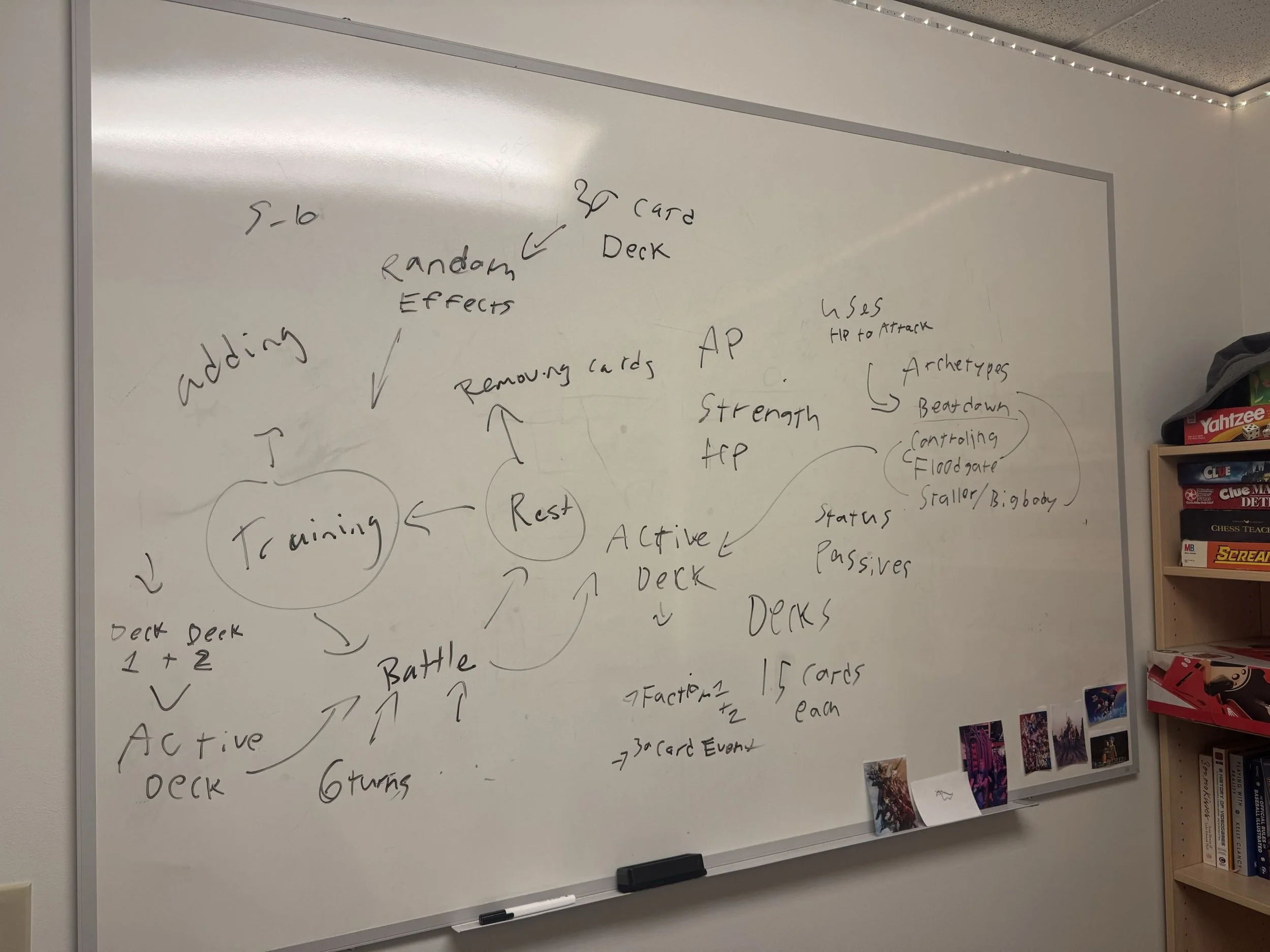
Here is the full concepting phase on the board. Seen here now are various additions and speculations on aspects of the game, including how many training cards should be available and what the 4 key archetypes would be designed to be.
There was much deliberation, but I eventually landed on the 4 key deck archetypes: Beatdown, Control, Floodgate, and Big Body.
Concepting The Cards

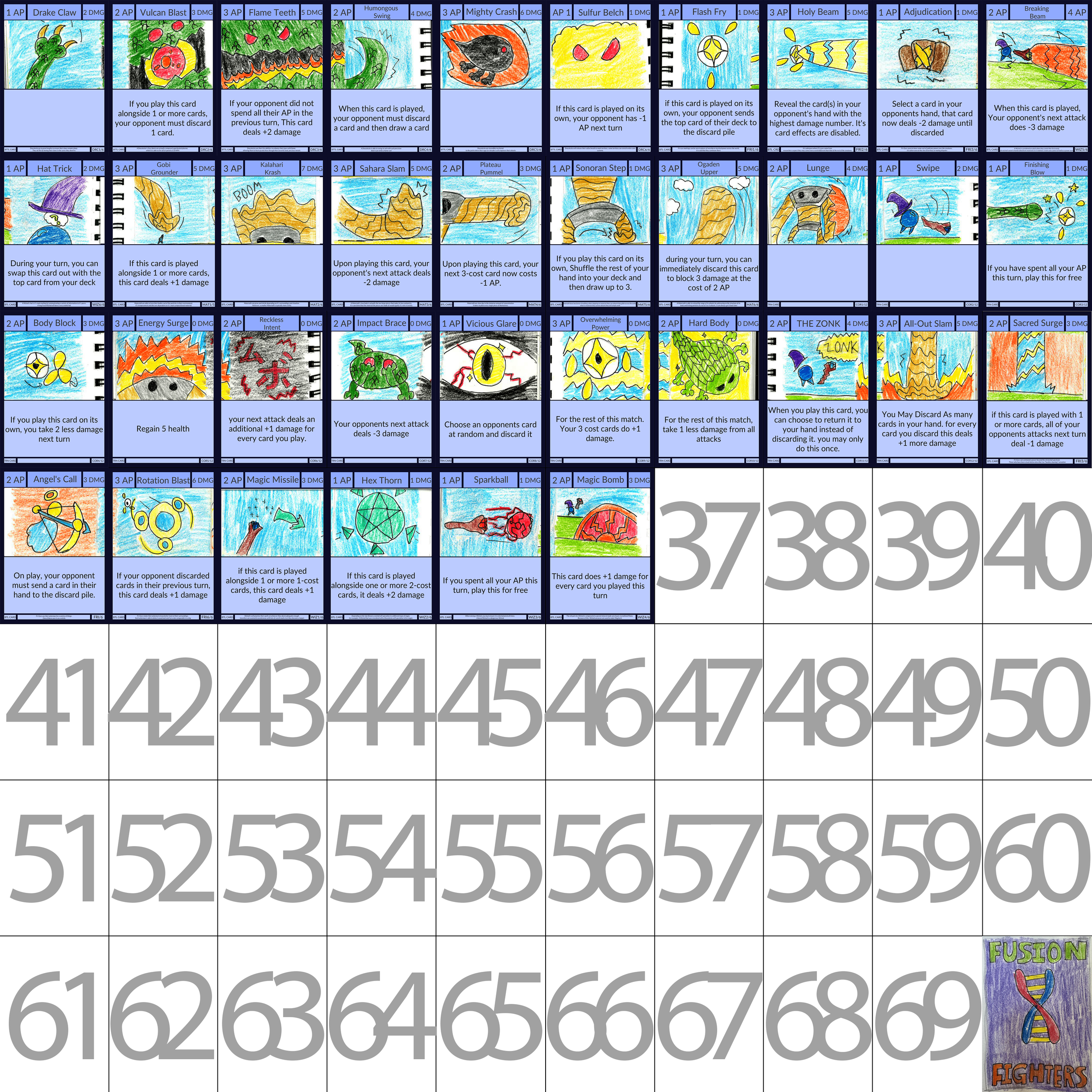
Seen here is part of the spreadsheet that was used to design the cards in each deck. These are the cards for the beatdown deck, Dracolecko.
Dracolecko was designed to be a highly aggressive deck that punished opponents for playing defensively, with cards such as Sulfur Belch and Flame Teeth as prime examples.
Dracolecko is also the only deck with two non-effect cards. This is due to its sheer strength in its effects, as well as its access to 3 cards at each AP level.
Great care was taken when designing each effect, using formulas to investigate how much impact each effect had, which can then be seen in the normalized damage section
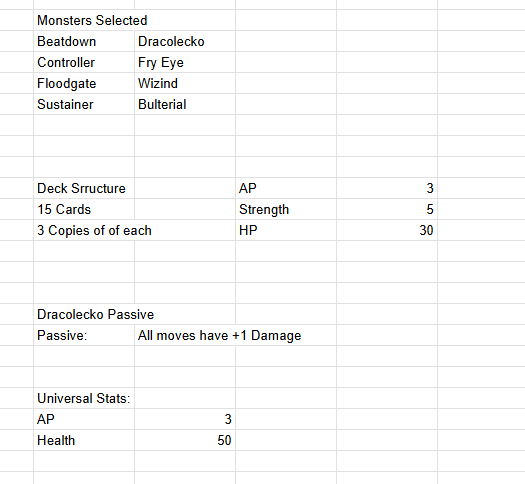
Seen here are additional speculations and ideas that were drafted or used in the spreadsheet. As seen in the previous version, I had a wide variety of monsters at my disposal; as such, I selected 4 that I think provide the most visual value to the game: Dracolecko, Bulterial, Wizind, and Fry Eye.
It was decided that each deck should have 3 copies of 6 cards to provide sufficient variety while keeping each deck lean, so that combined decks would be around 34-36 cards each, a reasonable amount, like that of the second version.
Also seen here is a currently unused idea for passives. Passives were meant to evoke the idea of abilities in Pokémon or talents in Monster Rancher and served as a way to further specialize in each deck.
Also seen here are a couple of Unused or now heavily modified stats. Strength was intended to be an attack modifier applied to cards, like version 1, but this was quickly scrapped after it felt too unintuitive to incorporate. AP and HP are the two universal stats, with AP being unchanged but HP having been modified from version to version between 30 and 50 HP

These are the cards designed for the control deck, Fry Eye. The deck's conceit is that it's meant to have small numbers and play defensively by manipulating the player's hand and deck. Many of its effects are designed to remove cards from play before they are used.
I think in retrospect, however, many of these card effects didn't perform as well as I desired them to, since deck outs were not a thing in the game.
This was also the most problematic deck in terms of the number of effects to keep track of, which was one of the main criticisms I received in feedback. This will be resolved by reworking effects to be more instantaneous and by introducing an "Active Zone" where players can place cards with active effects until they are resolved.

These are the cards designed for the floodgate archetype, Wizind. This deck was designed around cards with low individual power, but the ability to combo more easily. Barraging the opponent with a bunch of small, stacking points of damage.
This proved to be the most satisfying deck to many of my play testers. This is especially true because it allowed them to play at least 2 cards per turn, which, in a game where hands are 3 cards, is huge.

Seen here are the cards designed for the Big body archetype, Bulterial. Bulterial was designed to hit with big numbers, featuring the only 7-damage card in the game. But the idea is that they hit the slow lane. Only being able to come out with 1 card at a time unless through card effects.
This is why half of its cards were 3-cost cards, since there would be card effects that would reduce their cost, have an alternate, weaker effect at a lower cost, or allow for reshuffling of the hand.
The idea was that it was a very self-sustaining deck with a clear weakness: its speed. That could then be supported with one of the other decks.
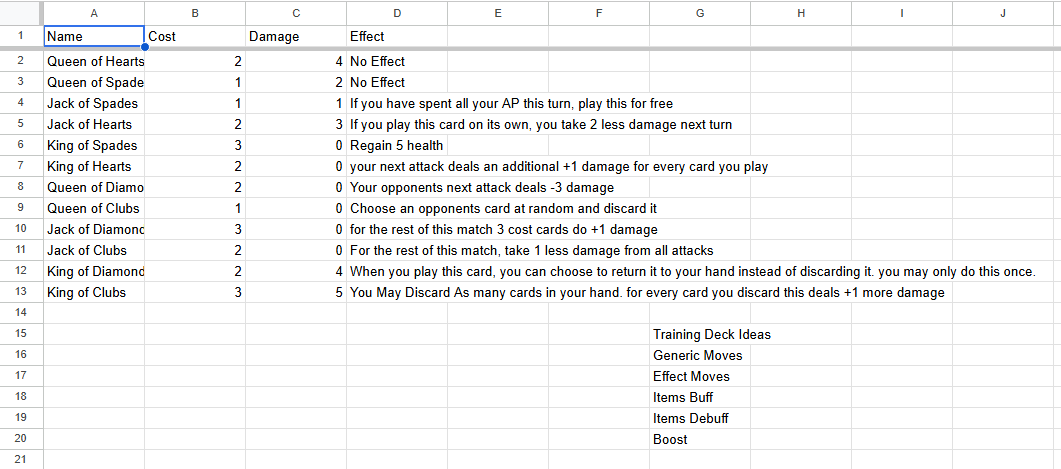
Seen here are the training cards I designed for the training phase
Training cards were designed to be generic benefit cards that would be nice to have in any deck
Some cards, however, were intentionally designed to favor some archetypes over others slightly. Such as some cards having greater synergy with small-number decks or big-number decks.
This was a highly interesting field to design in for that very reason; creating generic boosts that would help with deckbuilding proved to be a particularly challenging one.
Creating a Physical Prototype
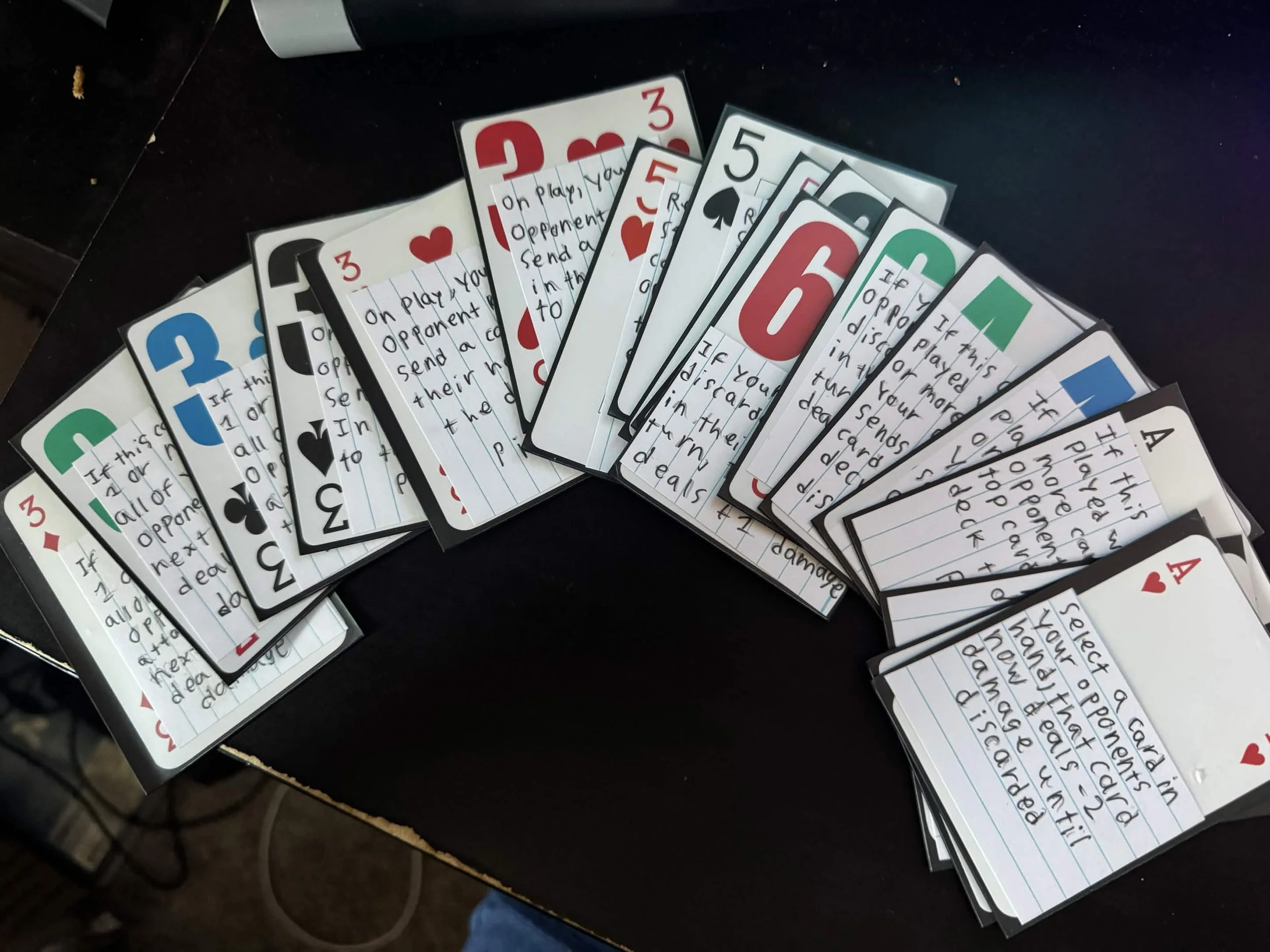
Seen here is a spread of the actual physical cards I used to test the game
I tested the game by first identifying the core combat loop's even functions. I did this by creating two decks of identical cards, then refining the rules and combat numbers from there.
I then introduced the milling system, where the player removes 3 cards from their deck at the end of combat. This proved to be a really engaging mechanic to work with, as not only did it introduce deck variety over time, but also reduced first-turn advantage.
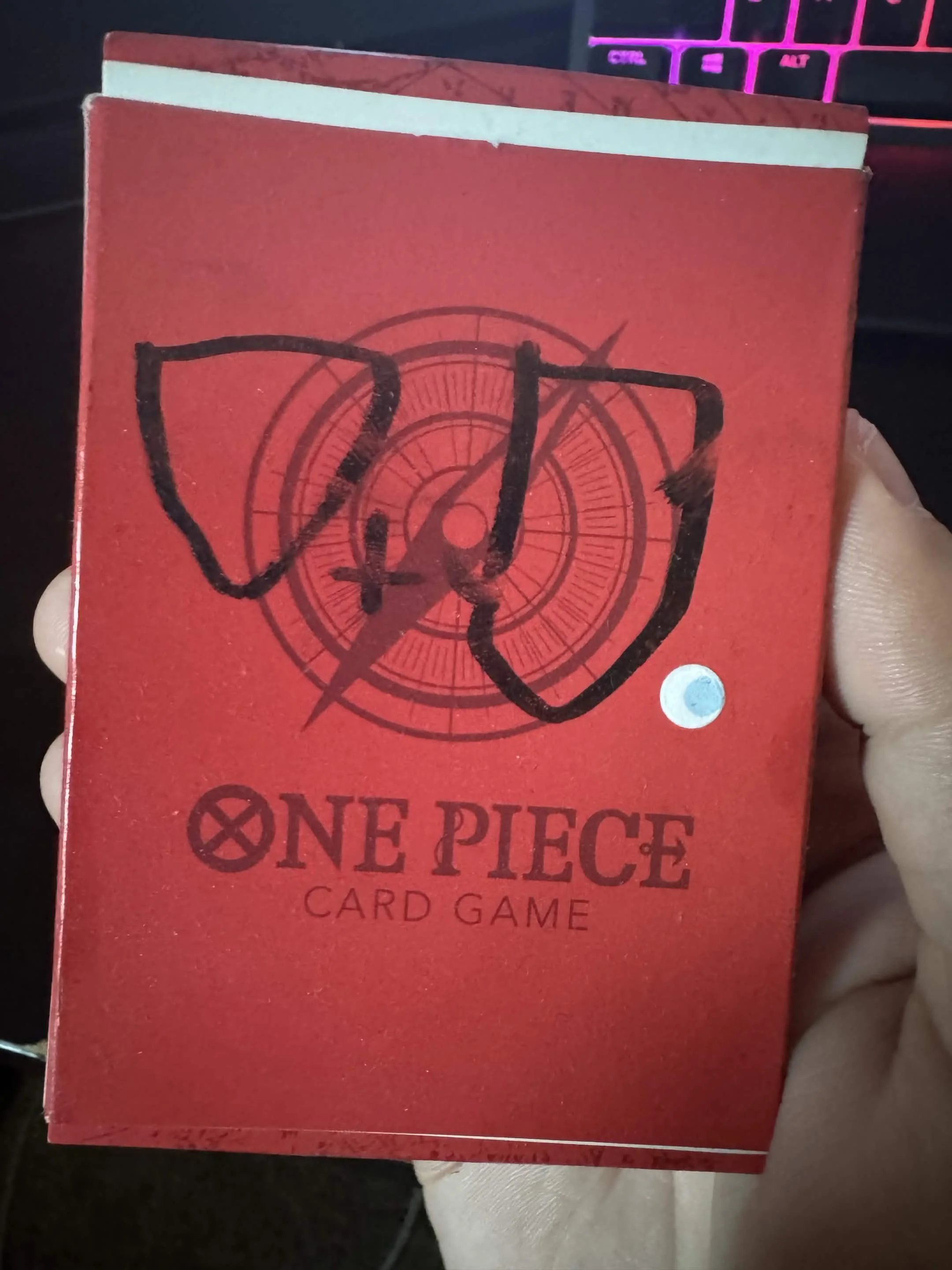
Here is one of the boxes where I kept one of the many decks I used for testing. Once it came time to design the major archetypes, I created 2 copies of each deck in physical form. This was done to ensure both players had full access to each archetype and experiment.
This was the most playtested physical version of the game, which allowed me to iron out the deck's complete archetypes.
To distinguish between decks in playtesting, I gave them different colored card sleeves to determine player color and then gave each card in the deck stickers to individually identify them
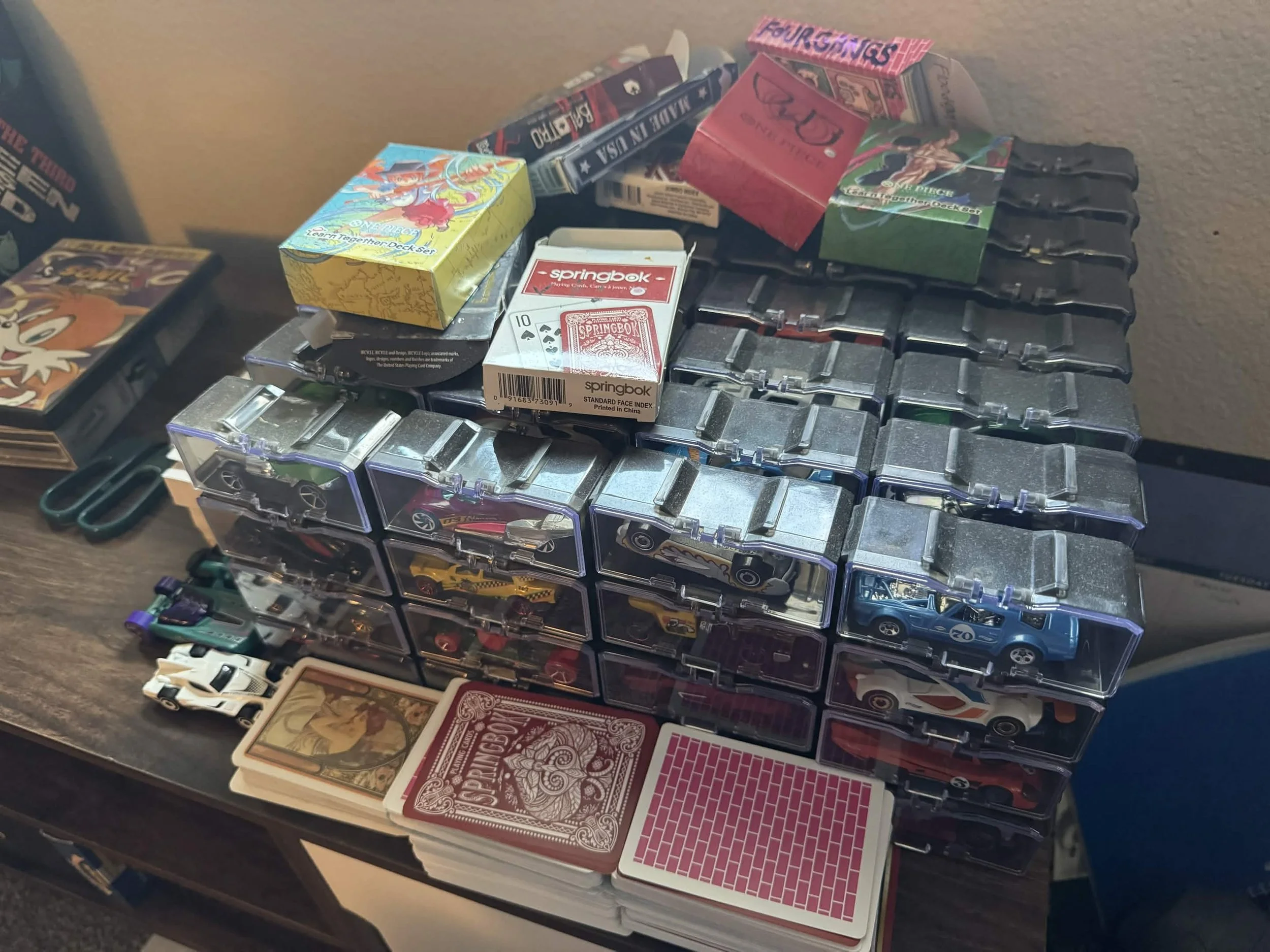
Here are all the decks I created. By the time I had created all these decks, I had begun to incorporate card effects into the game, meaning each card was given an additional piece of paper that dictated its effect. This is how I would playtest card effects in the physical edition. Just below is also the set of face cards used as proxies for the training cards. Allowing for the full gameplay loop to be tested sequentially.
Building a Digital Prototype
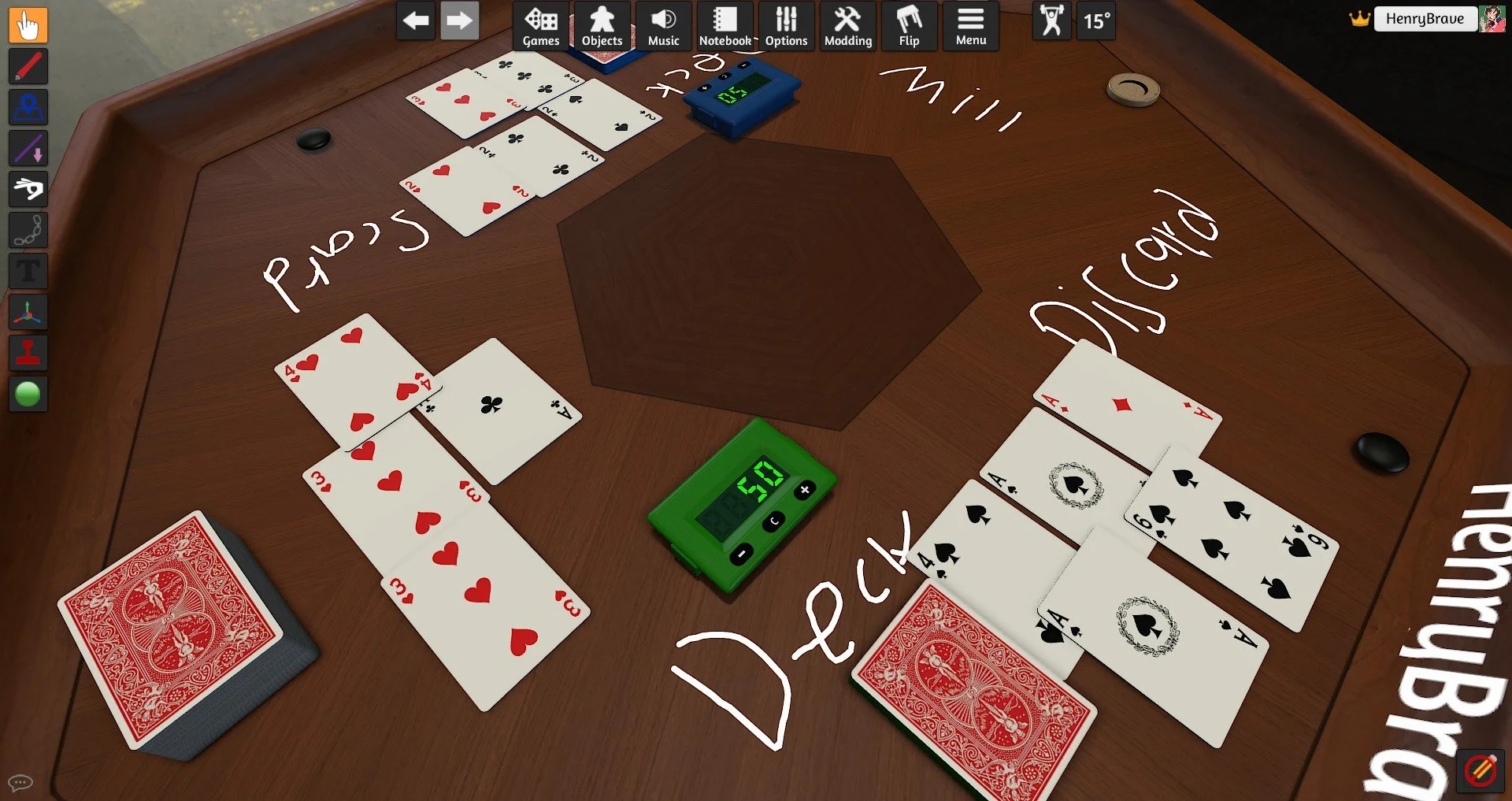
Seen here is the first digital version of the game. It was designed for rapid-fire testing with other online players. This specific version only included the original deck, which included the beatdown and floodgate decks. This version would inform many future design decisions, since it and its updates would be the primary form of playtesting.
Throughout the development of the game, I developed a workflow, which I have dubbed "Onion Method". The idea behind the onion method is that, when designing a game with multiple concepted, interlocking mechanics, I begin with the game's basic features and test them until I'm comfortable. I then add the next "layer" of mechanics and playtest those two mechanics together until comfortable, and repeat the process until I have fully incorporated the physical game. You'll see pieces of this method throughout the remainder of this page.
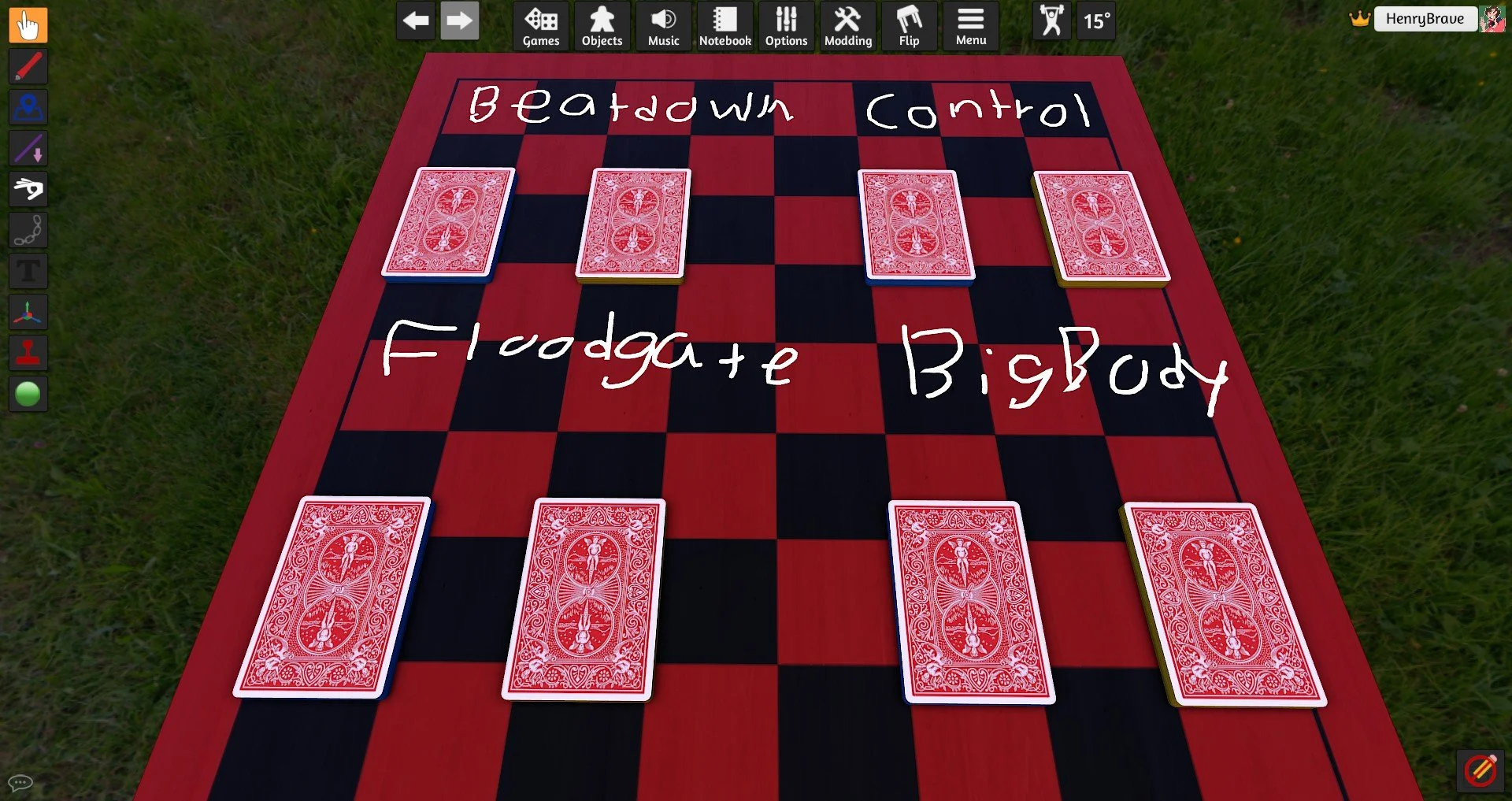
Here is the first major version of the game, featuring each major deck archetype. This was used frequently to test the various archetypes and determine whether their damage and point values were correctly adjusted, with many balance changes stemming from it.
To make it easier for players to playtest, intentionally color-coded each deck so players could more easily tell whose cards were whose.
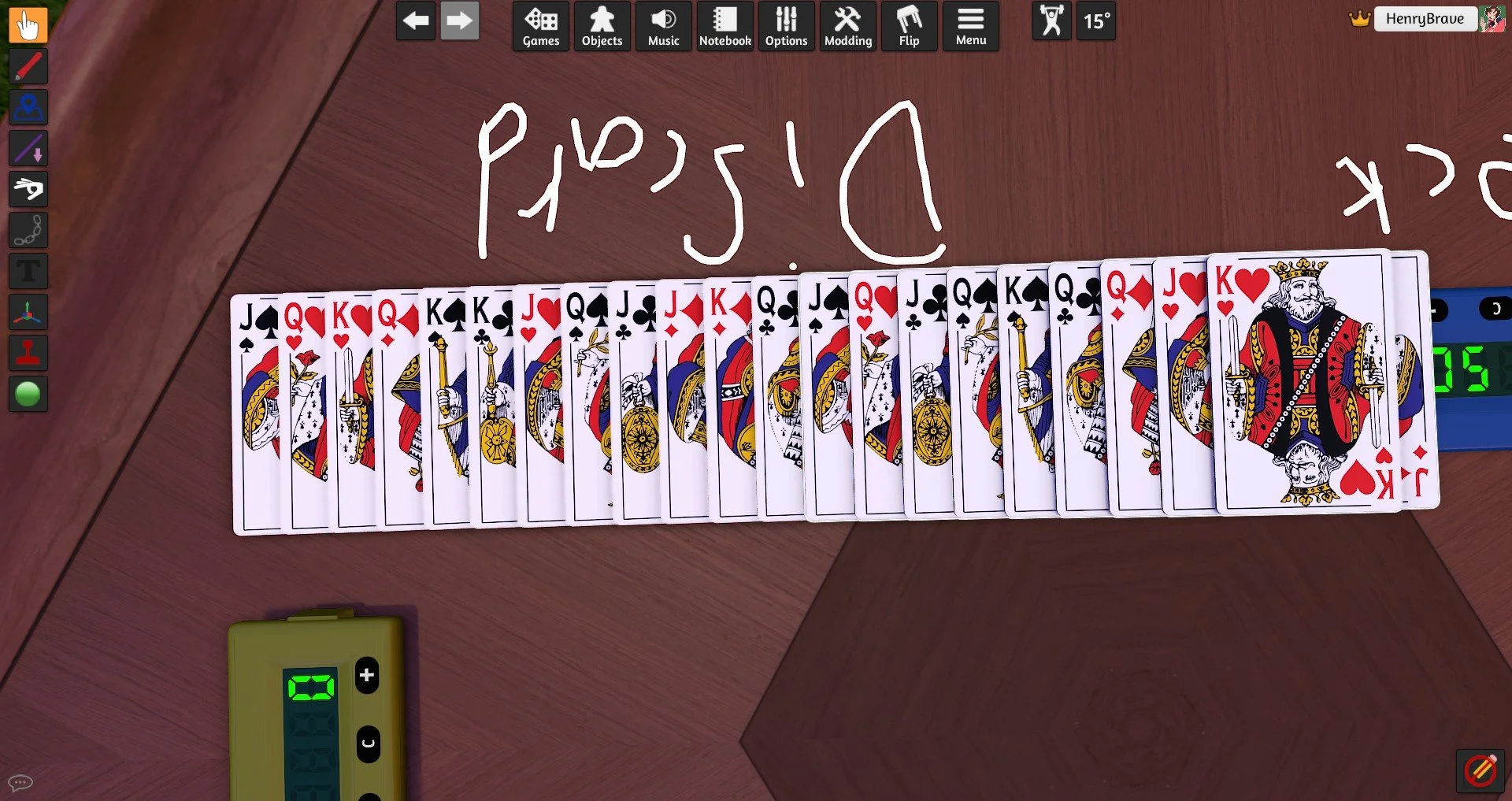
Seen in this spread are all the various face cards used for this version of the game. Face cards were used to represent the various trainer cards I had designed and tested.
The logic behind this decision was that number cards would confuse the player. So face cards would be used as a way to abstract these cards just enough to be seen as both important and also not a damage number card, since not every trainer card actually dealt damage to the opponent.
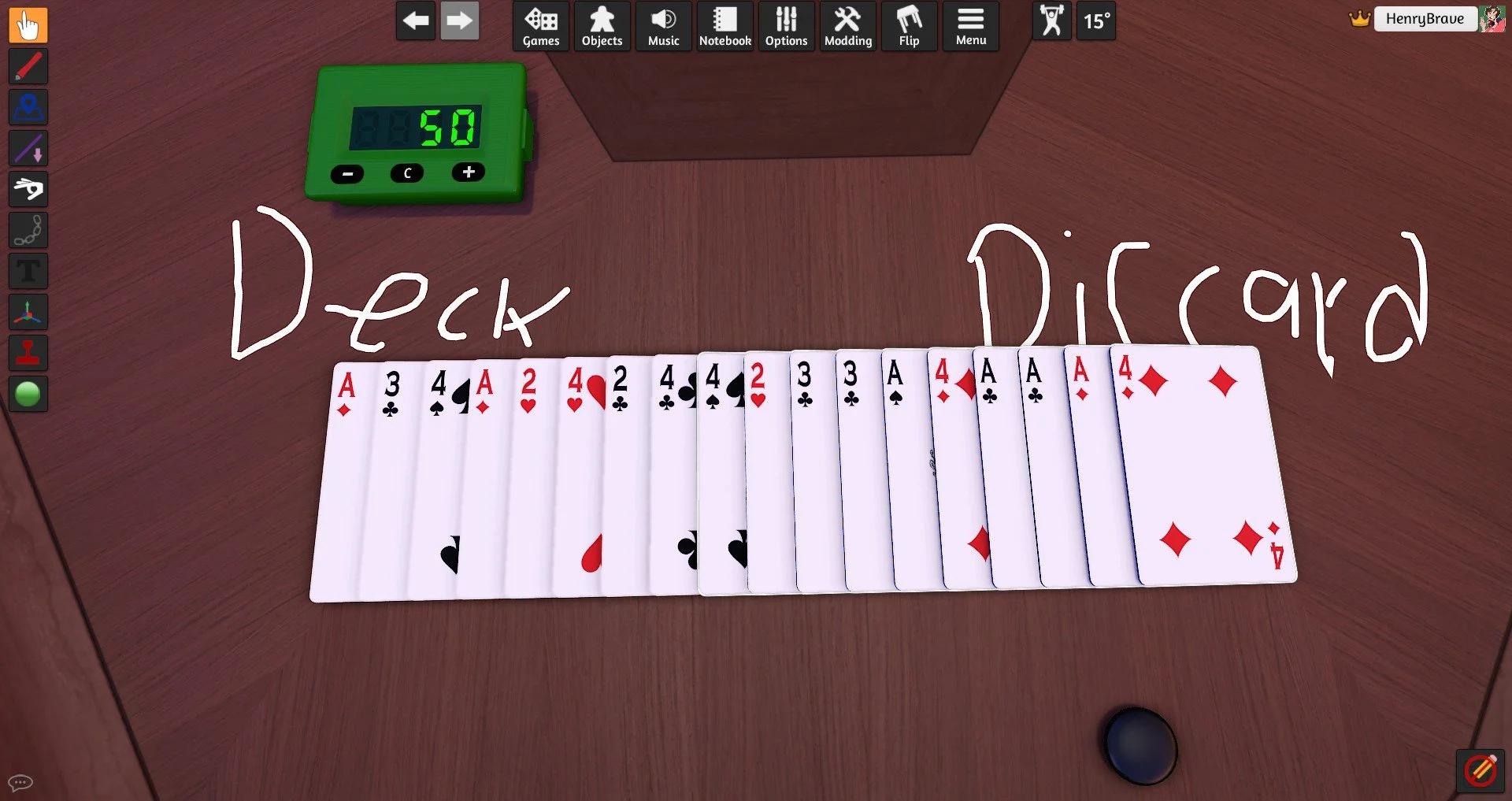
Seen in this spread is the floodgate deck before its card's effects. Thanks to its lack of any 3-cost cards, it is always able to play 2 cards per turn, allowing the deck to cycle through its cards quickly. The idea is that the low numbers could be supported through a deck with larger number cards, allowing for a hybrid playstyle
Out of all the decks, this one is the one that changed the least damage value-wise. In playtests, no player ever complained about the damage value of these cards, and they would then slot nicely into a floodgate deck when given effects.
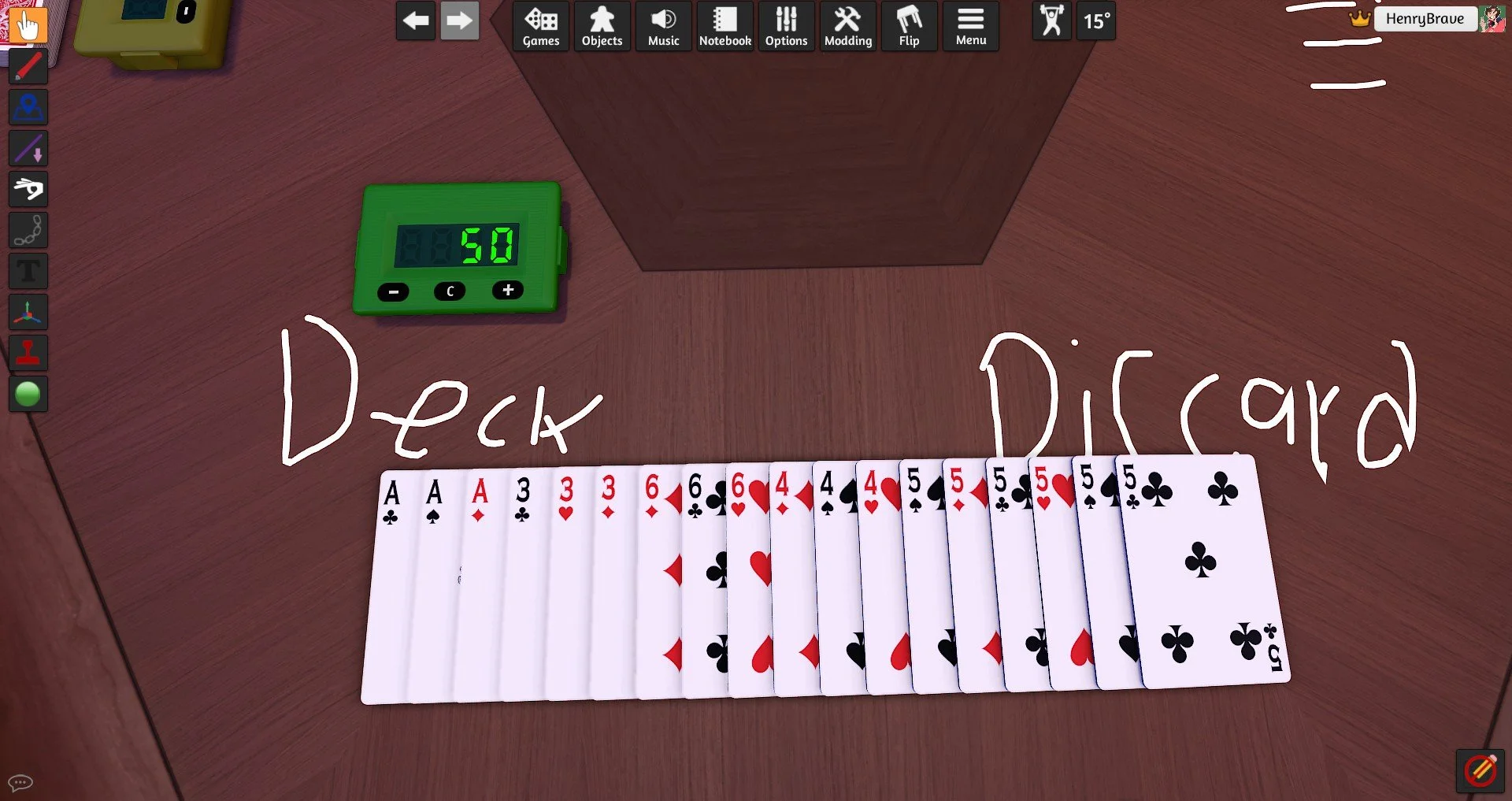
Seen in this spread is the big body deck without its effects. This deck underwent several changes over time in response to feedback. The large amount of 5 damage cards, for example, proved problematic since many players would immediately discard due to being useless in comparison to a six or even a four; as such, the archetype was given a second set of 6 damage cards in exchange for one of its five sets.
Eventually, however, when effects were added, this archetype would undergo a major rebalancing, since the effects and damage numbers available to the big body became extremely powerful and speedy thanks to its fair number of 2-cost cards. Because of this, it was given back its 5 damage cards and, instead, a 7 damage card to compensate.
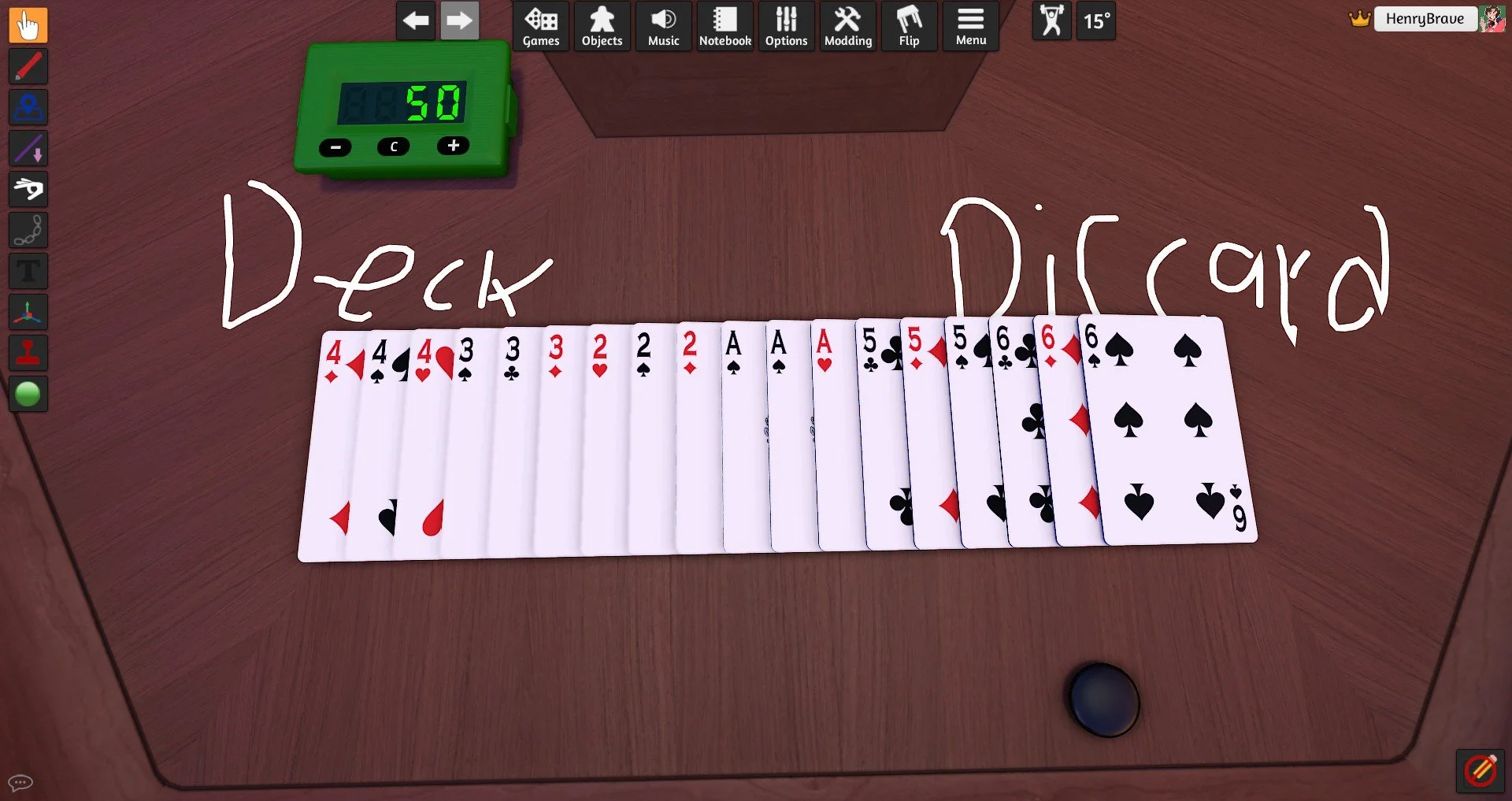
Here is the spread of cards in the beatdown archetype. Being the first archetype designed, it was designed with two of each AP cost in the game.many
It was this archetype that produced many of the rules governing the card design of this game. For example, this card is where I discovered how to balance the AP-to-damage ratio. 1 AP usually means the card deals 1-2 damage, 2-AP cost cards will typically do 3-4 damage, and 3 cost cards will usually deal 5-7 damage.
It was also through this deck that I discovered that to balance the game, I had to make undesirable cards desirable through card effects. For example, without card effects, 3 damage and 5 damage cards were seen as mostly useless and were the first to be milled out of the decks. Until I added card effects to them.
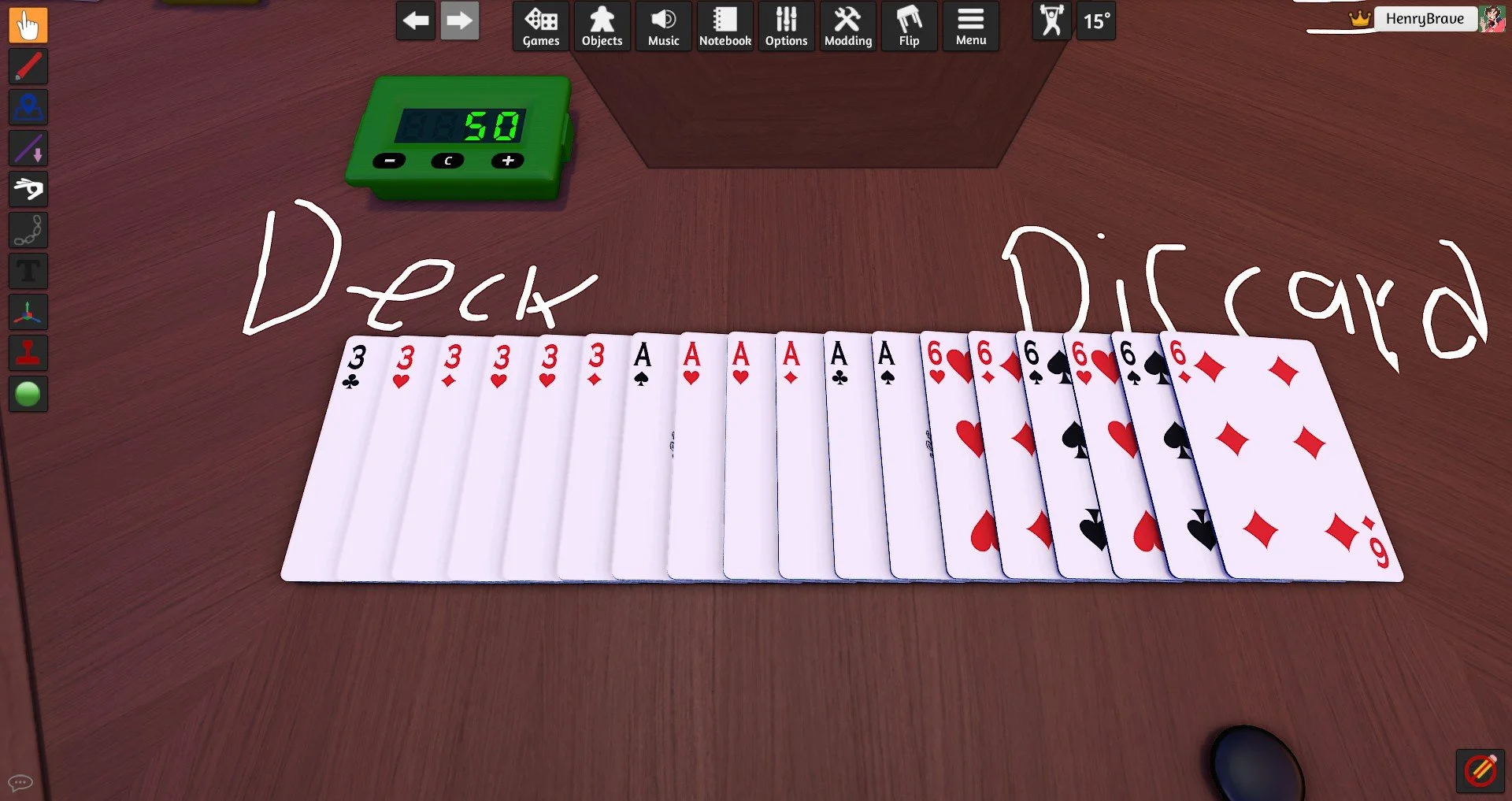
Seen here is the spread for the control deck without card effects. This deck received the most reworks during playtesting because I initially found it too strong. Originally, it had 6 copies of 4, allowing it to produce about 5 damage on an average turn, far more serious than some of the other archetypes.
This was then followed by giving the deck many threes. However, players would frequently discard the threes from the deck due to excess.
In the final deck, I kept the 3 damage cards but intentionally designed them with effects that would give them a much higher value.
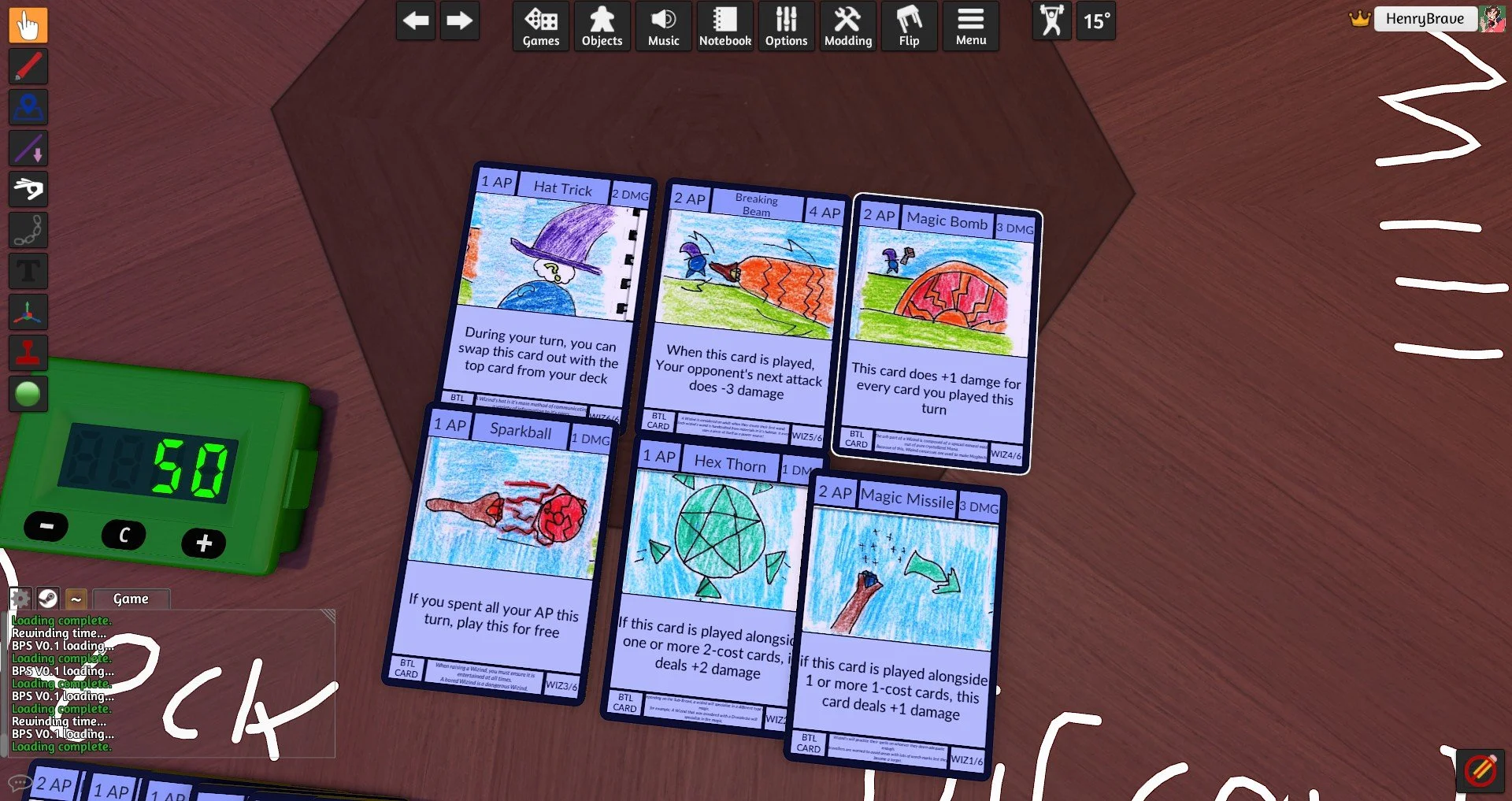
Here are the 6 cards that make up the floodgate deck. When designing the effects, I intentionally crafted them to leverage the archetype's strengths: fast playmaking. As such, many of the cards have effects that activate when played with another card.
There are two exceptions to this: Breaking Beam, their most powerful card, intended to provide a degree of defensive utility by reducing the amount of damage the opponent can deal next turn. The idea being that this is the only method besides trainer cards or another archetype for the deck to defend itself naturally.
Hat Trick was designed purely for playmaking. On its own, it is a high-value card: a 1-cost, 2-damage card that enables a variety of plays. Still, the player can use it to swap a card from the top of the deck, allowing for risky but rewarding gambles where the player can send this high-value card back for a potentially higher-value card.
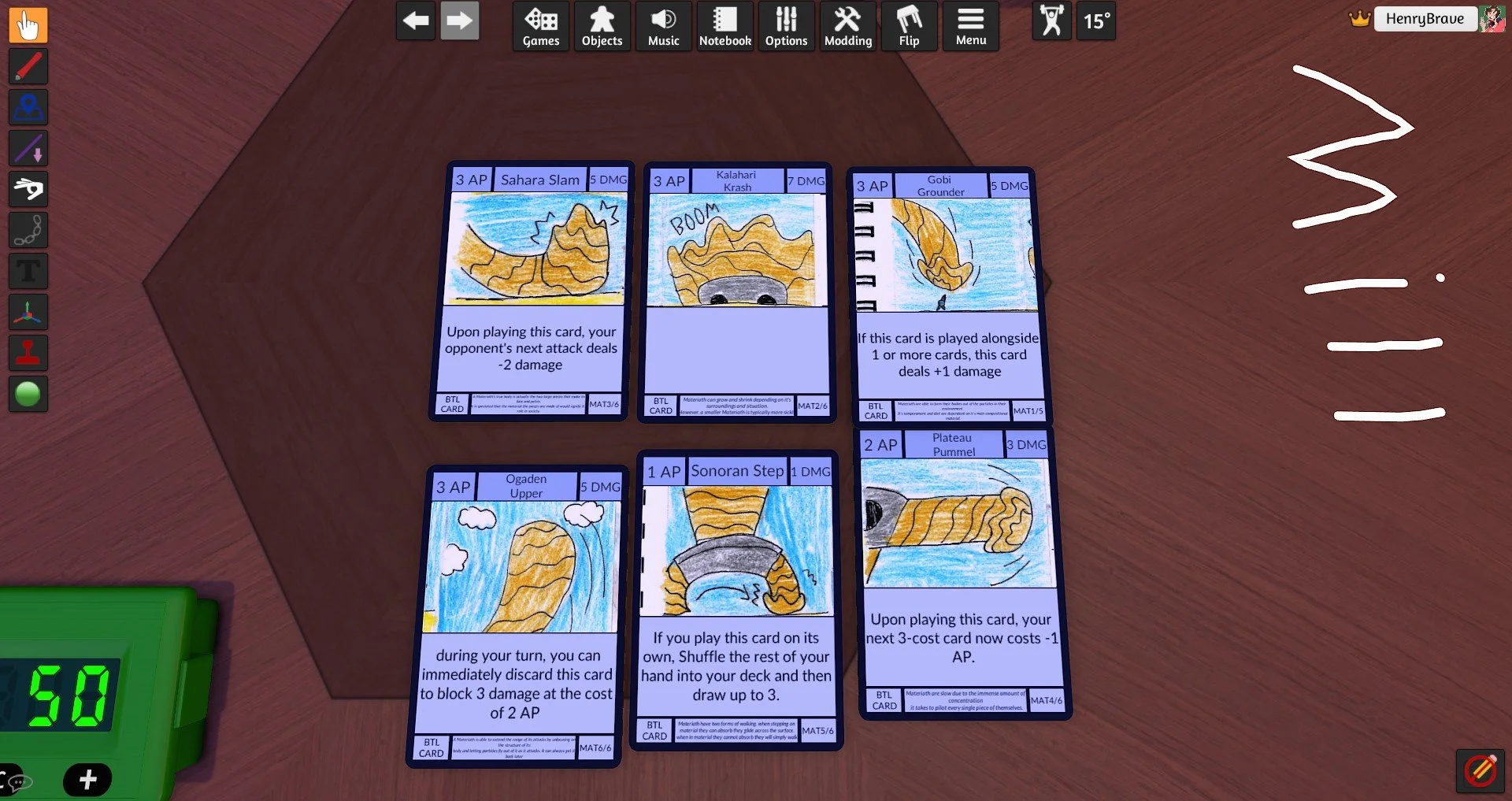
Here are the cards that comprise the Big Body Archetype. The effects for this archetype were designed around a scaling offense powered by their 1-cost and 2-cost card.
The 1 cost card, Sonoran Step, would allow for easy reshuffling of the hand, which can be used when the player has no effective methods of maximizing their damage and creating a better hand for themselves.
The 2-cost card, plateau pummel, was designed to be the playmaker card. On its own, the weak 2 costs 3 damage, but with the effect of reducing the cost of the next 3-cost card they play. Allowing for big damage plays when paired with a synergistic archetype
In hindsight, I think this deck needs further reworking, as having over half of the deck with 3-cost cards makes it too slow and unwieldy, even when paired. Either changing the effect of one of the 3 cost cards to be more friendly to the speed, or by reducing the cost of one of them.
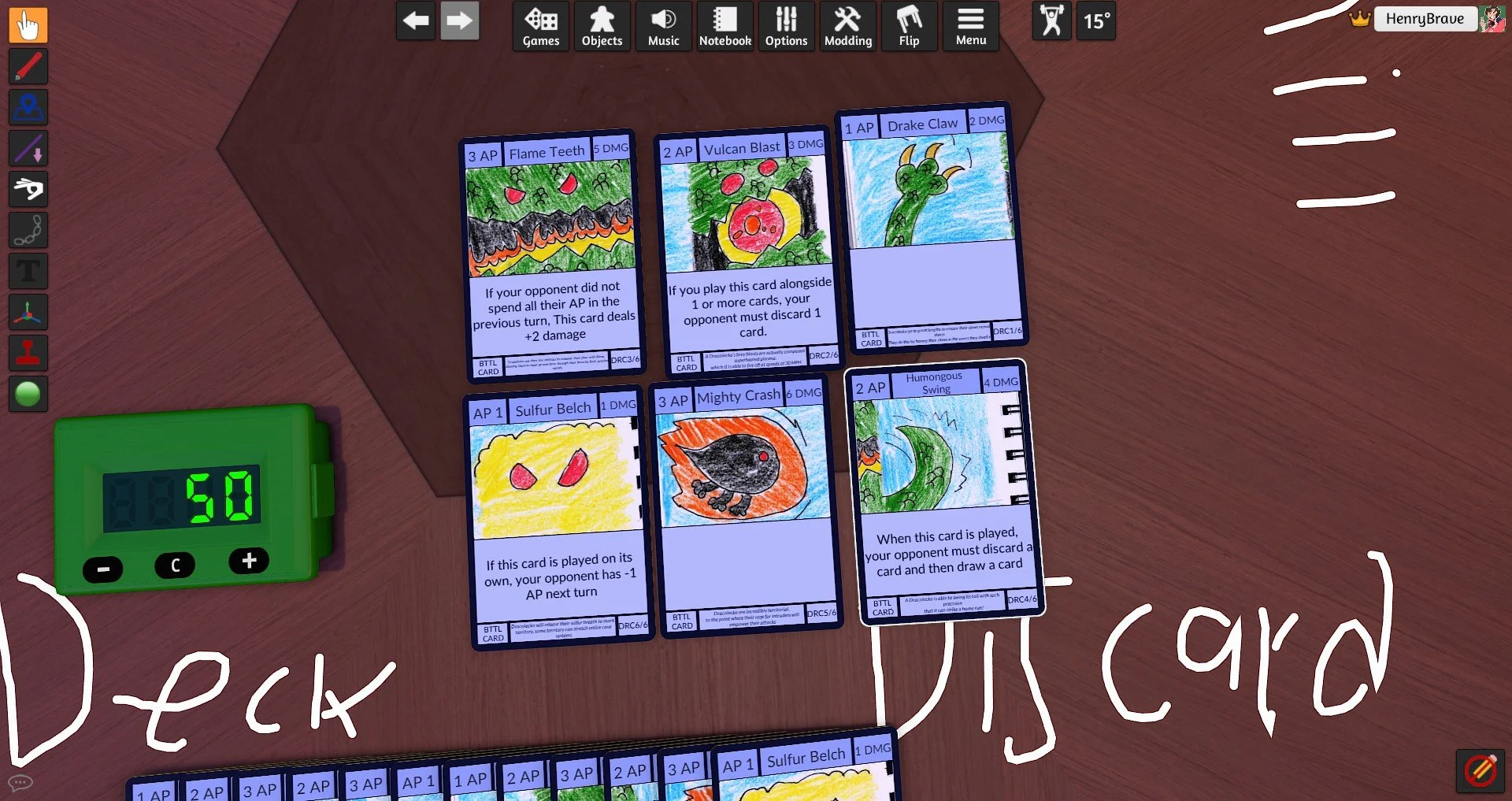
Here are the cards that made up the beatdown deck. The effects of this deck, as mentioned above, were designed to punish the opponent if they were playing defensively or force the opponent into bad situations.
This proved to be the most popular deck besides big body, with big body beatdown accounting for 1/3 of all playtest data.
One surprising piece of feedback I received was that players felt they had drawn a bugged or unfinished card when drawing Mighty Crash or Drake Claw, since they saw no text on it. From here, I learned that all cards should have text, even if it's just flavor text, to prevent confusion.
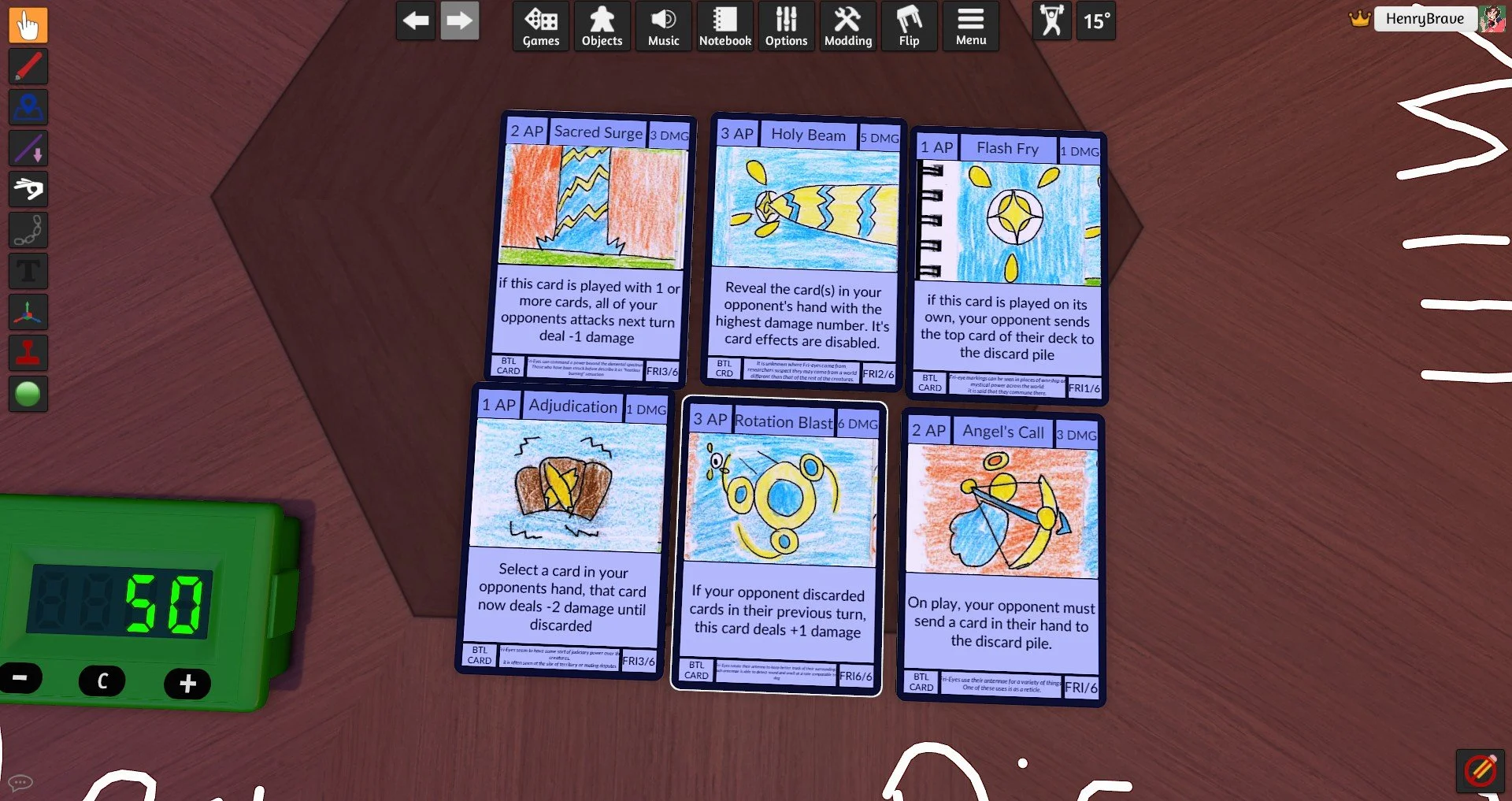
Here are the 6 cards that make up the control deck. This deck was designed around the idea of removing cards from the player's hand or deck to put them in bad situations. There is also a lot of damage prevention in the deck, which gives it a defensive nature.
This proved to be one of the most complained-about decks in playtesting, not because of its abilities or power, but because it proved to be very difficult to track the many effects that the deck would have.
In the future, I intend on making these effects a bit clearer and may outright make one of the cards a more generic attacking card to lighten the mental load the player goes through using this deck
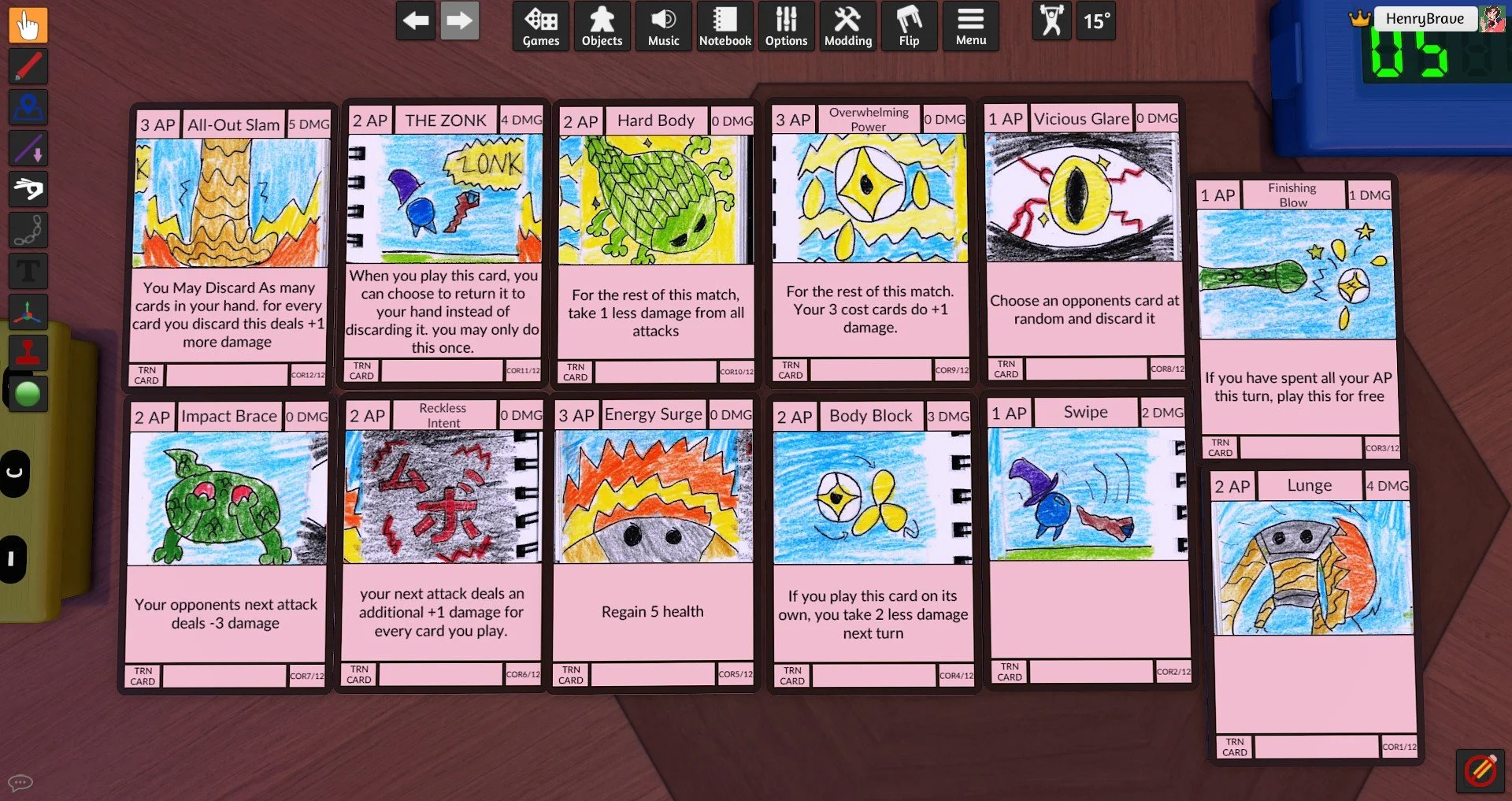
Seen here are all the training cards in the game.
The training phase works as follows: players place 6 cards from the training deck on the field, then take turns selecting cards from the field, eventually ending up with 3 each.
Since training cards are not part of any of the main monster decks, I intentionally designed them to be very powerful or generic versions of some abilities in the decks of some monsters
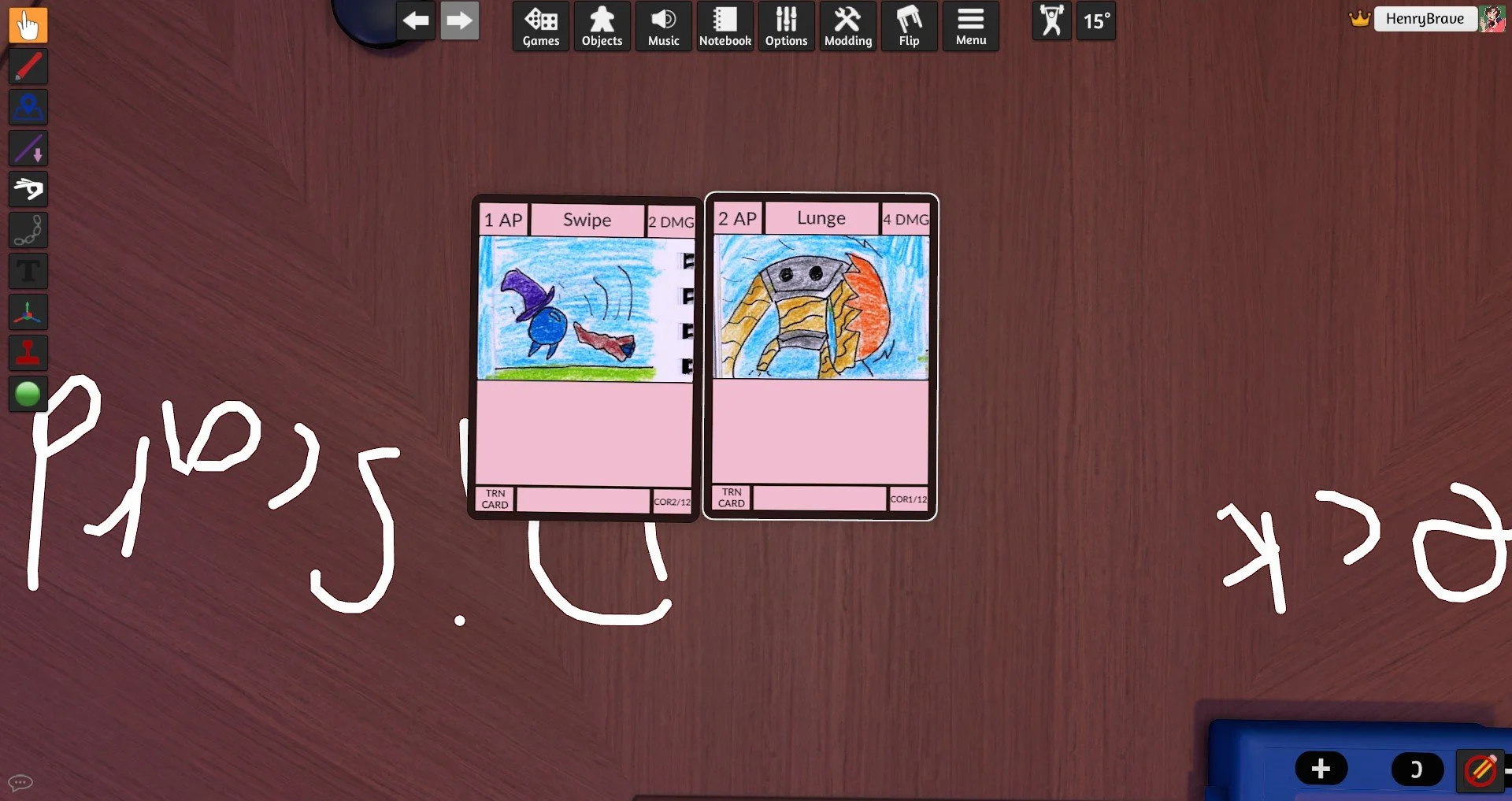
Seen here are two trainer cards. These trainer cards were designed as generic attacking cards that add damage to a deck, with 1- and 2-cost variants.
These were created to give decks that don't have many opportunities for multi-card playmaking some through the training phase.
In playtesting, however, they proved to be of relatively little value. I would rework them to be much more valuable by potentially reducing their costs
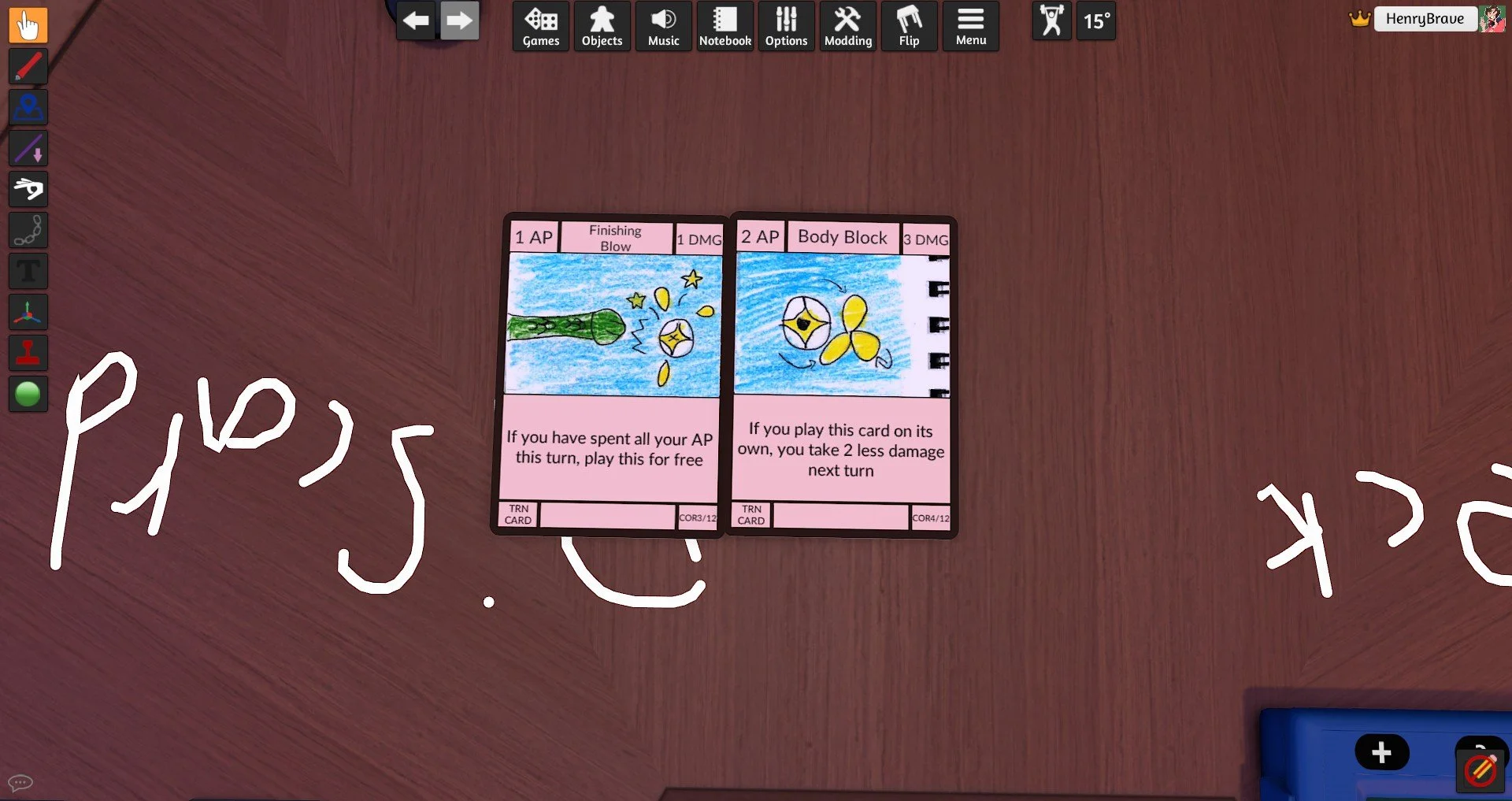
These two trainer cards were designed to be damage cards with effects that helped any archetype.
Defensive cards were originally much rarer in the decks, which is why I included a card like Body Block to aid those decks that lacked defensive tools.
However, in retrospect, I would dramatically change the card to be something more valuable. Since in playtesting, they didn’t prove to be as valuable as I wanted them to be
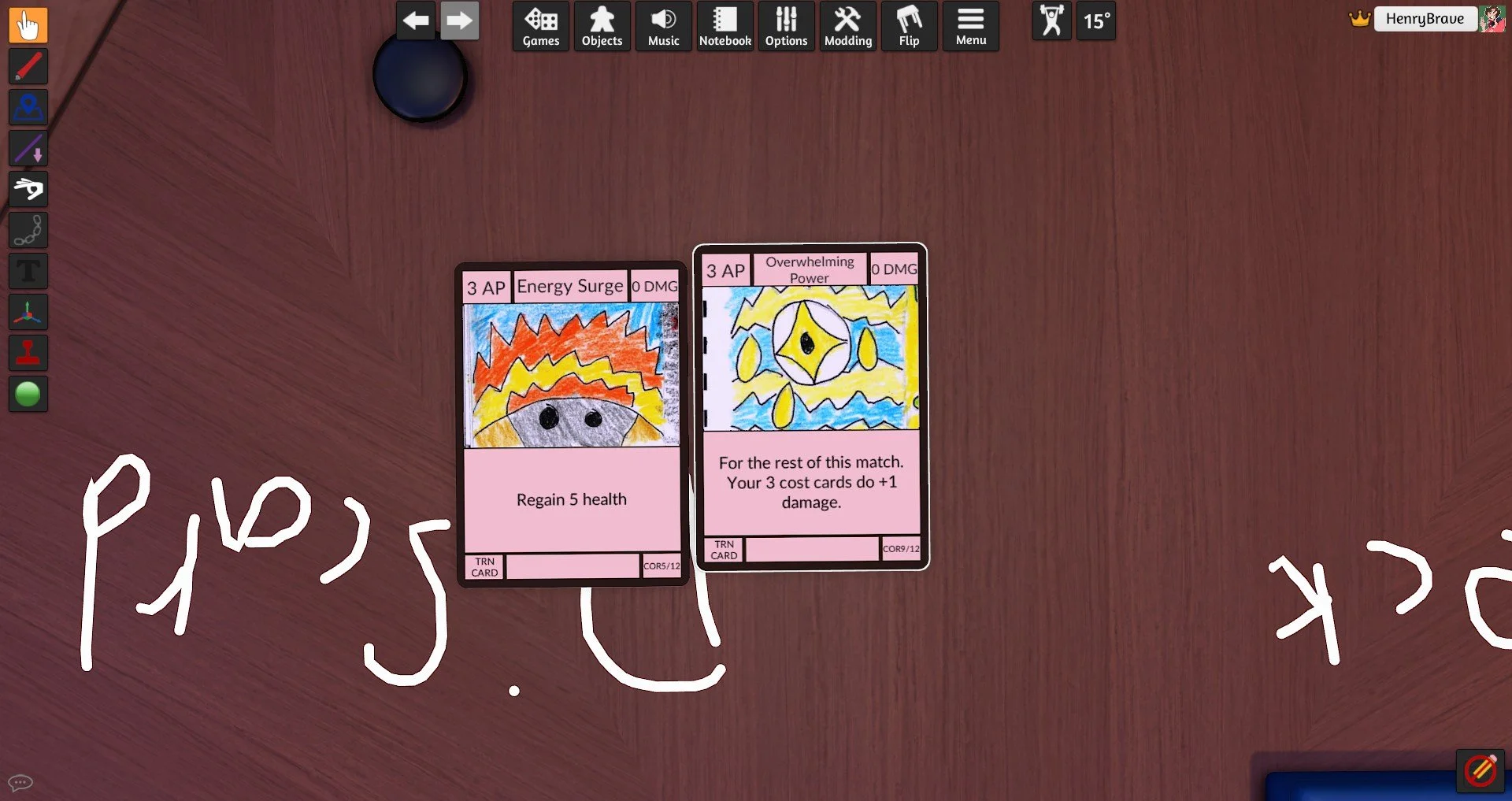
These two cards were designed as positive support cards, meant to support the player by providing benefits when played.
These cards resulted in being weaker than intended, with the high cost not being worth the value generated by the card, especially since regaining 5 health now means you only block a turn's worth of damage with no counterattack, not providing much value.
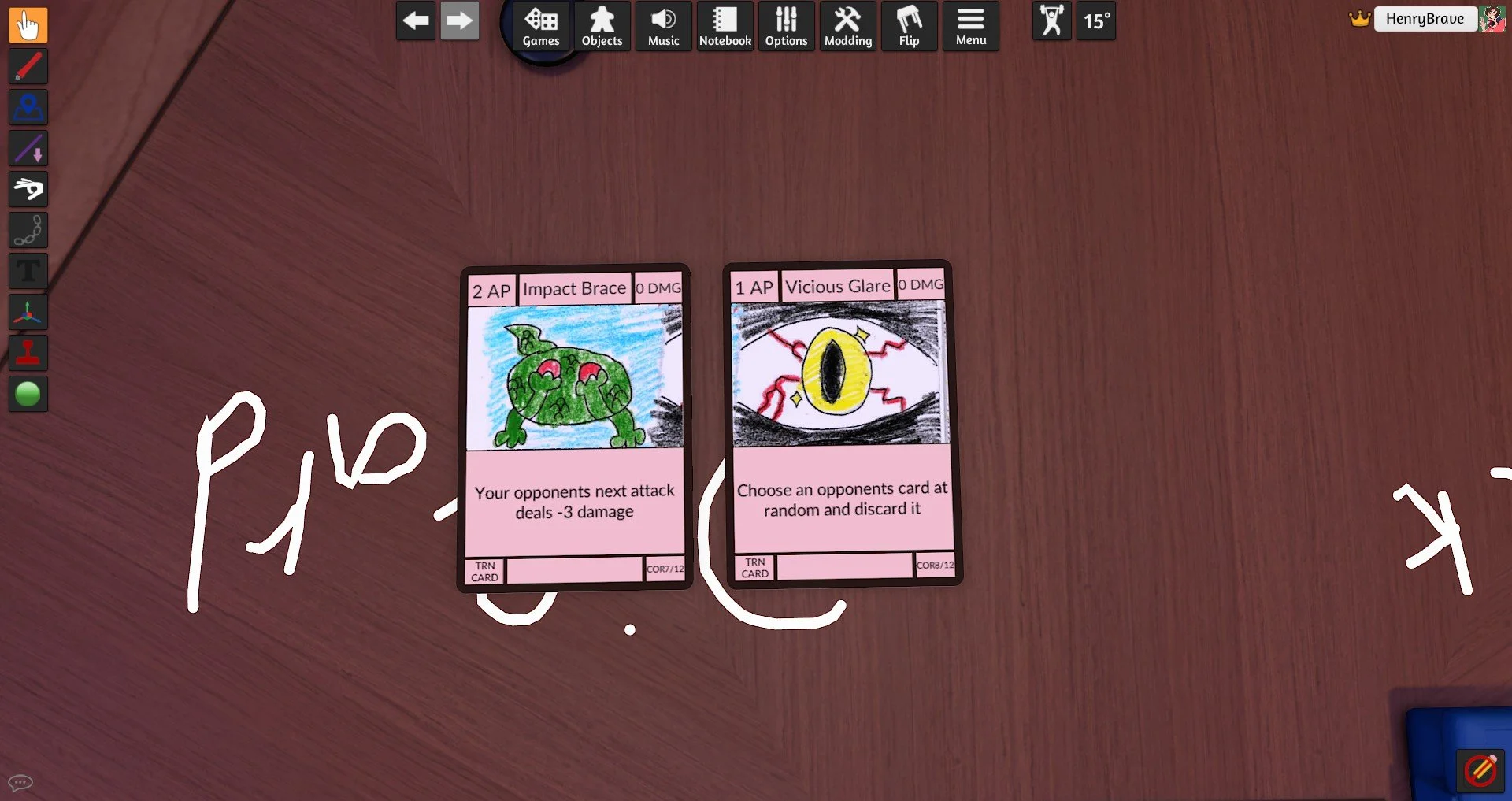
These two cards were designed to be negative support cards. Cards that would support the player by negatively impacting the opponent in some way. These cards provided much more value than their positive support counterparts due to their lower AP cost, allowing them to be combined with other cards for a much more effective hand.
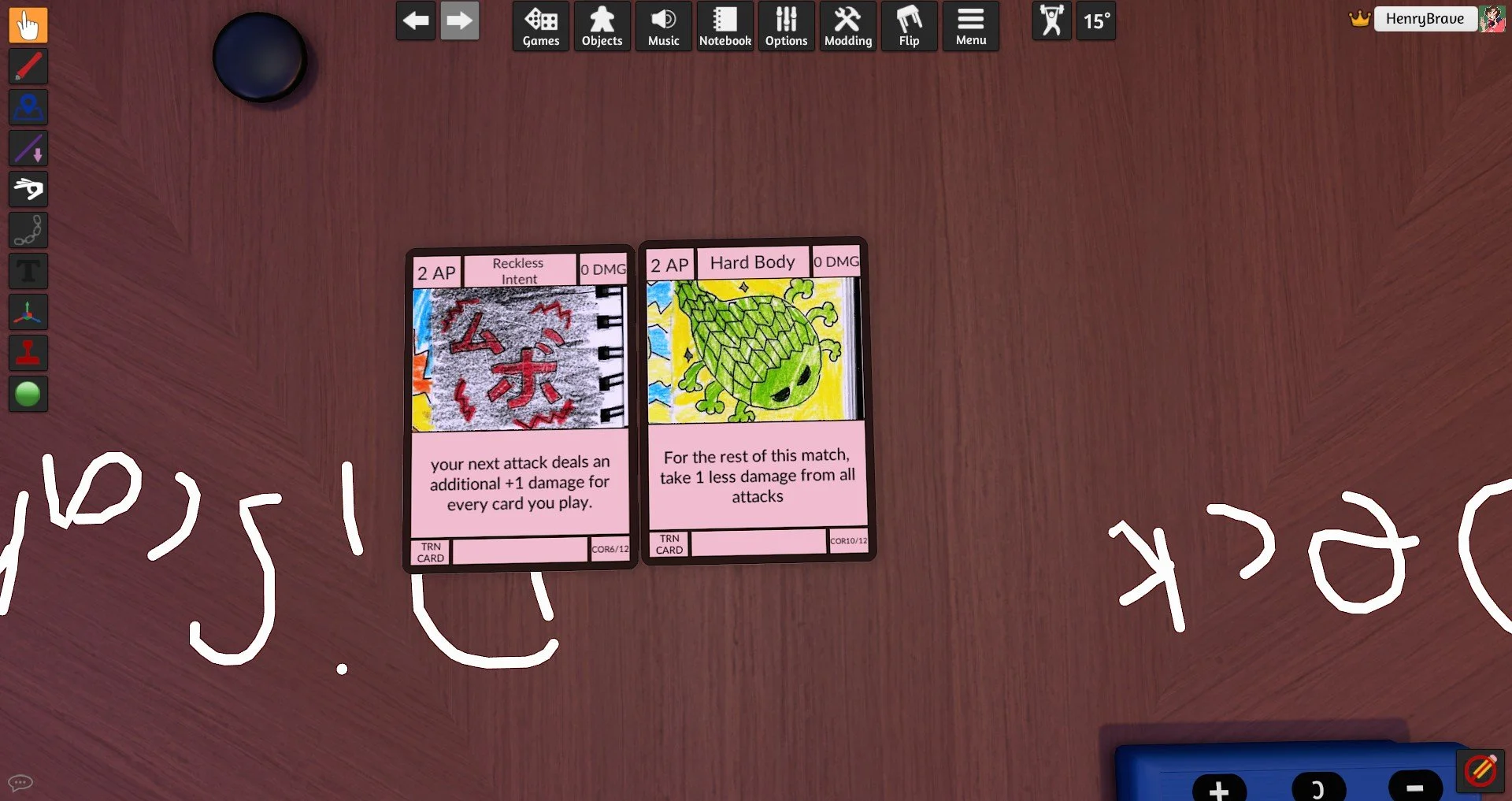
These two cards were meant to be permanent status effects that the player could apply to themselves. The idea being that they would simulate Monster Rancher's features, such as the currently unused “passive” concept.
Play testers consider these to be the strongest cards in the game, with hard bodies being so strong that they have outright won games on their own. In the future, these will be rebalanced to be more counteractable.
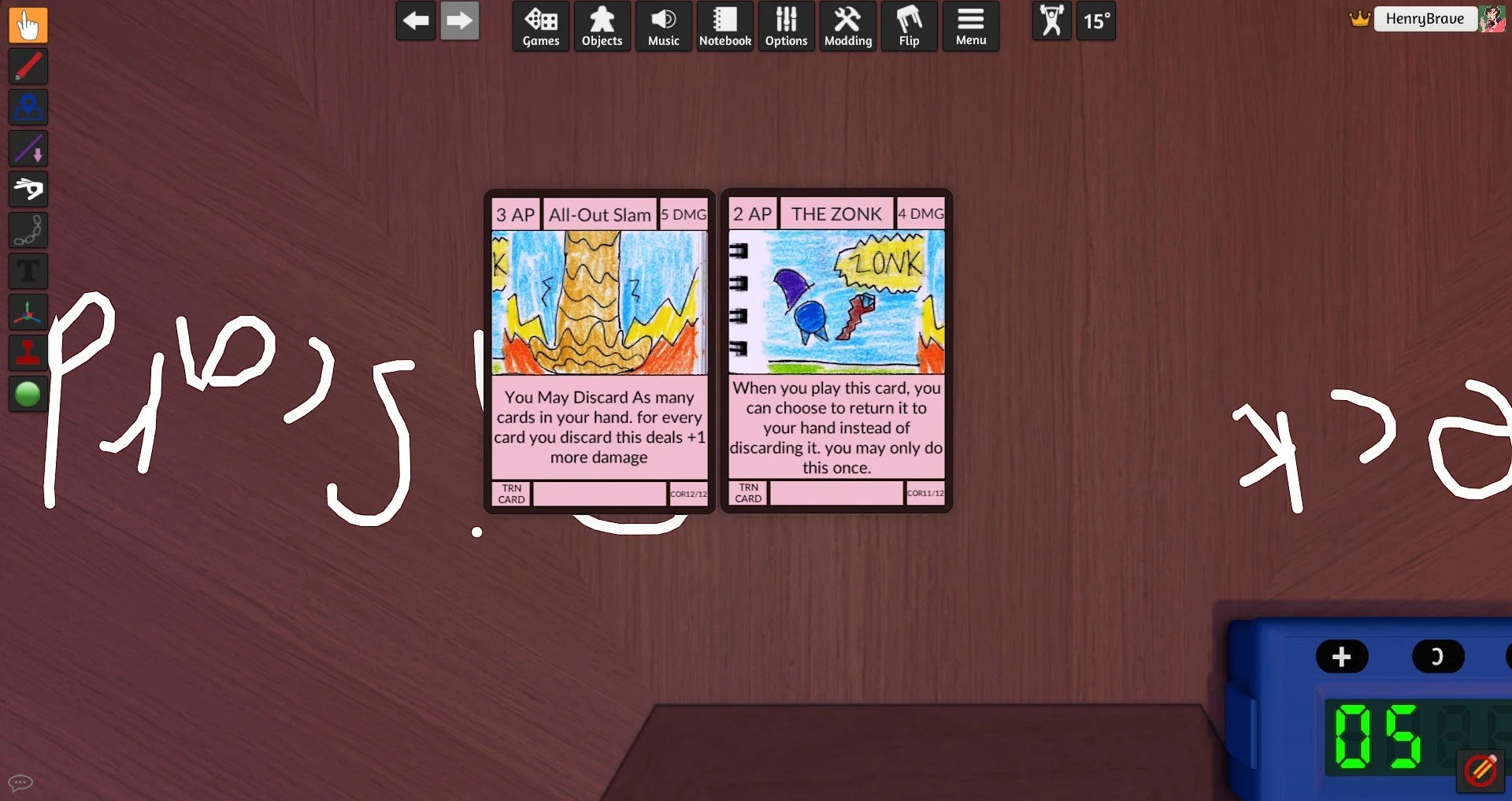
These two cards were designed after the rest of the trainer cards were created, since I was missing 2 additional card types to fulfill the 30-card trainer deck. These two were designed to be damaging cards that would explicitly benefit a small- or large-number deck.
All-out slam, for example, would benefit archetypes like Big Body or Beatdown since it allows them to discard their junk cards while still dealing damage.
Meanwhile, The Zonk would be heavily used by Floodgate or Control to add extra damage to a combo or to provide a reliable damage source in a bad hand.d
These ended up being some of the most engaging trainer cards to obtain, meaning in future revisions of the game, trainer cards will likely be designed more like these two.
Version 3 Gameplay Summary:
Version 3 scraped almost all of the mechanics from the previous two versions of the game. Instead, it was now a deck builder-based game heavily inspired by the tabletop card game Smash Up by Paul Peterson.
Monsters were no longer individual cards, but rather individual decks composed of several moves the monsters could conduct. Each move costs a certain amount of Ability points (AP) to enact, of which the player had 3 points to use how they saw fit every turn.
The player would be tasked with selecting two decks and combining them to fuse the two creatures. The players would then go through a 3-phase cycle. Training, in which training cards, a redesigned version of version 2's item cards, would be added to a player's deck.
The combat phase then followed this. In this game, each player has 50 health and must reduce the other players' health to zero using their deck cards. In combat, each player would have 3 cards in their hand.
Each card has an AP value of 1-3, meaning the player could play a few combinations, such as three 1-AP cards, a 2-AP card and a 1-AP card, or a 3-AP card.
After the combat phase, the players would enter the rest phase, during which they would remove three cards from their decks. They would continue this cycle until one player has three combat phase victories.